

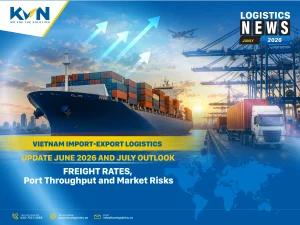
June 2026 marked another active month for Vietnam’s import-export logistics market. Trade volume continued to grow, cargo throughput at Vietnamese seaports remained positive, while international transportation costs were under pressure from rising ocean freight rates, peak season surcharges and ongoing geopolitical disruptions.
For importers and exporters, this is no longer a period where logistics can be planned only by comparing the lowest freight rate. Businesses need to monitor vessel schedules, booking availability, local charges, customs documentation, delivery commitments and alternative routing options more closely.
Looking ahead to July 2026, logistics costs are expected to remain under pressure, especially on major routes to the United States, Europe and other markets affected by peak season demand and shipping surcharges.
Quick Summary for Businesses
In June 2026, Vietnam’s goods exports reached approximately USD 50.79 billion, up 28.1% year-on-year, while imports reached around USD 53.43 billion, up 45.2% year-on-year. In the first six months of 2026, total exports reached USD 266.52 billion, while imports reached USD 283.17 billion, resulting in a goods trade deficit of approximately USD 16.65 billion.
This reflects strong demand for imported raw materials, machinery, components and production inputs, especially as manufacturers prepare for orders in the second half of the year.
From a logistics perspective, cargo transportation volume in June reached around 272.1 million tons, up 13.2% year-on-year. In the first six months of 2026, Vietnam handled more than 1.61 billion tons of transported goods. Cargo throughput via Vietnamese seaports was estimated at 687.45 million tons, up around 18%, while container throughput reached nearly 18 million TEUs, up around 12%.
The key point for July is clear: international ocean freight rates are likely to remain elevated or volatile, especially as shipping lines continue to apply peak season surcharges on several major routes.
1. Vietnam’s Import-Export Performance in June 2026: Strong Imports Create Higher Logistics Demand
June showed strong momentum in Vietnam’s trade activity. Export turnover continued to grow, while imports increased at an even faster pace. This indicates that businesses are actively importing production inputs, machinery, equipment, components and raw materials for manufacturing and export processing.
In the first half of 2026, the United States remained Vietnam’s largest export market, with an estimated export turnover of around USD 86.5 billion. China continued to be Vietnam’s largest import market, with import turnover estimated at around USD 115.2 billion.
For logistics planning, this creates three important implications.
First, higher import demand for raw materials, components and machinery puts more pressure on booking, consolidation, customs clearance and inland transportation. Businesses importing from China, South Korea, Japan, ASEAN or Europe should plan shipments earlier instead of waiting until production deadlines are close.
Second, exports to the United States and Europe require tighter cost control. When ocean freight rates and surcharges change quickly, a delayed booking or unclear cost structure can significantly affect the total landed cost.
Third, the trade deficit in the first half of 2026 suggests that businesses are actively building production capacity and inventory, but this also increases pressure on warehousing, cash flow, inventory management and delivery planning.
For exporters shipping to the U.S. market, KVN Logistics has previously shared practical notes on documentation, container loading and booking preparation in this article: Shipping Packaging and FIBC Cargo to the USA: Booking, Container Loading and Export Documents.
2. Seaport and Inland Transportation: Higher Throughput Requires Stronger End-to-End Coordination
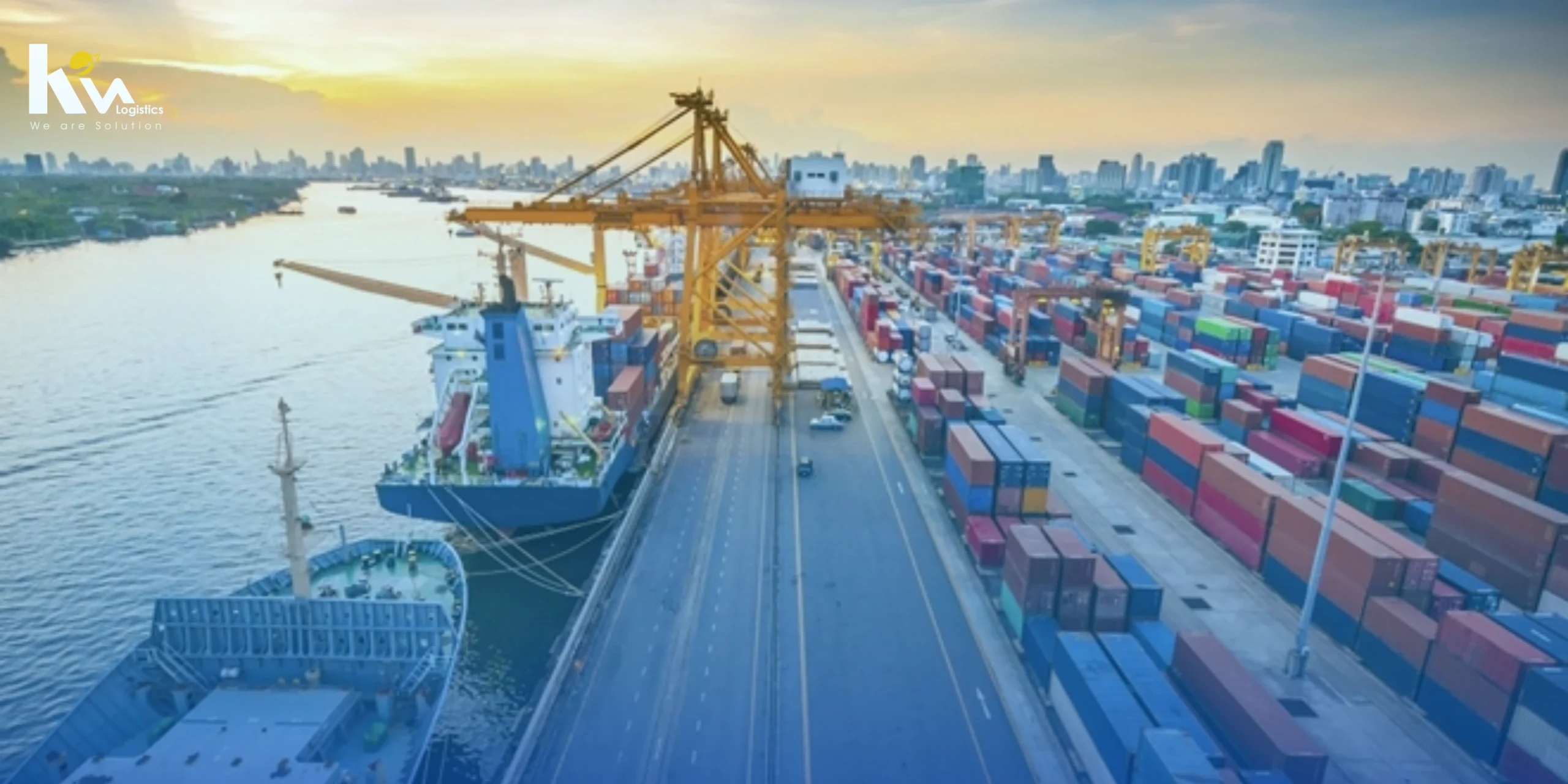
Vietnam’s seaport cargo throughput continued to grow in the first half of 2026. The estimated volume of more than 687 million tons and nearly 18 million TEUs reflects Vietnam’s increasingly important role in regional and global supply chains.
Hai Phong also recorded strong performance, with cargo throughput in the first six months of 2026 reaching around 96 million tons, up 11.4% year-on-year. As a major gateway in Northern Vietnam, Hai Phong remains critical for industrial zones, electronics, machinery, production materials and containerized trade.
Another positive signal is that Cai Mep and Hai Phong were ranked among the world’s top-performing container ports in the 2025 Container Port Performance Index. Cai Mep ranked 11th and Hai Phong ranked 13th, strengthening Vietnam’s position as a key logistics and trade gateway in Asia.
However, higher port throughput also means that businesses must pay closer attention to the first-mile and last-mile stages of logistics. The total cost of a shipment is not determined by ocean freight alone. Inland trucking, container pick-up and return, warehouse handling, free time, demurrage, detention, storage fees and delivery scheduling all need to be managed carefully.
This is why import-export shipments should be planned as an end-to-end logistics solution, rather than as separate disconnected stages.
KVN Logistics supports businesses with integrated logistics solutions covering ocean freight, inland transportation, warehousing, customs documentation and shipment coordination. For a broader view of Vietnam’s seaport system, businesses may also refer to KVN’s article: Top 7 Largest Seaports in Vietnam and Their Role in Import-Export Logistics.
3. Ocean Freight Rates: July Remains Under Pressure from Peak Season and Surcharges
As July begins, the global ocean freight market has not shown clear signs of cooling down. Several major freight indices reported rising spot rates in early July, especially on routes from Asia to the United States, Northern Europe and the Mediterranean.
Shipping lines have also introduced or adjusted Peak Season Surcharges, General Rate Increases and other cost adjustments on selected routes. This is particularly relevant for shipments from Asia, including Vietnam, to Europe and North America.
For exporters, the issue is not only the quoted ocean freight rate. The real cost of a shipment often includes multiple layers of charges, such as:
- Peak Season Surcharge
- General Rate Increase
- Bunker Adjustment Factor
- Container Imbalance Charge
- Terminal Handling Charge
- Delivery Order fee
- Documentation fee
- Local charges
- Demurrage, detention and storage
- Additional costs caused by vessel delay, rollover or missed cut-off
Businesses should therefore compare logistics quotations based on the total cost structure, not only the base ocean freight.
For more practical cost-control insights, businesses can refer to KVN Logistics’ related article: What Does a Freight Forwarder Do in B2B Trade?.
4. Geopolitical Disruptions: From “Cheapest Route” to “Transport Option Portfolio”
The global logistics market in June continued to be affected by geopolitical disruptions, especially in areas connected to major maritime routes. Tensions in the Middle East and risks around strategic shipping corridors can affect vessel schedules, fuel costs, insurance premiums, war risk surcharges, transit times and delivery reliability.
In this environment, businesses should no longer make logistics decisions based only on the cheapest route. Instead, importers and exporters should build a transport option portfolio.
This means comparing several solutions based on cost, time, risk and flexibility:
- Traditional ocean freight when schedules are stable
- Alternative ocean routes when disruptions occur
- Different transshipment ports
- Multimodal transport combining sea, road, rail or air
- Air freight for urgent, high-value or time-sensitive cargo
- Buffer inventory and warehousing solutions for critical materials
For shipments connected to Europe, businesses may also consider multimodal options or alternative corridors depending on cargo type, delivery deadline and budget. KVN Logistics has analyzed this trend in the article: Direct Vietnam–Netherlands Flight: A New Signal for Vietnam–EU Logistics Connectivity.
For supply chain risks linked to the Middle East, businesses can also read: Strait of Hormuz Volatility: What Supply Chains Need When Reopening Does Not Mean Back to Normal.
5. Customs and Documentation: July Is the Right Time to Review Import Procedures
In addition to freight costs, July 2026 is also an important time for businesses to review customs procedures and import documentation.
On June 29, 2026, the Prime Minister of Vietnam issued Decision No. 31/2026/QD-TTg on the list of imported goods required to complete customs procedures at the import border gate. The decision will take effect on August 14, 2026, replacing Decision No. 23/2019/QD-TTg.
Although the official effective date is in August, businesses with import shipments in July should review their product categories, customs declaration locations, import border gates and related documentation in advance.
Key documents that should be checked carefully include:
- Sales contract
- Commercial invoice
- Packing list
- Bill of lading
- Certificate of origin
- Import license, if applicable
- Quality inspection certificate, if applicable
- Insurance documents
- HS code classification
- Consignee and notify party information
- Product description and shipment details
For shipments involving multiple HS codes, machinery, raw materials, chemicals, specialized equipment or regulated products, early documentation review can help reduce the risk of customs delay, storage fees, demurrage, detention and late delivery.
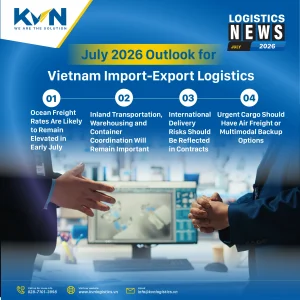
July 2026 Outlook for Vietnam Import-Export Logistics
1. Ocean Freight Rates Are Likely to Remain Elevated in Early July
With peak season demand, shipping surcharges and limited space on certain routes, ocean freight rates are expected to remain volatile in July. Routes to the United States, Northern Europe and the Mediterranean should be monitored more closely, especially for shipments with strict delivery deadlines.
Recommendation: Businesses should secure bookings earlier, compare several sailing options, clarify surcharges before confirmation and closely monitor cut-off times to avoid rollover risks.
2. Inland Transportation, Warehousing and Container Coordination Will Remain Important
As imports of production inputs and exports of finished goods both increase, the pressure on inland logistics is likely to continue. Businesses should plan container trucking, warehouse space, loading schedules, container return and delivery appointments in advance.
For companies that need to store, split, consolidate or stage cargo before final delivery, warehousing solutions can help reduce operational pressure and limit unexpected costs.
3. International Delivery Risks Should Be Reflected in Contracts
When shipping schedules, surcharges and insurance conditions can change quickly, businesses should review their Incoterms, delivery commitments, cost responsibilities and force majeure clauses.
For international buyers, exporters should communicate clearly about ETD, ETA, possible delays, surcharge changes and alternative transport options.
4. Urgent Cargo Should Have Air Freight or Multimodal Backup Options
Not every shipment should wait for the next ocean vessel. For samples, replacement parts, high-value goods, medical products, production-line components or event-related cargo, air freight or multimodal transport may be more suitable.
Although the transport cost may be higher, it can still be lower than the cost of delayed production, missed delivery commitments or contract penalties.
Practical Recommendations for Importers and Exporters in July 2026
1. Confirm Bookings Earlier Than Usual
For long-haul routes such as the United States, Europe or routes affected by capacity pressure, businesses should plan shipments at least two to three weeks in advance. Time-sensitive shipments should also have backup booking options.
2. Request a Full Breakdown of Freight and Local Charges
Businesses should avoid comparing freight quotations based only on ocean freight. A complete cost review should include local charges, peak season surcharges, bunker adjustments, container imbalance charges, documentation fees, free time, demurrage and detention conditions.
3. Review Documents Before Cargo Arrival or Cut-Off
Small errors in invoice, packing list, HS code, certificate of origin, consignee information or cargo description can delay customs clearance. For regulated products, documentation should be reviewed before the shipment departs from the origin port.
4. Avoid Relying on a Single Transport Route
In a volatile market, businesses should have at least two or three logistics options: a fast route, a cost-efficient route and a backup route. This approach helps reduce risk when schedules change, space becomes limited or new surcharges are applied.
5. Treat Logistics Cost as Part of Product Cost
Freight rates, surcharges, warehousing, storage, late delivery and working capital costs all affect profit margins. Businesses should update logistics costs by shipment instead of relying on a fixed estimate for the whole season.
6. Work with a Forwarder That Thinks in Solutions
A suitable freight forwarder should not only provide rates. They should also advise on routing, risk control, documentation, customs coordination, carrier communication, inland transport and contingency planning.
KVN Logistics supports businesses with practical logistics solutions designed around each shipment’s actual requirements — from sea freight, air freight and inland transportation to warehousing, customs documentation and shipment tracking.
FAQ: Vietnam Import-Export Logistics in July 2026
What were the key highlights of Vietnam’s import-export logistics market in June 2026?
The main highlights were strong trade growth, faster import growth, rising demand for raw materials and machinery, increased cargo throughput at Vietnamese seaports and continued pressure on international freight rates.
Will ocean freight rates decrease in July 2026?
A sharp decrease is not yet clear in the short term. At the beginning of July, many major container freight routes remained elevated or volatile, while shipping lines continued to apply peak season surcharges on selected routes. Businesses should update rates weekly instead of relying on old quotations.
What should exporters to the United States and Europe prepare in July?
Exporters should secure bookings early, check surcharges, clarify free time, prepare documents before cut-off and keep backup sailing options. For orders with strict delivery commitments, ETD, ETA and delay risks should be discussed with buyers in advance.
When should a business consider air freight or multimodal transport?
Air freight or multimodal transport should be considered when the shipment is urgent, high-value, production-critical, event-related or subject to penalties if delivered late. In these cases, a higher freight cost may still be more efficient than the cost of delay.
KVN Logistics: Supporting Businesses Through a Volatile Logistics Market
July 2026 is a period when importers and exporters need to be more proactive in logistics planning. Instead of only looking for the lowest freight rate, businesses should prioritize solutions that help control total cost, delivery schedule, documentation and operational risks.
With the positioning “We are the Solution”, KVN Logistics works with businesses to design suitable logistics plans for each shipment — from routing comparison, booking, documentation and customs clearance to inland transportation, warehousing and shipment monitoring.
Contact KVN Logistics to discuss the right logistics solution for your import-export plans in July and the second half of 2026.
Reference Sources
- Vietnam Logistics Review / logistics.gov.vn
- Vietnam Logistics Business Association
- Vietnam socio-economic data for June and the first half of 2026
- Vietnam Maritime and Waterway Administration
- Drewry World Container Index
- Xeneta ocean freight market updates
- Peak season surcharge announcements from international shipping lines