

The launch of a direct flight between Hanoi and Amsterdam is not only a milestone for aviation, but also a positive signal for the broader Vietnam–Netherlands–EU trade corridor. For importers and exporters, the new route can support faster movement of people, documents, samples, urgent shipments and market-development activities.
However, for most B2B cargo with large volumes, sea freight remains the backbone of Vietnam–EU trade thanks to its cost efficiency, capacity and strong connection to major European gateways such as Rotterdam.
In the context of the EVFTA, Vietnam’s national logistics development strategy and the growing need for supply chain diversification, KVN Logistics sees the Vietnam–Netherlands route not merely as a point-to-point connection, but as a strategic gateway for Vietnamese businesses to reach deeper into the European market.
Direct Hanoi–Amsterdam Flight: A New Milestone in Vietnam–Netherlands Connectivity
From June 2026, Vietnam Airlines officially operates a direct route between Hanoi and Amsterdam, creating a new connection between Vietnam and the Netherlands. This is an important development in the Vietnam–Europe aviation network, especially as Amsterdam is one of Europe’s major aviation hubs, offering broad connectivity to many economic centers across the continent.
From a logistics perspective, the value of a direct flight goes beyond passenger transport. For importers and exporters, the new route can support several critical supply chain activities, including:
- Sending product samples, documents, components or urgent shipments.
- Reducing travel time for sales, technical, inspection and quality-control teams.
- Strengthening direct engagement between Vietnamese suppliers and EU buyers.
- Supporting trade fairs, market visits, contract negotiations and supplier audits.
In other words, the direct flight adds a faster layer of connectivity to the Vietnam–Netherlands trade corridor. Yet for large-volume B2B cargo, sea freight continues to play the central role.
Why the Netherlands Matters in Vietnam–EU Logistics
The Netherlands has long been considered one of the most important gateways for international cargo entering Europe. With its strategic location, advanced seaport and airport infrastructure, strong distribution network and high-quality logistics services, the Netherlands is not only a final consumer market but also a redistribution hub for cargo moving onward to Germany, Belgium, France, Northern Europe and other EU countries.
For Vietnamese businesses, the Netherlands plays three key logistics roles.
First, it is a major import market within the EU. Vietnamese exports such as electronics, machinery, garments, footwear, agricultural products, furniture, consumer goods and industrial materials all have potential through this market.
Second, the Netherlands functions as a redistribution gateway. Many shipments entering the Netherlands do not stop there, but continue to other European destinations via trucking, rail, inland waterways or short-sea services.
Third, the Netherlands has a mature logistics ecosystem that combines the Port of Rotterdam, Amsterdam Schiphol Airport, bonded warehouses, distribution centers and customs services. This fits the current needs of businesses that no longer require only “port-to-port shipping”, but integrated logistics solutions from factory in Vietnam to warehouse or distribution point in Europe.
Does the Direct Flight Change the Role of Sea Freight?
Yes, but not by replacing it.
The direct flight strengthens time-sensitive logistics activities, while sea freight remains the primary solution for large commercial shipments. These two modes should not be seen as competitors, but as complementary parts of a more flexible supply chain strategy.
For Vietnamese exporters shipping to the Netherlands and the EU, air freight is suitable for samples, high-value goods, urgent shipments or emergency replenishment. Meanwhile, sea freight remains the most practical option for commercial containers, raw materials, mass-produced goods, machinery, equipment, packaging, garments, furniture, consumer products and cargo that requires cost optimization per unit.
The new direct air route allows businesses to work faster with EU buyers, handle documents more efficiently, send samples more conveniently and respond to market demand more quickly. Once the commercial order is confirmed, sea freight remains the optimal mode for moving large-volume shipments.
This is where KVN Logistics can build a strong advisory angle: air freight and sea freight are not opposing choices. They can be designed together according to each stage of the order cycle.
Sea Freight Vietnam–Netherlands: The Main Corridor for B2B Cargo to Europe
For commercial shipments with large volume, sea freight from Vietnam to the Netherlands typically connects major Vietnamese port clusters such as Hai Phong, Cai Mep–Thi Vai and Ho Chi Minh City with key European gateway ports, particularly Rotterdam.
The strength of the Vietnam–Netherlands sea freight corridor lies in its capacity, cost competitiveness and ability to connect deeply into the European distribution network. After cargo arrives at port, businesses can choose from several onward delivery options, including:
- Delivery to port, warehouse or distribution center in the Netherlands.
- Inland trucking to Germany, Belgium, France or nearby markets.
- Bonded warehouse solutions, partial distribution or scheduled delivery.
- FCL, LCL, door-to-door or port-to-port services depending on shipment requirements.
For KVN Logistics, this creates an opportunity to position Vietnam–Netherlands logistics as a gateway solution to the EU, rather than simply a single shipping lane.
Impact on Exports from Vietnam to the EU
The direct Hanoi–Amsterdam flight may create positive effects for Vietnamese exports in several ways.
First, direct connectivity makes it easier for Vietnamese businesses to access customers, distributors, trade fairs and procurement networks in Europe. Faster travel between Vietnam and the Netherlands can improve negotiation, sample approval, complaint handling, supplier assessment and market development.
Second, the new route supports the B2B sales process. In many industries, European buyers often request product samples, technical documents, certifications, testing results or direct discussions before confirming orders. If these steps are handled more quickly, the conversion cycle from inquiry to confirmed order may be shortened.
Third, once orders are confirmed, demand for sea freight may increase accordingly. Large shipments still require container loading, vessel booking, customs declaration, export documentation, cargo tracking, issue handling and final delivery coordination in Europe.
This shows that the direct flight does not reduce the demand for sea freight. Instead, it can indirectly stimulate overall logistics demand between Vietnam and the EU.
Impact on Imports from the EU to Vietnam
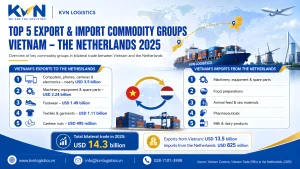
In the reverse direction, stronger Vietnam–Netherlands connectivity also supports Vietnamese businesses importing goods from the EU, especially machinery, equipment, components, industrial materials, chemicals, pharmaceuticals, processed food and consumer products with high compliance requirements.
For urgent shipments, samples or maintenance components, air freight via Amsterdam can be a suitable option. However, for machinery, raw materials, palletized industrial cargo or large-volume orders, sea freight remains more cost-effective.
The combination of air freight and sea freight enables importers to split cargo flows more strategically: urgent items can move by air, while larger-volume shipments move by sea. This approach helps businesses balance speed, cost and supply chain stability.
Alignment with Vietnam’s Trade and Logistics Development Direction
The launch of a new direct connection with the Netherlands comes at a time when Vietnam is accelerating international integration, logistics development and the utilization of next-generation trade agreements such as the EVFTA.
The EVFTA creates more opportunities for Vietnam–EU trade, improves market access and supports more efficient customs procedures. As Vietnamese goods gain more advantages in entering the EU market, the demand for professional logistics services will continue to grow, especially in documentation, rules of origin, transport booking, multimodal shipping, warehousing and international freight forwarding.
At the same time, Vietnam’s logistics development strategy for 2025–2035, with a vision to 2050, emphasizes sustainable, efficient and high-value logistics services. It also highlights digital transformation, green logistics and the need to improve the competitiveness of Vietnamese logistics companies.
In this broader picture, the Vietnam–Netherlands corridor is a clear example of multi-layered connectivity: aviation accelerates commercial interaction, seaports handle large-volume cargo flows, and integrated logistics providers help businesses control the entire supply chain from Vietnam to the EU and vice versa.
Opportunities for KVN Logistics
With the positioning “We are the Solution”, KVN Logistics can approach the Vietnam–Netherlands route from a solution-driven perspective, rather than simply offering freight rates.
First, KVN can advise customers on suitable sea freight options for shipments to the Netherlands and the EU, including port of loading, port of discharge, carrier selection, sailing schedule, estimated transit time, FCL or LCL options and relevant surcharges.
Second, KVN can connect related services such as domestic trucking in Vietnam, customs declaration, export documentation, international freight, container tracking and coordination with partners in Europe.
Third, KVN can support businesses in building multimodal logistics plans. For example, samples or technical documents can move quickly by air, while the main commercial order moves by sea. For shipments requiring delivery deeper into Europe, cargo can move by sea to Rotterdam and then continue by trucking or rail to the final destination.
Fourth, KVN can develop advisory content by product group, including industrial cargo, production materials, machinery, consumer goods, packaging, agricultural products, temperature-sensitive cargo and shipments requiring EVFTA-related origin documents.
This is how a piece of aviation news can be transformed into a deeper logistics insight that is highly relevant to B2B customers.
What Should Businesses Prepare for Vietnam–Netherlands Shipments?
To better leverage the Vietnam–Netherlands–EU trade corridor, businesses should prepare logistics plans early instead of waiting until orders are confirmed.
First, they should clearly define Incoterms, port of loading, port of discharge, final delivery address and cost responsibilities between buyer and seller. This helps reduce disputes and avoid unexpected logistics costs.
Second, businesses should prepare a complete set of documents, including contract, commercial invoice, packing list, bill of lading, certificate of origin if applicable, quality certificates or other specialized documents depending on the product.
Third, shipment planning should take seasonal factors into account. Routes to Europe may be affected by peak seasons, surcharge fluctuations, container availability, port congestion or changes in sailing schedules. Early booking and contingency planning are therefore important.
Finally, businesses should work with a logistics partner capable of providing overall advisory support, not only freight quotations. An efficient shipment requires optimization across cargo packing, booking, documentation, customs, international transport and final delivery.
KVN Logistics: Connecting Vietnam and the Netherlands Through Integrated Logistics Solutions
The direct Hanoi–Amsterdam flight is a positive signal for Vietnam–Netherlands and Vietnam–EU trade relations. However, for most B2B importers and exporters, the real value does not lie in choosing air freight or sea freight separately. It lies in designing the right logistics solution for each cargo type, order stage and target market.
KVN Logistics supports businesses with shipping needs from Vietnam to the Netherlands, from the Netherlands to Vietnam and onward connections across the EU. With strengths in sea freight, inland transportation, customs brokerage and a solution-oriented mindset, KVN aims to help customers optimize costs, control timelines and improve supply chain stability.
As Vietnam continues to integrate more deeply into global supply chains, every new transport connection creates new opportunities. With the Vietnam–Netherlands route, that opportunity is not only in the sky, but also in the sea containers carrying Vietnamese goods to the European market.
FAQ
1. Does the direct Vietnam–Netherlands flight replace sea freight?
No. The direct flight is suitable for samples, documents, urgent shipments and high-value cargo. For large-volume B2B shipments, sea freight remains the main solution due to its cost efficiency and large capacity.
2. Why is the Netherlands an important gateway for Vietnamese goods entering the EU?
The Netherlands has a strong logistics ecosystem, including the Port of Rotterdam, Amsterdam Schiphol Airport and extensive distribution networks across Europe. Many shipments entering the Netherlands can be redistributed to other EU markets.
3. What types of cargo are suitable for sea freight from Vietnam to the Netherlands?
Sea freight is suitable for containerized goods, industrial cargo, machinery, raw materials, furniture, garments, packaging, consumer products, processed agricultural goods and shipments that require cost optimization.
4. How can businesses combine air freight and sea freight?
Businesses can send samples, documents or urgent components by air, while shipping the main commercial order by sea. This helps balance speed, cost and supply chain control.
5. How can KVN Logistics support Vietnam–Netherlands shipments?
KVN Logistics can support sea freight planning, FCL/LCL options, domestic trucking, customs declaration, export documentation, cargo tracking, Vietnam–Netherlands shipping and onward delivery to other EU markets.