

Road trucking or domestic sea shipping—which is the better option for transporting goods between Northern and Southern Vietnam?
For manufacturers, importers, exporters, and distribution companies, choosing the right transportation method can significantly affect logistics costs, delivery schedules, inventory planning, and supply chain efficiency.
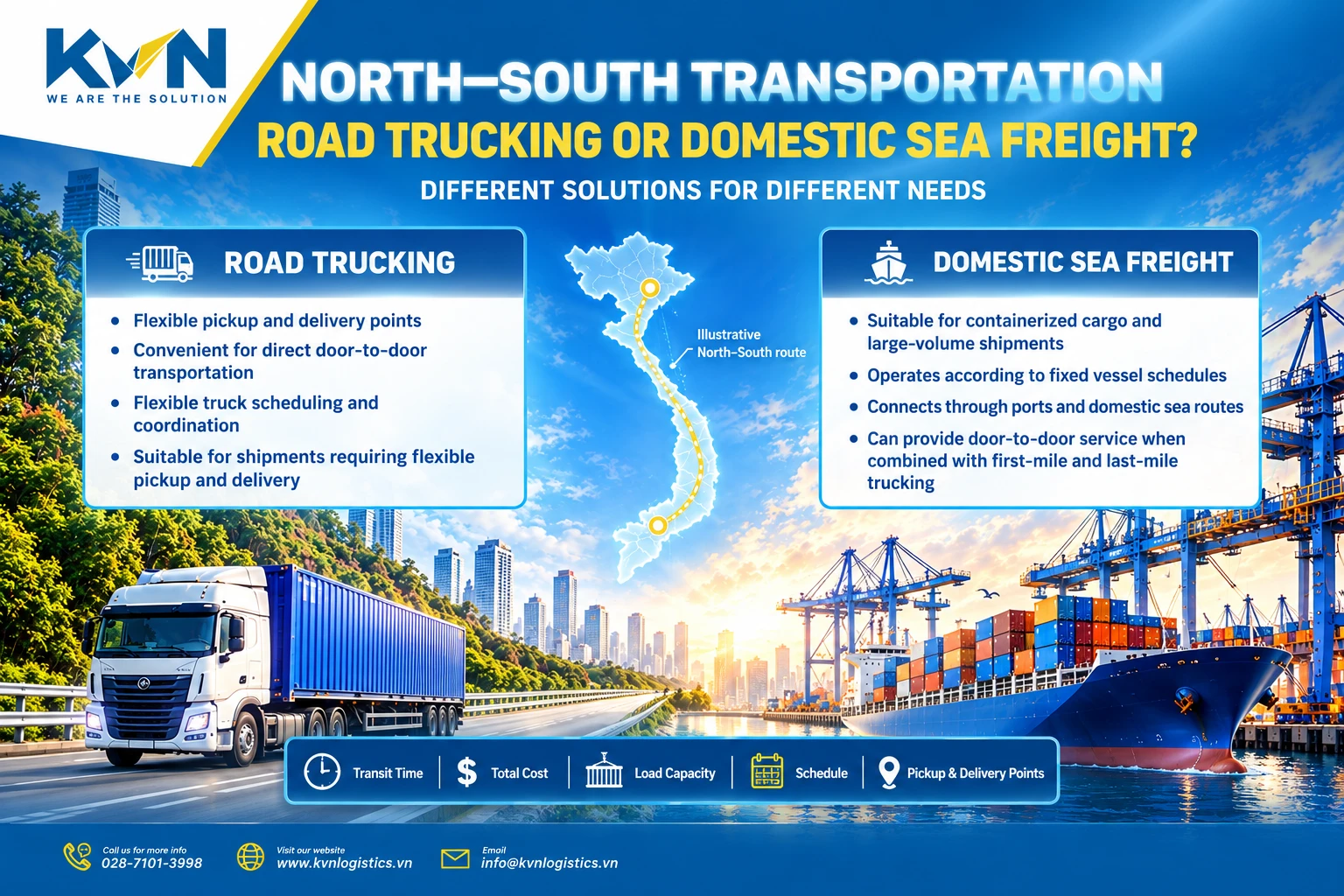
Road freight offers flexibility, direct delivery, and generally shorter transit times. Domestic sea shipping, also known as coastal shipping, may provide a more economical solution for large-volume cargo, containerized shipments, and recurring transportation between Vietnam’s northern and southern regions.
However, neither method is universally better.
The most suitable option depends on cargo volume, total door-to-door logistics costs, delivery deadlines, factory locations, and transportation reliability.
This guide compares North–South road trucking and domestic sea freight in Vietnam and provides a practical decision framework for businesses evaluating their transportation options.
Quick Answer: Road or Sea Freight for North–South Shipping in Vietnam?
Road trucking is generally more suitable for time-sensitive shipments, flexible pickup and delivery schedules, smaller cargo volumes, and direct factory-to-warehouse transportation.
Domestic sea shipping is often worth considering for full-container loads (FCL), large cargo volumes, recurring shipments, and businesses that can plan deliveries around vessel schedules.
For many shipments, the most effective solution is a combination of both modes:
Factory → Inland Trucking → Origin Port → Domestic Sea Shipping → Destination Port → Inland Trucking → Warehouse
Instead of comparing trucking rates against ocean freight rates alone, businesses should evaluate the complete door-to-door transportation chain.
1. Road Trucking vs Domestic Sea Shipping: Key Differences
| Comparison Criteria | Road Trucking | Domestic Sea Shipping |
|---|---|---|
| Transit time | Generally faster | Depends on vessel schedules and port operations |
| Door-to-door delivery | Direct and flexible | Requires inland transportation at both ends |
| Small shipments | Often more convenient | May require consolidation and additional handling |
| Large shipments | Cost depends on vehicle capacity and distance | Potential cost advantage for containerized and high-volume cargo |
| Scheduling | More flexible dispatch arrangements | Subject to vessel departures and cargo cut-offs |
| Cargo handling | Generally fewer transfer points | Additional port and container handling |
| Last-mile delivery | Can be integrated directly | Requires trucking from the destination port |
| Main operational risks | Traffic, road restrictions, vehicle availability, weather | Vessel delays, port congestion, missed cut-offs, weather |
| Typical applications | Urgent cargo, flexible delivery, direct transportation | Large-volume cargo, container shipments, planned distribution |
The comparison demonstrates an important distinction:
Road trucking primarily competes on flexibility and delivery time, while domestic sea shipping can offer economies of scale for suitable cargo.
However, the final decision should always be based on the specific shipment rather than general assumptions about either mode.
2. How Does North–South Road Freight Work in Vietnam?
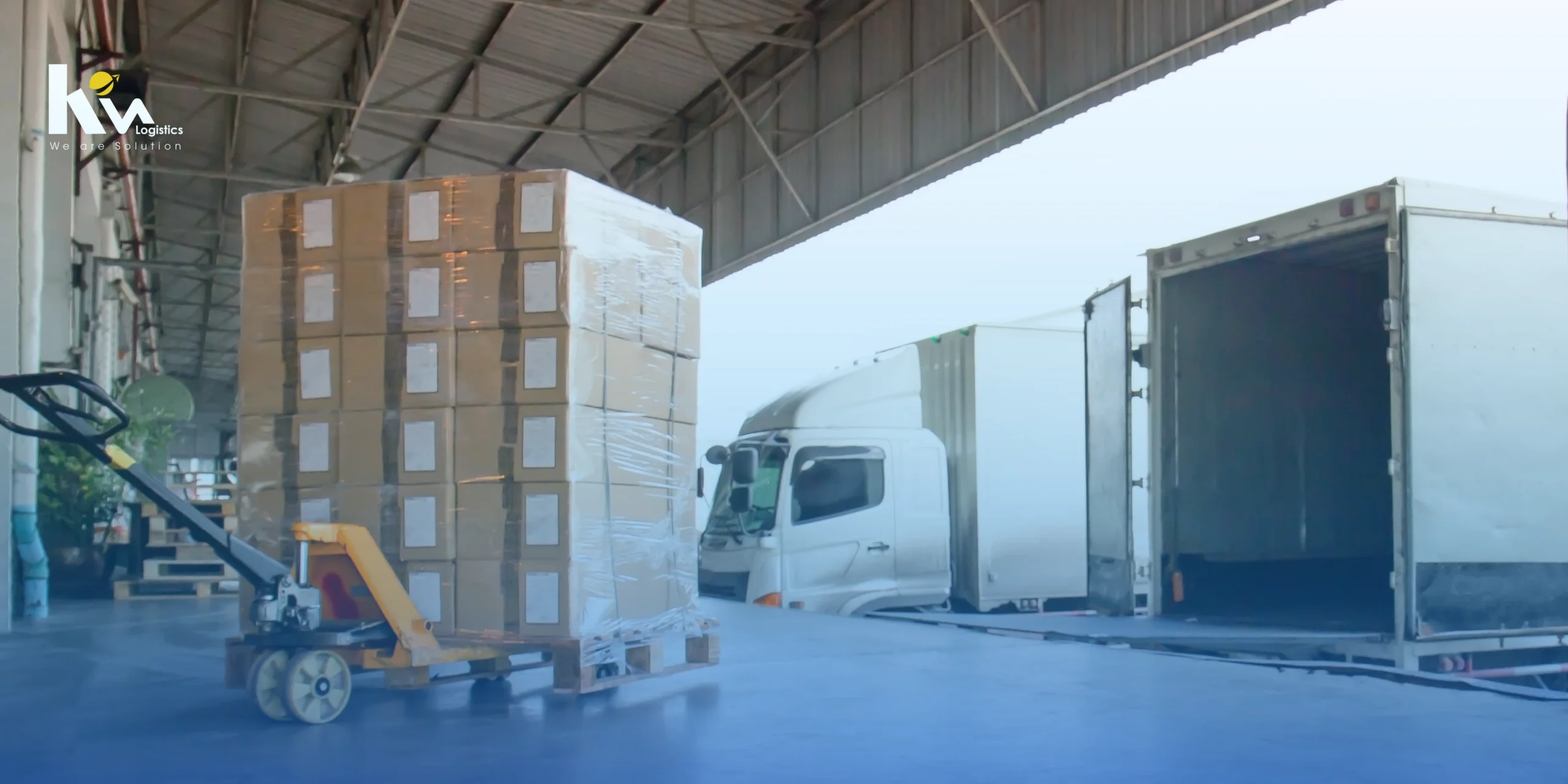
North–South road freight involves transporting goods directly between factories, warehouses, distribution centers, industrial parks, or other delivery points using trucks and road-based transportation equipment.
Typical routes include:
- Bac Ninh to Binh Duong
- Hai Phong to Ho Chi Minh City
- Hanoi to Dong Nai
- Southern Vietnam industrial zones to Northern Vietnam distribution centers
Depending on cargo characteristics, transportation may involve conventional cargo trucks, container trucks, or specialized vehicles.
Advantages of Road Trucking
One of the most important benefits of road transportation is its ability to provide relatively direct pickup and delivery services.
A typical shipment can follow a straightforward transportation chain:
Factory Pickup → Long-Haul Trucking → Final Delivery
Compared with coastal shipping, road transportation can avoid several additional stages, including port gate-in, vessel loading, sea transit, cargo discharge, and port pickup.
This makes road trucking particularly relevant when:
- Delivery deadlines are strict.
- Cargo must move directly between facilities.
- Shipment volumes are relatively small or irregular.
- Production schedules change frequently.
- Businesses require flexible pickup arrangements.
- Additional cargo handling should be minimized.
Road trucking also plays an important role in international logistics by connecting factories, industrial zones, inland container depots, and seaports.
KVN Logistics provides Inland Trucking services across Northern, Central, and Southern Vietnam, supporting cargo movements between ports, warehouses, factories, and industrial facilities.
Limitations of Road Transportation
Despite its flexibility, trucking may become relatively expensive over longer distances, particularly when cargo requires multiple vehicles or repeated long-haul movements.
Other considerations include vehicle weight restrictions, highway conditions, driver scheduling, fuel-related costs, cargo handling requirements, and possible waiting time at factories.
For businesses moving large volumes between Northern and Southern Vietnam, these variables should be compared against coastal shipping alternatives.
3. How Does Domestic Sea Freight Work Between Northern and Southern Vietnam?
Domestic sea freight transports cargo between Vietnamese ports using coastal shipping services.
For North–South freight movements, shipments may connect the Hai Phong port area in Northern Vietnam with suitable ports or terminals in Southern Vietnam, depending on available domestic vessel services.
A typical transportation chain may involve:
Northern Factory → Trucking → Hai Phong Port → Domestic Vessel → Southern Port → Trucking → Destination Warehouse
Unlike direct road freight, coastal shipping typically involves multiple transportation and handling stages.
These may include:
- First-mile trucking from the factory to the departure port.
- Container reception and terminal handling.
- Domestic sea transportation.
- Container discharge and handling at the destination port.
- Last-mile trucking to the receiving factory or warehouse.
The total transportation arrangement therefore extends well beyond the sea freight segment.
Why Businesses Consider Coastal Shipping
Domestic sea shipping can be particularly attractive when cargo characteristics and delivery requirements allow businesses to use the capacity of maritime transportation.
Potential advantages include:
- Economies of scale for larger shipment volumes.
- Suitability for containerized cargo.
- Opportunities to consolidate recurring shipments.
- Reduced dependence on long-haul trucking for the main transportation leg.
- Potential cost advantages for suitable long-distance routes.
However, these advantages depend on the actual origin, destination, cargo volume, sailing schedule, and total handling requirements.
Businesses should also confirm that an appropriate domestic coastal service is available for their selected port pair and shipment date.
4. Transit Time Comparison: Which Method Is Faster?
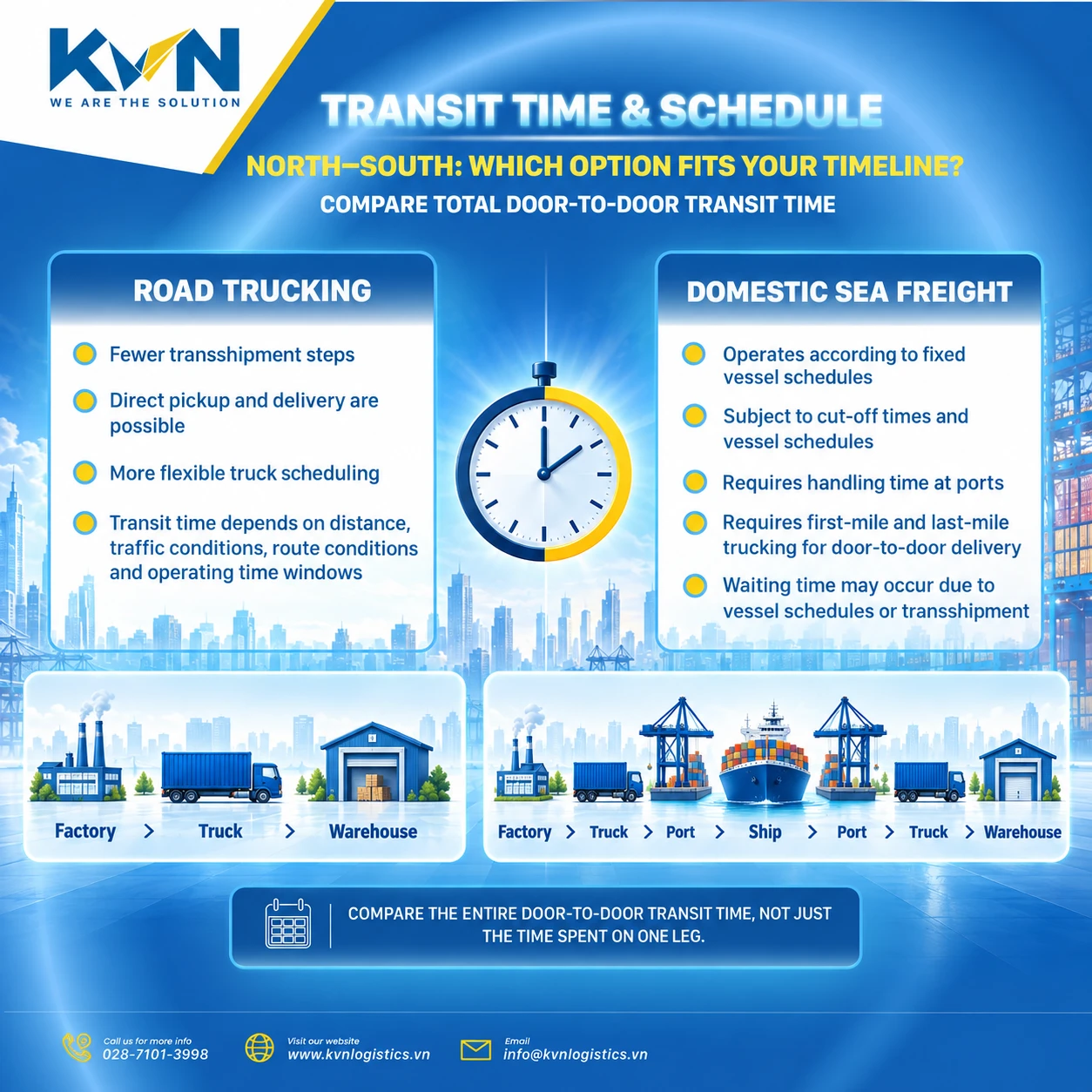
Road trucking generally offers shorter door-to-door lead times than domestic sea shipping for many North–South shipments in Vietnam.
However, actual transportation times vary according to shipment conditions.
Road Freight Transit Time
Road freight lead time depends on:
- Actual pickup and delivery addresses.
- Road distance and route conditions.
- Type of truck or container.
- Loading and unloading duration.
- Vehicle and driver arrangements.
- Traffic and weather conditions.
- Factory receiving schedules.
The advantage is that cargo can often move directly from origin to destination without waiting for a vessel departure.
Nevertheless, businesses should not treat advertised line-haul transit times as guaranteed door-to-door delivery times.
Domestic Sea Freight Transit Time
For coastal shipping, total transit time includes several separate components.
Total Lead Time = First-Mile Trucking + Port Waiting/Handling + Sea Transit + Destination Handling + Last-Mile Trucking
The sea transit itself may represent only one portion of the overall delivery period.
A shipment arriving at the destination port is not necessarily ready for immediate delivery.
Cargo release procedures, terminal availability, trucking arrangements, and warehouse receiving schedules can affect the final delivery date.
Why Door-to-Door Lead Time Matters
Consider a manufacturer that needs materials delivered from Northern Vietnam to a factory in Southern Vietnam.
If the production line requires the materials urgently, even a lower sea freight rate may not justify a longer lead time.
Conversely, if the manufacturer has sufficient inventory and can schedule replenishment in advance, coastal shipping may become more attractive.
The correct comparison should therefore measure:
Cargo Ready Date → Final Delivery Date
rather than comparing vehicle travel time with vessel transit time alone.
5. Comparing Transportation Costs: Freight Rate vs Total Logistics Cost
Cost is often the main reason businesses consider domestic sea shipping.
However, comparing only the main freight rates can produce misleading results.
A quoted coastal shipping rate may be lower than a trucking rate, but the shipment may require additional services that increase total expenditure.
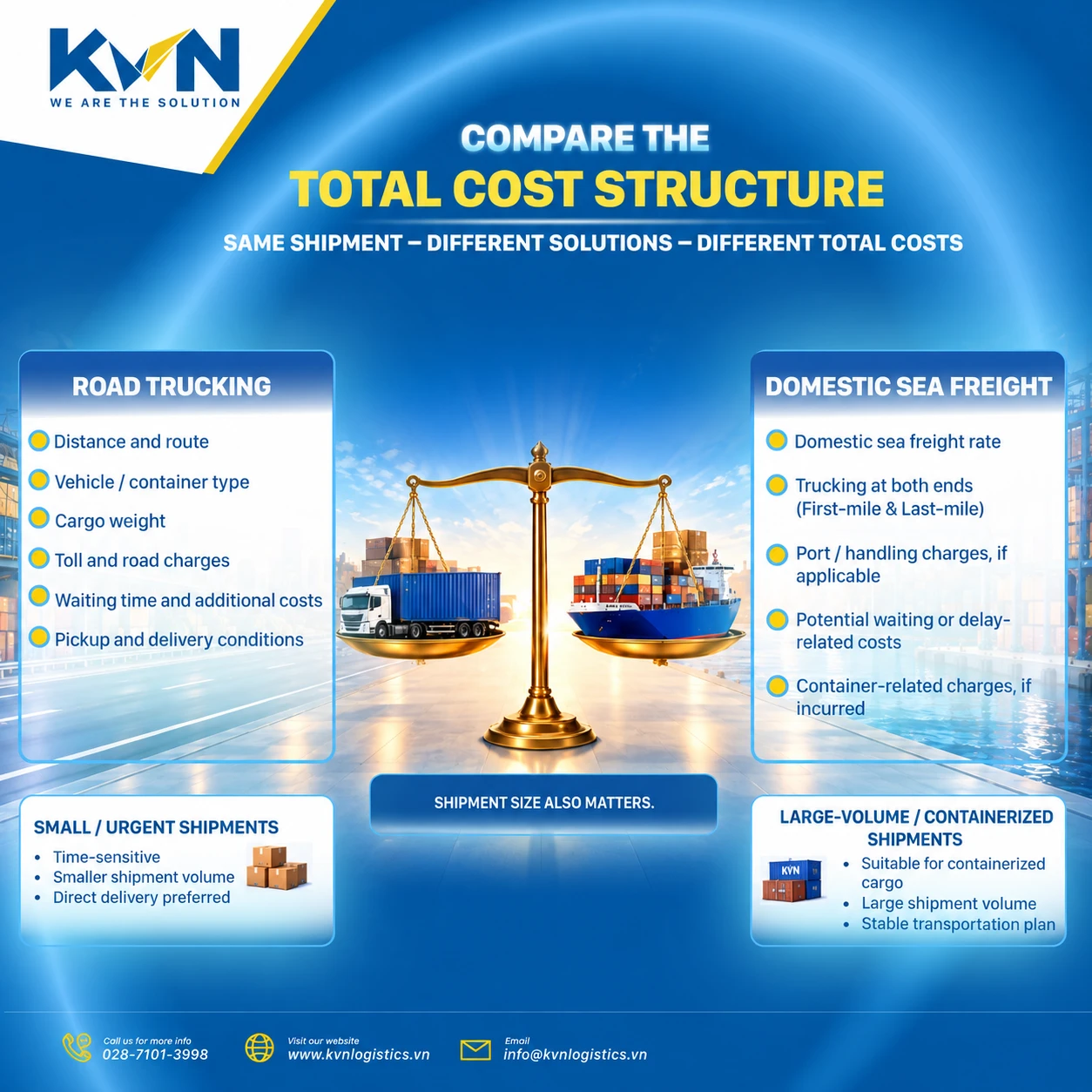
Road Freight Cost Structure
A road freight quotation may include:
- Main trucking charge.
- Pickup and delivery arrangements.
- Loading or unloading charges, where applicable.
- Waiting-time charges.
- Special equipment costs.
- Route-specific surcharges.
- Additional operational requirements.
Domestic Sea Freight Cost Structure
A coastal shipping quotation may include:
- First-mile trucking.
- Origin port and terminal handling.
- Domestic sea freight.
- Destination port and terminal handling.
- Last-mile trucking.
- Container handling.
- Storage or other applicable charges.
Not every charge applies to every shipment. Quotations should clearly identify which items are included and excluded.
Example: Comparing Two Transportation Quotations
Assume a company needs to move one 40-foot container from a factory in Northern Vietnam to a warehouse in Southern Vietnam.
<text preserveWhitespace> **Option A — Road Transportation**
Long-haul trucking + applicable handling and waiting charges
Option B — Domestic Sea Transportation
Origin trucking + origin port charges + coastal shipping + destination port charges + destination trucking
</text>
Even if the main coastal shipping rate is substantially lower than the road transportation rate, the final difference may become smaller once port handling and trucking costs are added.
A lower freight rate does not automatically mean a lower total transportation cost.
The appropriate evaluation metric is:
Total Door-to-Door Logistics Cost
Businesses managing container transportation should also understand the difference between freight charges and other operational fees.
For further guidance, see KVN Logistics’ article on Hidden Logistics Surcharges: THC, CIC, D/O, Storage, Demurrage and PSS.
Some charges discussed in that international shipping guide may not apply to domestic coastal shipments, so the actual domestic quotation should always be checked separately.
6. How Cargo Volume Influences the Transportation Decision
Cargo volume can significantly affect the economics of North–South freight transportation.
Small or Irregular Shipments
For relatively small shipments, road trucking may offer greater convenience and flexibility.
Businesses can select transportation arrangements based on cargo weight, dimensions, and delivery requirements without necessarily organizing a full container-based port transportation chain.
Where applicable, consolidated road transportation may also offer an alternative.
Full-Container Loads and High-Volume Cargo
Domestic coastal shipping becomes more relevant for shipments such as:
- Full-container loads.
- Industrial materials.
- Manufacturing components.
- Machinery and equipment.
- Large-volume packaged products.
- Recurring distribution cargo.
For these shipments, the cost of using a vessel for the long-distance movement may be worth comparing against direct long-haul trucking.
Recurring Shipment Volumes
Shipment frequency is another important consideration.
A business sending one container occasionally has different transportation requirements from a manufacturer moving multiple containers every week.
Recurring shipments can create opportunities to:
- Align dispatch plans with vessel schedules.
- Consolidate cargo where operationally appropriate.
- Improve container planning.
- Coordinate first-mile and last-mile transportation.
- Develop more predictable shipment forecasts.
- Evaluate longer-term freight arrangements.
For regular North–South freight movements, logistics providers should ideally receive monthly or quarterly volume forecasts rather than information about only one shipment.
Container selection also affects transport feasibility. Businesses can refer to KVN Logistics’ Guide to Shipping Container Types, Sizes and Applications when evaluating suitable equipment.
7. Schedule Reliability and Operational Risks
Transportation reliability is not determined by speed alone.
A faster transportation method may still experience delays, while a slower method may provide acceptable performance when shipments are planned appropriately.
Road Trucking Risks
Potential operational challenges include:
- Traffic congestion.
- Weather disruptions.
- Road restrictions.
- Truck availability.
- Vehicle breakdowns.
- Factory loading delays.
- Delivery appointment limitations.
One advantage of road transportation is that dispatch schedules and routing may be adjusted more readily when operational conditions permit.
Domestic Sea Shipping Risks
Domestic sea freight introduces additional dependencies, including:
- Vessel departure schedules.
- Cargo acceptance deadlines.
- Port handling capacity.
- Container availability.
- Vessel delays.
- Weather disruptions.
- Destination discharge and pickup arrangements.
A shipment that misses its applicable port cut-off may need to wait for another suitable sailing.
Consequently, businesses should coordinate factory readiness, origin trucking, and terminal delivery before confirming the overall transportation plan.
KVN Logistics explains the importance of shipping schedules, cargo acceptance deadlines, and operational coordination in its Sea Freight Booking Process: Cut-Off, SI, VGM and CY/CFS guide.
Specific documentation and cut-off requirements differ between domestic coastal movements and international shipments.
8. First-Mile and Last-Mile Trucking: The Hidden Factors in Coastal Shipping
First-mile and last-mile transportation can significantly influence the competitiveness of domestic sea freight.
Consider a shipment departing from an industrial park in Northern Vietnam and arriving at a factory in Binh Duong.
The shipping plan might follow:
Northern Industrial Park → Hai Phong Port → Southern Port → Binh Duong Factory
The actual cost of this solution depends on the distance between the factory and the departure port, as well as the distance from the destination port to the receiving facility.
If both locations are relatively close to suitable ports, coastal shipping may offer a stronger cost advantage.
If the origin and destination are far from their respective ports, trucking and handling costs may offset part of the potential savings.
Northern Vietnam: Hai Phong and Industrial Zones
Hai Phong is a major logistics gateway serving industrial and manufacturing locations in Northern Vietnam.
Common cargo movements involve connections between port terminals, depots, and industrial zones in Hai Phong, Bac Ninh, Hung Yen, Hanoi, Thai Nguyen, and neighboring areas.
For more information, explore Container Trucking from Hai Phong to Northern Vietnam Industrial Zones.
Southern Vietnam: Cat Lai, Cai Mep and Industrial Zones
In Southern Vietnam, trucking connections between the Cat Lai and Cai Mep port areas and manufacturing locations in Ho Chi Minh City, Dong Nai, Binh Duong, and surrounding provinces play an important role in cargo distribution.
The appropriate terminal and trucking arrangement depend on the actual shipment.
For further details, read Container Trucking from Cat Lai and Cai Mep to Southern Vietnam Industrial Zones.
These regional transportation networks highlight why inland trucking is essential even when the main long-distance transportation leg takes place by sea.
9. When Should Businesses Choose Road Trucking?
Road transportation is generally worth prioritizing when the shipment requires flexibility and direct delivery.
Time-Sensitive Cargo
Urgent manufacturing materials, production components, or customer orders may require shorter delivery lead times.
Factories Located Far from Suitable Ports
Long first-mile and last-mile trucking distances can reduce the cost advantage of coastal shipping.
Small or Variable Cargo Volumes
Road transportation can be easier to arrange when shipment quantities fluctuate.
Direct Factory-to-Factory Delivery
Businesses may prefer direct transportation when minimizing transfers and intermediate handling is important.
Frequently Changing Production Schedules
Road trucking may offer more flexibility when pickup and delivery requirements change at short notice.
However, road transportation should still be evaluated against vehicle availability, cargo restrictions, and actual delivery requirements.
10. When Should Businesses Consider Domestic Sea Shipping?
Domestic sea freight may be suitable when cost optimization is a priority and cargo can be transported according to a structured schedule.
High-Volume or Containerized Cargo
Larger shipments may benefit from the economies of scale available through maritime transportation.
Regular North–South Cargo Flows
Manufacturers with predictable transportation demand can evaluate coastal shipping as part of their long-term logistics planning.
Flexible Delivery Requirements
Cargo that does not require immediate delivery may be better suited to scheduled vessel services.
Favorable Port Access
Factories and warehouses located within practical trucking distances of suitable departure and destination ports may benefit from lower first-mile and last-mile costs.
Long-Distance Cost Optimization
For appropriate shipment volumes and transportation conditions, coastal shipping can provide a competitive alternative to direct long-haul trucking.
Nevertheless, the decision must reflect the complete shipment chain and confirmed sailing availability.
11. Multimodal Transport: Combining Road and Sea Freight
Road trucking and domestic sea shipping should not always be viewed as competing transportation methods.
In practice, they often operate as complementary components of the same logistics solution.
An integrated transportation chain may include:
Factory → Trucking → Seaport → Coastal Shipping → Seaport → Trucking → Distribution Center
This approach combines the local delivery flexibility of trucks with the capacity of maritime transportation.
The objective is not to select the cheapest transportation mode for each individual segment.
Instead, businesses should optimize the complete logistics chain based on four factors:
Cost + Transit Time + Reliability + Operational Feasibility
For example, choosing a lower-cost vessel service may not create savings if the resulting schedule requires additional storage, causes production delays, or generates extra delivery costs.
For companies transporting containers between facilities, ports, inland container depots, and warehouses, KVN Logistics provides further operational guidance in Domestic Container Trucking in Vietnam: Port–Factory–Warehouse.
A coordinated transport plan helps ensure that the cargo, trucking arrangement, vessel schedule, and receiving facility operate within compatible timelines.
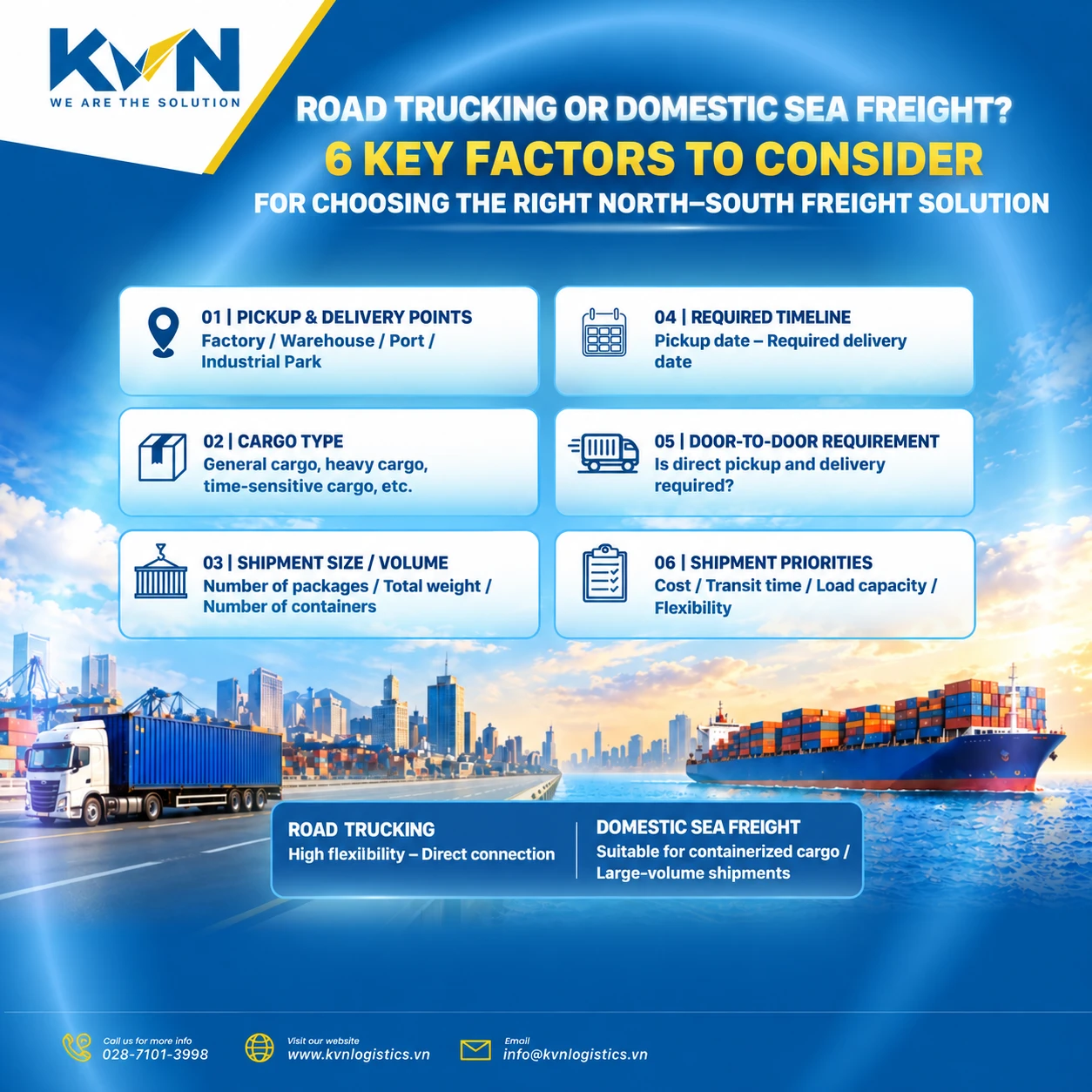
12. Decision Framework: Road or Sea Shipping for North–South Freight?
Before selecting a transportation method, businesses should answer six practical questions.
Question 1: What Is the Required Delivery Deadline?
When delivery is urgent, road transportation should usually be evaluated first.
If the delivery schedule is flexible, coastal shipping can be included in the comparison.
Question 2: What Is the Cargo Volume?
Small or irregular shipments may favor flexible road transportation.
Containerized shipments and larger cargo volumes warrant further evaluation of domestic sea options.
Question 3: How Frequently Will the Cargo Move?
A one-time shipment should not necessarily be planned in the same way as a recurring weekly or monthly transportation program.
Question 4: Where Are the Pickup and Delivery Locations?
Calculate the transportation distance between each facility and the relevant ports.
This directly affects the cost and feasibility of sea-based solutions.
Question 5: What Is the Financial Impact of Delayed Delivery?
A lower freight rate may not compensate for:
- Production downtime.
- Inventory shortages.
- Missed customer delivery deadlines.
- Additional warehousing expenses.
- Emergency transportation requirements.
For some cargo, delivery reliability matters more than the lowest available freight rate.
Question 6: What Is the Total Door-to-Door Cost?
Compare both options using their complete operational scope.
| Cost Component | Road Option | Domestic Sea Option |
|---|---|---|
| Origin pickup | Included or separately charged | First-mile trucking |
| Main transportation | Long-haul trucking | Coastal shipping |
| Origin port charges | Generally not applicable | Where applicable |
| Destination port charges | Generally not applicable | Where applicable |
| Final delivery | Included or separately charged | Last-mile trucking |
| Handling and waiting | As applicable | As applicable |
| Potential delay-related costs | Assess | Assess |
| Total logistics cost | Calculate | Calculate |
This comparison provides a more reliable basis for transportation decisions than comparing freight quotations in isolation.
13. Shipment Information Checklist for a Transportation Quotation
To evaluate road and domestic sea freight options accurately, businesses should prepare the following information.
| Information Required | Example |
|---|---|
| Pickup location | Bac Ninh, Vietnam |
| Delivery location | Binh Duong, Vietnam |
| Commodity | Industrial components |
| Gross cargo weight | 18 metric tons |
| Cargo volume | 55 CBM |
| Cargo classification | General cargo |
| Container type, if applicable | 40HC |
| Shipment frequency | 4 containers per week |
| Cargo ready date | November 10, 2026 |
| Required delivery date | November 14, 2026 |
| Loading/unloading arrangements | Forklift available |
| Special requirements | Factory delivery appointment |
The information above is illustrative, not an actual shipment quotation or confirmed transit schedule.
For recurring shipments, companies should also provide monthly volume forecasts, expected seasonal peaks, production schedules, and inventory requirements.
These details help logistics providers evaluate transportation feasibility and identify a more appropriate solution.
14. How KVN Logistics Supports North–South Freight Transportation in Vietnam
KVN Logistics approaches domestic transportation as part of an integrated shipment-management process.
Rather than focusing exclusively on arranging individual truck movements, KVN works to coordinate transportation requirements between ports, depots, industrial parks, warehouses, and manufacturing facilities.
Depending on the shipment, relevant services and coordination may include:
- Inland trucking between factories and warehouses.
- Container transportation between ports, ICDs, depots, and industrial facilities.
- First-mile and last-mile trucking arrangements.
- Transportation scheduling and dispatch coordination.
- Integration with applicable sea freight services.
- Shipment milestone monitoring.
- Coordination of logistics documentation where required.
Through KVN InlandMove and its Inland Trucking services, KVN Logistics supports domestic cargo transportation across Vietnam’s northern, central, and southern regions.
For businesses evaluating a combined road–sea option, the appropriate routing and available coastal service should be confirmed for the specific shipment. KVN’s Sea Freight service portfolio provides additional context on its freight forwarding capabilities, although domestic coastal service availability should not be assumed from international ocean freight offerings alone.
Request a North–South Freight Transportation Assessment
To evaluate a suitable transportation arrangement, businesses can provide:
Pickup Location → Delivery Location → Commodity → Weight/CBM → Shipment Volume → Required Delivery Date
For recurring shipments, additional weekly or monthly volume forecasts can help improve transportation planning.
KVN Logistics can assess the relevant trucking requirements and coordinate suitable logistics options based on cargo characteristics, route conditions, operational feasibility, and delivery expectations.
KVN Logistics – We are the Solution.
Frequently Asked Questions About North–South Freight in Vietnam
Is road trucking or domestic sea shipping cheaper in Vietnam?
Domestic sea shipping can be more cost-effective for suitable high-volume and containerized shipments over long distances. However, road transportation may be more economical when port handling and first-mile or last-mile trucking costs are high. The comparison should use total door-to-door logistics costs.
Is road freight faster than coastal shipping in Vietnam?
Road freight generally provides shorter door-to-door delivery times for many North–South shipments. Coastal shipping requires additional planning around vessel schedules, port handling, and trucking at both ends. Actual transit times depend on the specific route and operating conditions.
What types of cargo are suitable for domestic sea shipping?
Domestic sea shipping is often worth considering for containerized goods, industrial materials, large-volume cargo, and recurring shipments that can accommodate scheduled departures.
Can domestic sea freight provide door-to-door delivery?
Yes. Domestic sea transportation can be combined with inland trucking to create a door-to-door logistics chain from the origin factory to the final warehouse or distribution center, provided suitable services and arrangements are available.
Should smaller shipments use road freight or coastal shipping?
Smaller shipments may benefit from road transportation because of its flexibility. Coastal shipping can also be considered where suitable cargo consolidation and delivery arrangements are available. The best option depends on shipment size, handling costs, route availability, and delivery requirements.
What information is needed to compare road and sea transportation rates?
Businesses should provide pickup and delivery locations, cargo type, gross weight, volume, container requirements, shipment frequency, cargo ready date, and required delivery date. These details allow logistics providers to assess the appropriate transportation configuration.
How can businesses reduce North–South freight transportation costs?
Businesses can improve cost efficiency by consolidating shipments where appropriate, planning transportation in advance, optimizing loading capacity, coordinating trucking with available vessel schedules, reducing unnecessary handling, and comparing complete door-to-door costs rather than freight rates alone.
Conclusion: Choose the Right Logistics Solution, Not Just the Lowest Freight Rate
The decision between road trucking and domestic sea shipping in Vietnam should reflect the operational requirements of each business.
Road transportation offers flexibility, direct delivery, and generally faster lead times.
Domestic sea shipping may provide cost advantages for suitable large-volume shipments, particularly where transportation can be planned around vessel schedules and efficient port connections.
For many manufacturers and distribution businesses, combining both modes within a coordinated logistics plan may offer an effective balance between cost, reliability, and delivery performance.
The best North–South freight solution is the one that delivers the required cargo to the right destination, at the right time, with an appropriate total logistics cost.
KVN Logistics supports businesses in evaluating and coordinating inland transportation solutions across Vietnam, connecting factories, ports, warehouses, and industrial zones as part of a practical supply chain strategy.
KVN Logistics – We are the Solution.