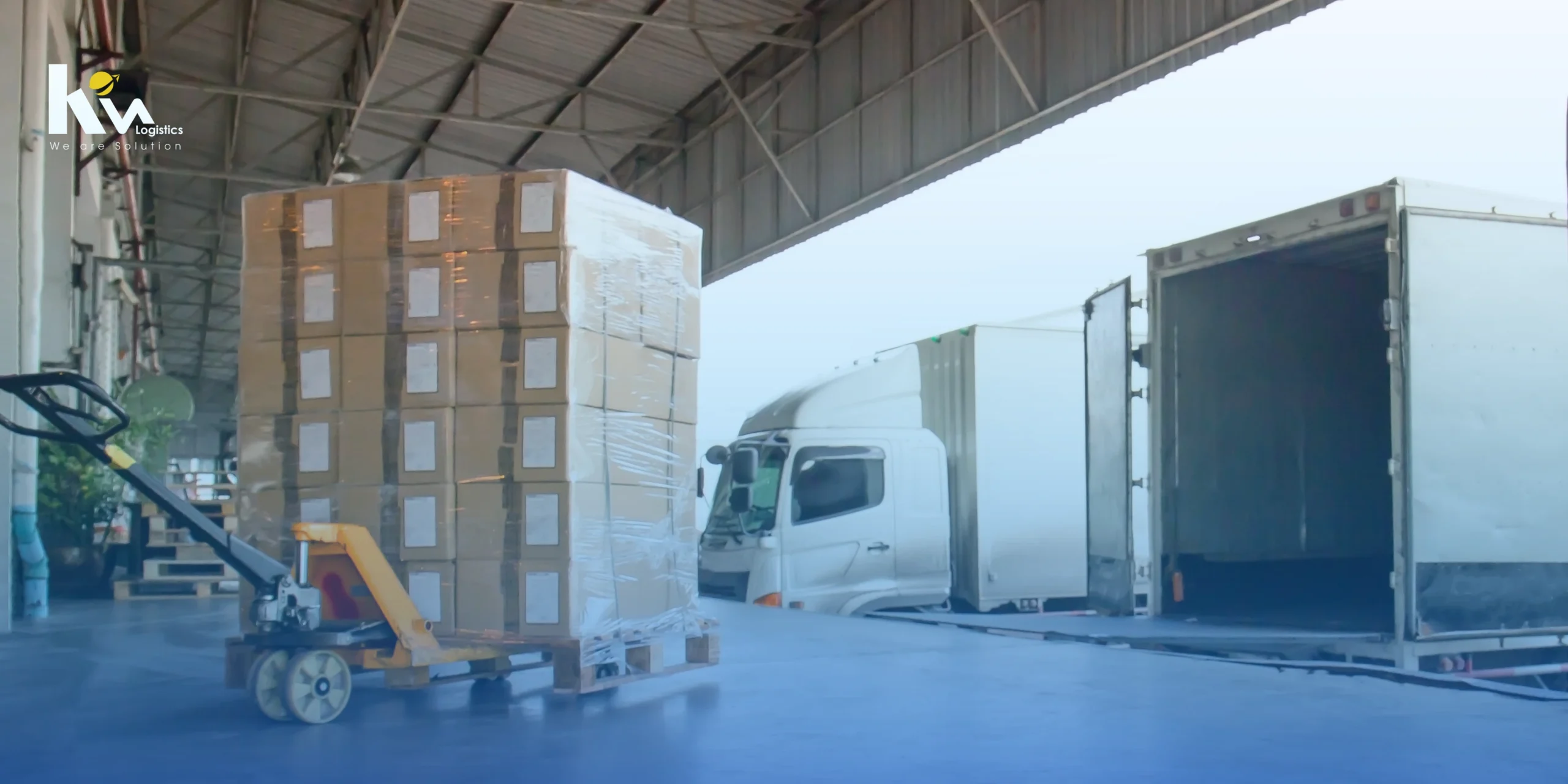


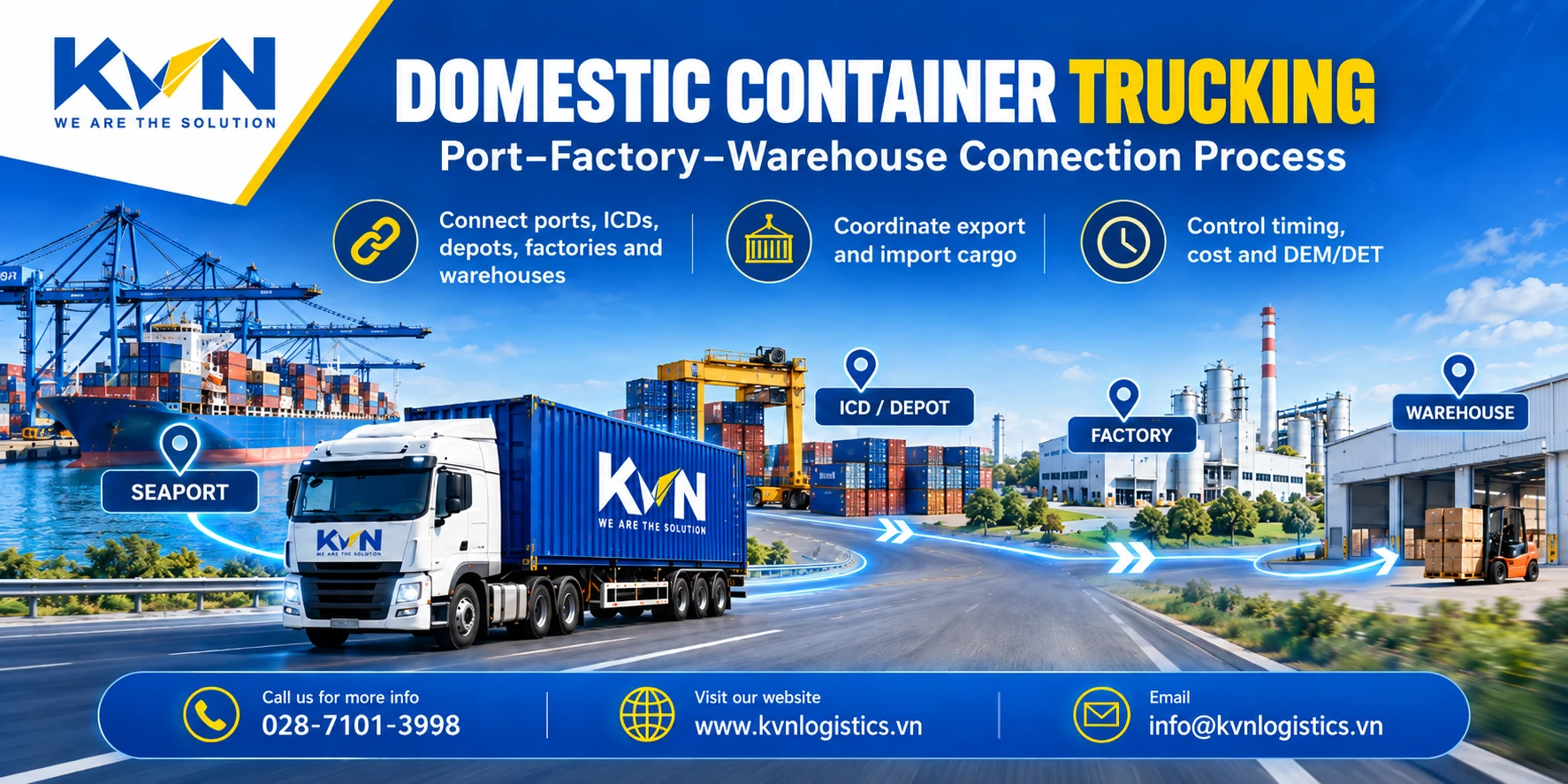
Domestic container trucking is the road transportation and operational coordination of containers between seaports, ICDs, depots, factories and warehouses.
Although inland trucking may represent only the first or last leg of an international shipment, it can directly affect vessel cut-offs, factory production schedules, container free time, delivery commitments and total logistics costs.
An import container that has arrived at port but cannot be delivered to the factory on time may delay raw-material availability. An export container that finishes loading but reaches the terminal after CY cut-off may miss the planned vessel.
For this reason, container trucking should not be treated simply as “booking a truck.” Effective inland container transport requires coordination between vessel schedule, container availability, port or depot operations, factory loading, documentation, customs status, delivery windows and empty-container return.
KVN Logistics provides Inland Trucking services in Vietnam connecting ports, warehouses, factories and industrial zones, with trucking coordinated alongside Sea Freight and Customs & Docs when required.
Quick Answer: What Is Domestic Container Trucking?
Domestic container trucking refers to the movement of shipping containers by road within a country.
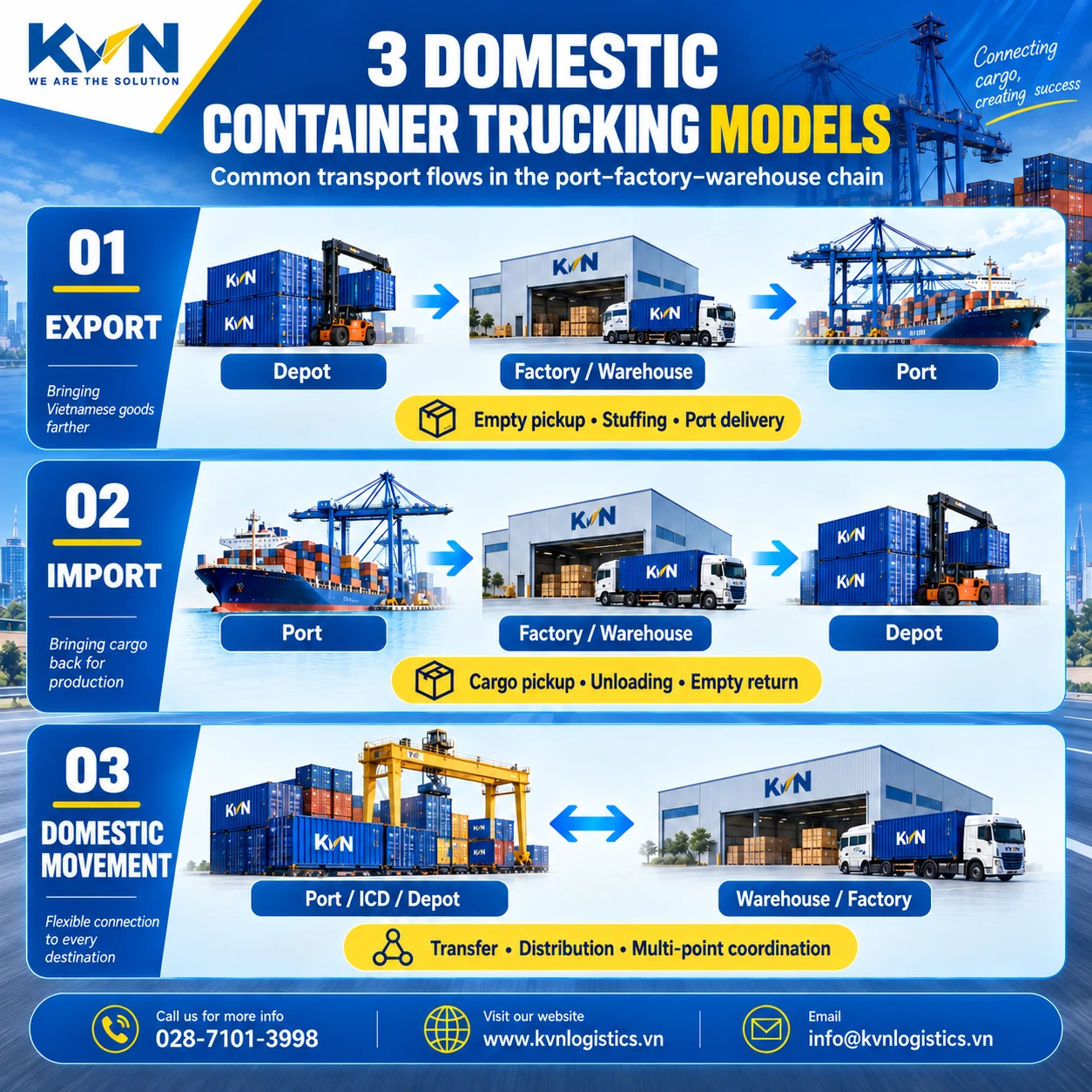
In Vietnam, common transport flows include:
Export: Depot → Factory/Warehouse → Seaport or ICD
Import: Seaport/ICD → Factory/Warehouse → Empty Container Depot
Depending on the shipment, additional moves may be required between terminals, ICDs, container depots or intermediate warehouses.
The objective is not simply to move the container from Point A to Point B. The trucking plan must also match vessel cut-offs, customs clearance, factory loading or unloading capacity and container free time.
How Does Container Trucking Work for Export Shipments?
A typical export container movement follows:
Empty Depot → Factory/Warehouse → Export Terminal
The empty container is collected from a carrier-designated depot, positioned at the factory for stuffing, sealed and transported to the port or terminal before the applicable CY cut-off.
Several operational milestones must be aligned: empty-container release, depot location, loading appointment, VGM, customs procedures, terminal gate-in and vessel cut-off.
This is why an export trucking schedule should usually be planned backward from the cut-off rather than forward from the vessel ETD.
KVN Logistics explains this workflow in greater detail in its Sea Freight Booking Process: Cut-Off, SI, VGM & CY/CFS guide. The guide notes that a shipment may need to complete SI, VGM, customs and terminal requirements well before the vessel departs.
For example, if a vessel departs on Friday but CY cut-off is Thursday, the container cannot wait until Friday to leave the factory. Loading, customs and inland transport must be scheduled earlier.
How Does Container Trucking Work for Import Shipments?
A common import flow is:
Port/ICD → Factory/Warehouse → Empty Container Depot
Once the container becomes available for collection and the required import procedures have been completed, trucking is arranged from the terminal to the consignee’s factory or warehouse.
After unloading, the empty container normally needs to be returned to the designated depot within the applicable free-time conditions.
The operational sequence may therefore look like:
ETA → D/O → Customs Clearance → Container Pickup → Factory Delivery → Unloading → Empty Return
This last step is important. The trucking job does not necessarily end when the laden container reaches the factory.
If unloading is delayed or the empty container is returned late, additional detention or other container-related costs may arise depending on the carrier’s terms.
Connecting Ports, ICDs, Depots, Factories and Warehouses
Container logistics involves several different facilities, each with a specific operational role.
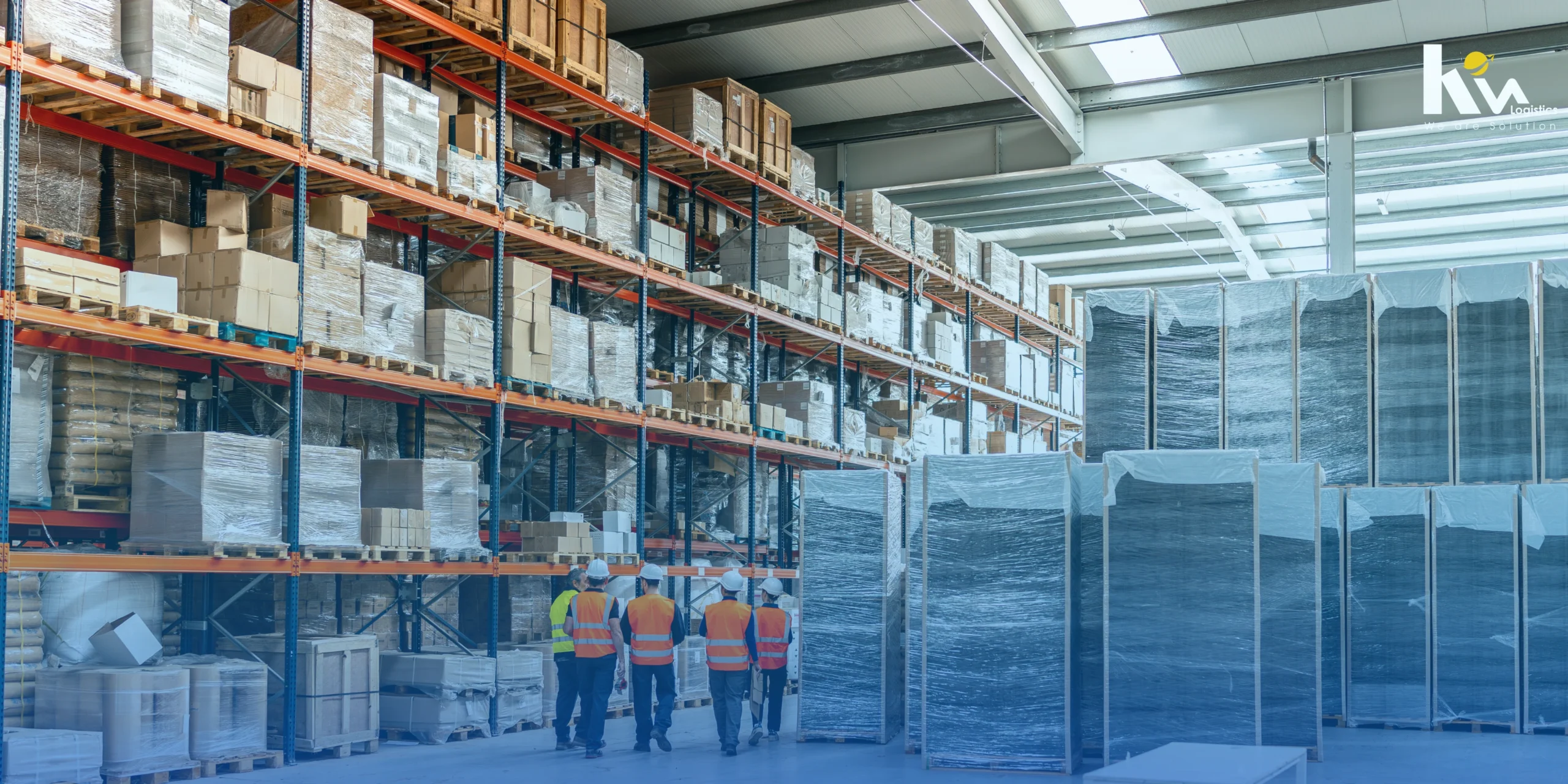
A seaport terminal handles containers entering or leaving the maritime transport network. An ICD – Inland Container Depot may support inland container handling, customs-related activities and connectivity between production areas and ports. A container depot commonly handles empty-container release, return, storage or equipment management. The factory is typically the location where export containers are stuffed or import containers are unloaded, while a warehouse may support storage, consolidation, distribution or cargo staging.
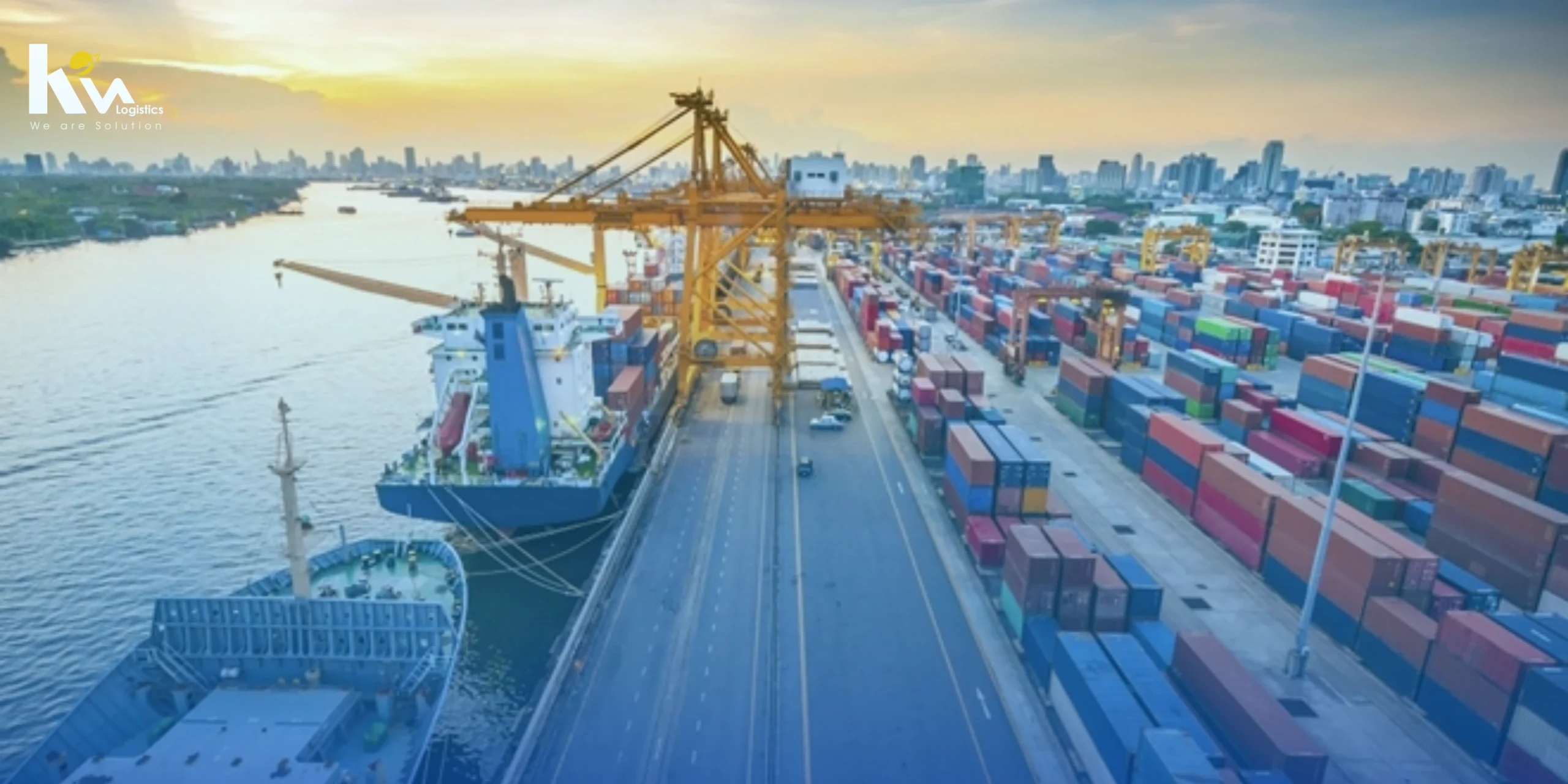
In Vietnam, major container flows are concentrated around Northern and Southern gateway regions. Hai Phong and Lach Huyen support a large manufacturing corridor in Northern Vietnam, while Cat Lai and Cai Mep–Thi Vai serve important production and trading areas across Ho Chi Minh City and the Southeast region. KVN Logistics provides a detailed overview in its guide to Vietnam’s major seaports.
This geographical relationship matters because a port should not be selected based on ocean freight alone.
Businesses should also consider factory-to-port distance, trucking time, container depot location, terminal cut-offs, congestion, local charges and empty-container return requirements.
A slightly lower ocean freight rate may not result in a lower total logistics cost if it requires significantly longer or more complicated inland transportation.
Common Container Types Used in Inland Trucking
Domestic trucking requirements vary according to container type, cargo weight and loading method.
| Container | Typical Applications |
|---|---|
| 20DC / 20GP | Dense dry cargo, raw materials and industrial goods |
| 40DC | Higher-volume general dry cargo |
| 40HC | Lightweight or bulky cargo requiring additional volume |
| Reefer | Food, pharmaceutical or temperature-controlled cargo |
| Open Top | Machinery and over-height cargo |
| Flat Rack | Oversized machinery and Out-of-Gauge cargo |
| Tank Container | Suitable bulk liquid cargo |
For Open Top, Flat Rack and oversized cargo, the inland transport plan becomes more complex because total loaded dimensions, axle loads, route restrictions, lifting requirements and access to the loading site may need to be assessed.
Businesses can review KVN Logistics’ Common Shipping Container Types: Sizes, Uses & Selection Guide before selecting equipment. The guide covers standard dry, High Cube, Reefer, Open Top, Flat Rack and Tank containers and highlights the importance of evaluating dimensions, cargo weight and loading method rather than container volume alone.
Domestic Container Trucking Process in Vietnam
A reliable trucking operation begins before the truck is dispatched.
Step 1: Collect Complete Shipment Information
The logistics coordinator first needs to determine whether the shipment is export or import, the number and type of containers, pickup and delivery locations, relevant port or depot, cargo weight, cargo-ready time and any special handling requirements.
For exports, vessel schedule and cut-off information are particularly important.
For imports, container availability, customs status, delivery appointment and empty-return instructions should be confirmed.
Incomplete shipment information can result in the wrong vehicle arrangement, inefficient routing or additional waiting costs.
Step 2: Check Operational Deadlines
For export containers, the main timeline may include empty-container pickup, factory stuffing, customs clearance, VGM and CY cut-off.
For import containers, planners should check D/O availability, customs clearance status, terminal pickup conditions, factory receiving time and container free time.
These milestones should be treated as one connected operating schedule.
Step 3: Plan the Appropriate Trucking Arrangement
The required trucking arrangement depends on container type, cargo weight, route, delivery location and operating conditions.
KVN Logistics evaluates shipment requirements and coordinates suitable transport capacity through its trucking partner network rather than positioning the service around ownership of a fixed truck fleet.
For larger shipments involving multiple containers, dispatches may also be divided into several waves instead of sending every truck to the factory at the same time.
This can be particularly useful when a factory has limited loading bays, limited staging space, fixed receiving hours or restricted loading capacity.
Step 4: Confirm Pickup and Delivery Milestones
Before dispatch, the parties should agree on the expected sequence:
Truck Dispatch → Container Pickup → Factory Arrival → Loading/Unloading → Factory Departure → Port Gate-In/Empty Return
For export cargo, the final gate-in time must remain within the applicable terminal cut-off.
For import cargo, the plan should include not only delivery to the factory but also unloading time and empty-container return.
Step 5: Track the Shipment by Operational Milestones
A useful trucking update should provide more information than simply saying that “the truck is on the way.”
Relevant milestones may include truck arrival at the pickup point, container release, factory arrival, loading or unloading completion, departure from the factory, terminal gate-in, empty return and Proof of Delivery.
Milestone-based tracking helps manufacturers coordinate production, warehouse labour and shipment documentation more effectively.
What Documents Are Commonly Required for Container Trucking?
The exact documentation depends on whether the shipment is export or import, the shipping line, terminal and customs requirements.
A typical container shipment may involve a Booking Confirmation, Delivery Order, EIR, container and seal numbers, customs documentation, VGM for an export container and Proof of Delivery.
For export shipments, the Booking Confirmation normally provides operational information such as the vessel/voyage, equipment requirements, empty-container instructions and applicable cut-offs.
For import shipments, the Delivery Order and customs release status are important factors before container collection can proceed.
Businesses that need coordinated import-export documentation can connect inland trucking with KVN Logistics’ Customs & Docs services, which currently cover customs clearance and trade documentation support.
What Affects Domestic Container Trucking Rates?
There is no single trucking rate that applies to every container movement.
The cost depends on several operational variables, including distance, routing, container type, cargo weight, pickup and delivery points, depot location, waiting time, delivery schedule and special handling requirements.
A 20ft container carrying dense industrial raw materials may create different vehicle and weight considerations from a 40HC carrying lightweight packaging products.
The route itself also matters. Two trips with a similar number of kilometres may have different costs because of urban traffic restrictions, tolls, port waiting time, depot location or truck turnaround efficiency.
Waiting time is another important factor. A truck that arrives at a factory but waits several hours for loading or unloading remains occupied even though the vehicle is not moving.
Import shipments also require attention to the empty-container return location. Delivery to the factory is only one part of the total truck movement.
For this reason, businesses comparing trucking quotations should confirm exactly what is included in the quoted scope rather than comparing only the headline price.
DEM, DET, Storage and Empty-Container Return
Container trucking is closely connected with container free time.
Demurrage generally relates to a container remaining at the terminal beyond the applicable free period.
Detention generally relates to the container being kept outside the terminal beyond the permitted free period.
Storage usually refers to terminal or facility storage charges.
The exact definitions, charging rules and free-time conditions may vary by carrier, terminal, shipment and trade lane, so businesses should confirm the terms applicable to each booking rather than applying one rule to every shipment.
KVN Logistics has a dedicated guide explaining THC, CIC, D/O fees, storage, demurrage, detention and other logistics surcharges.
For import containers, a practical control sequence is:
ETA → Customs & D/O → Pickup → Factory Delivery → Unloading → Empty Return
The planning question should therefore not be only:
“When can the container leave the port?”
It should also be:
“When can the factory unload it, and when can the empty container be returned?”
Common Problems in Container Trucking
Domestic trucking may involve a relatively short physical distance compared with international sea freight, but the operation can change quickly.
Vessel ETA may move. A container may not yet be available. A depot may change the empty-return location. The terminal may become congested. Factory loading may take longer than expected. Customs clearance may not be completed on schedule. Traffic conditions may delay delivery.
For exports, even a small delay may put the container at risk of missing CY cut-off.
For imports, delays may reduce the available free-time buffer and increase the risk of additional container charges.
This is why effective trucking requires both an initial transport plan and active coordination when conditions change.
Connecting Inland Trucking With Sea Freight
In international logistics, container trucking is normally one part of a wider shipment chain:
Factory → Inland Trucking → Export Port → Sea Freight → Import Port → Inland Trucking → Warehouse/Factory
When sea freight and inland trucking are planned independently, a vessel schedule change may require the truck booking, loading appointment and documentation timeline to be rearranged separately.
KVN Logistics’ Sea Freight service currently covers FCL, LCL, Master Consolidation, Bulk Cargo and Project Cargo, allowing inland transportation to be coordinated with the international freight plan when required.
For manufacturing companies, the same approach can be extended further through Door-to-Door Logistics from factory pickup to final delivery, connecting inland trucking, customs, international freight, warehousing and final delivery under one operating plan.
How KVN Logistics Supports Domestic Container Trucking
KVN Logistics approaches inland trucking as a shipment-coordination function rather than simply arranging a vehicle.
Depending on the shipment, the scope may include transportation between ports, ICDs, depots, factories and warehouses; empty-container positioning; export-container delivery to terminals; import-container pickup; delivery scheduling; empty-container return; coordination with Sea Freight; coordination with Customs & Docs; multi-container dispatch planning; and Door-to-Door shipment coordination.
KVN’s English service pages currently position Inland Trucking as a flexible domestic transport solution connecting ports, warehouses and factories across Northern, Central and Southern Vietnam.
The transport capacity for individual shipments can be coordinated through suitable trucking partners based on route, container type, cargo conditions and delivery requirements.
The objective is to connect port operations, factory schedules and shipment deadlines under one practical transport plan.
What Information Is Needed for a Container Trucking Quotation?
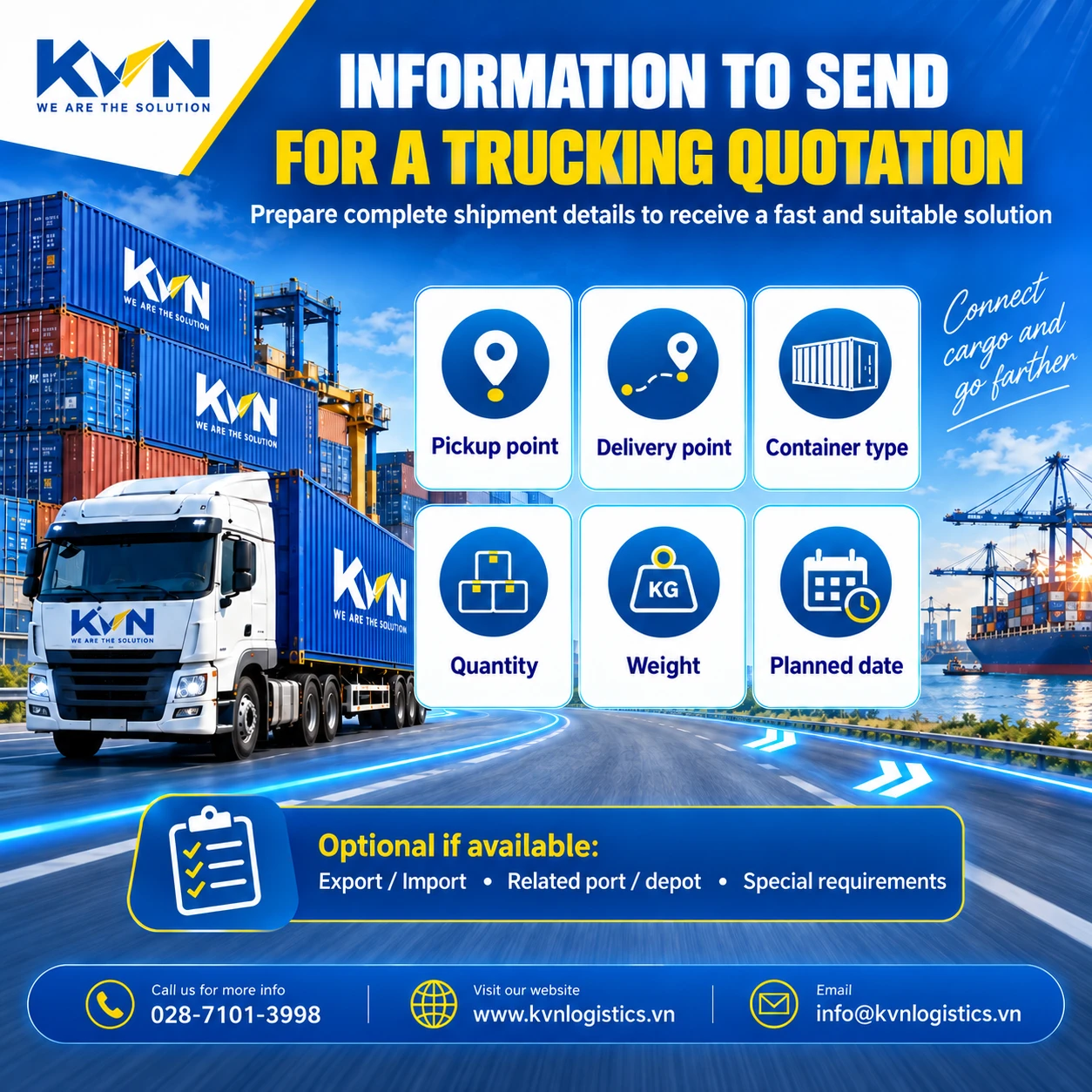
To receive a more accurate quotation, businesses should provide the commodity, export or import status, container type, number of containers, gross cargo weight, pickup point, delivery point, requested date and any special operational requirements.
For export cargo, providing the Booking Confirmation, CY cut-off and empty-container pickup depot can help the logistics team assess the schedule more accurately.
For import cargo, useful information includes the arrival port or terminal, expected release timing, delivery location and empty-container return depot if already confirmed.
A quotation based on complete shipment data is more useful than a general “port-to-factory rate” because it allows the trucking plan to reflect the actual operating conditions.
Request a Domestic Container Trucking Solution in Vietnam
If your business needs container transportation between a port, ICD, depot, factory or warehouse in Vietnam, provide the following core information:
Pickup → Delivery → Container Type → Cargo Weight → Quantity → Required Date
KVN Logistics can then evaluate the route, shipment timeline and operational requirements to coordinate a suitable inland trucking solution.
KVN Logistics – We are the Solution.
FAQ: Domestic Container Trucking in Vietnam
What is domestic container trucking?
Domestic container trucking is the movement of shipping containers by road between seaports, ICDs, depots, warehouses, factories and other inland logistics locations.
What is the difference between container trucking and container haulage?
The terms are often used interchangeably. Container haulage normally refers specifically to the physical road movement of a container, while container trucking may also be used more broadly to describe dispatching, scheduling, pickup, delivery and container-return coordination.
How is container trucking priced in Vietnam?
Pricing depends on the route, container type, cargo weight, pickup and delivery points, depot location, waiting time and any special operating requirements. An accurate quotation therefore requires shipment-specific information.
How early should export trucking be arranged?
There is no universal lead time. The schedule should be calculated backward from the CY cut-off while allowing sufficient time for empty-container pickup, factory loading, customs procedures, VGM and transport to the terminal.
When can an import container be collected from the port?
Collection depends on the shipment’s release status and applicable terminal, carrier and customs procedures. D/O, customs clearance and other required conditions should be confirmed before truck dispatch.
How can businesses reduce demurrage and detention risk?
The key is to coordinate documentation, container pickup, factory receiving capacity, unloading and empty-container return within the available free time. The exact free-time terms should always be confirmed for the individual shipment.