

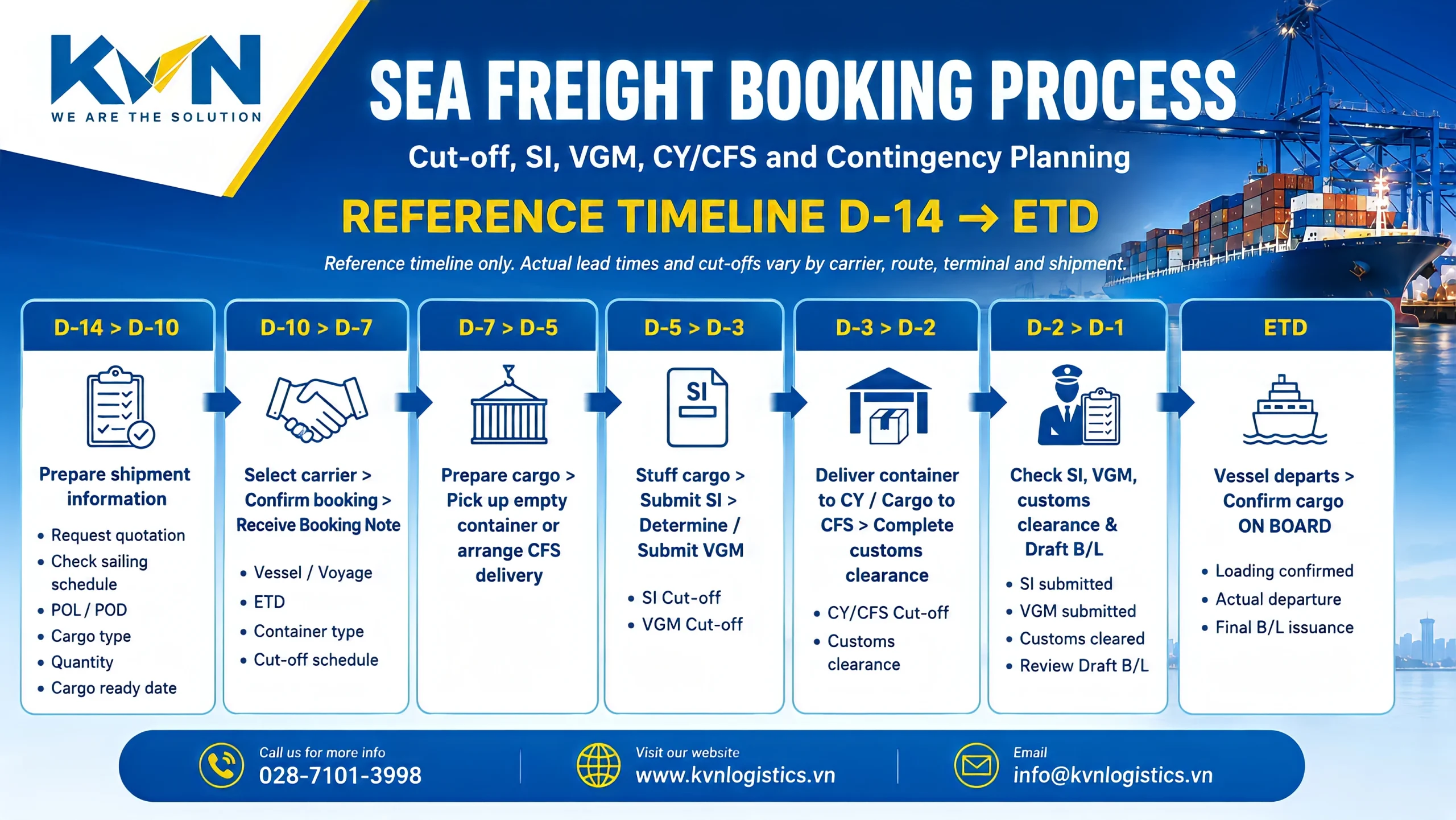
A sea freight booking involves much more than choosing a vessel, receiving a Booking Confirmation and waiting for the ETD.
In a real export shipment, shippers need to coordinate multiple operational milestones at the same time, including vessel schedules, equipment availability, Shipping Instructions (SI), Verified Gross Mass (VGM), CY or CFS cut-offs, customs procedures, inland trucking and final on-board confirmation.
Missing just one deadline may result in the container not being loaded on the planned vessel, an LCL shipment missing its consolidation box, additional storage or trucking costs, or a delayed delivery to the buyer.
For businesses using KVN Logistics Sea Freight services, understanding the complete booking workflow is especially important because FCL, LCL, inland trucking and customs documentation often need to operate under one coordinated timeline. KVN Logistics’ current Sea Freight portfolio includes FCL, LCL, Master Consolidation, Bulk Cargo and Project Cargo solutions.
Quick Answer: What Is the Sea Freight Booking Process?
A typical export sea freight booking process can be summarized as:
Cargo Information → Quotation → Sailing Schedule → Booking Confirmation → Empty Container/CFS → SI → Customs → VGM → CY/CFS Cut-Off → Vessel Loading → On-Board Confirmation
The most important point is:
ETD is not the same as cut-off time.
The cargo or container usually needs to complete several operational and documentation milestones well before the vessel’s scheduled departure.
Key Sea Freight Booking Terms at a Glance
| Term | What It Means |
|---|---|
| Booking Confirmation / Booking Note | Confirmation that space has been booked with the carrier or logistics provider |
| ETD | Estimated Time of Departure |
| ETA | Estimated Time of Arrival |
| SI Cut-Off | Deadline for submitting Shipping Instructions |
| VGM Cut-Off | Deadline for submitting the Verified Gross Mass |
| CY Cut-Off | Deadline for an FCL container to be accepted at the designated container yard or terminal |
| CFS Cut-Off | Deadline for LCL cargo to be delivered to the designated CFS |
| Documentation Cut-Off | Deadline for required shipping documentation |
| On Board | Confirmation that the cargo/container has actually been loaded onto the vessel |
| Rolling | A shipment is not loaded on the originally planned sailing and is moved to a later vessel or voyage |
These deadlines are not universal. They may vary by shipping line, port, service, destination, terminal and individual booking.
1. Prepare Complete Cargo Information Before Requesting a Booking
The first stage of the sea freight booking process is to standardize the shipment information.
Businesses should normally prepare:
- POL – Port of Loading or pickup location;
- POD – Port of Discharge or delivery location;
- commodity;
- estimated HS Code;
- number of packages;
- packaging type;
- gross and net weight;
- package dimensions;
- total CBM;
- required container type;
- Cargo Ready Date;
- Incoterms;
- required ETD or delivery deadline;
- DG or Non-DG status;
- temperature requirements for reefer cargo;
- documentation or regulatory requirements;
- pickup and delivery addresses for Door-to-Door shipments.
The more accurate the cargo information is at the beginning, the easier it becomes to compare equipment, routing, schedules and total logistics costs.
For FCL Shipments
The shipper must determine the appropriate container type, which may include:
- 20′ Dry Container;
- 40′ Dry Container;
- 40′ High Cube;
- Reefer;
- Open Top;
- Flat Rack;
- or other specialized equipment.
Container selection should not be based on CBM alone.
Package dimensions, gross weight, container payload, door opening dimensions, loading method, cargo securing requirements and cargo characteristics should also be assessed.
Businesses can refer to KVN Logistics’ Common Shipping Container Types: Sizes, Uses & Selection Guide when preparing equipment requirements before booking. The guide specifically recommends assessing cargo dimensions, weight and loading method rather than simply choosing equipment based on nominal container size.
For LCL Shipments
Accurate package dimensions and weight become even more important because LCL pricing and consolidation planning may depend on:
- CBM;
- chargeable weight;
- number of packages;
- cargo compatibility;
- handling requirements;
- destination;
- consolidation schedule.
For LCL shipments, the shipper also needs to consider the CFS cut-off and consolidation schedule, rather than looking only at the vessel ETD.
2. Compare Quotations and Select the Right Sailing
Once cargo information has been confirmed, the carrier or freight forwarder can evaluate:
- vessel schedules;
- routing;
- direct versus transshipment services;
- transit time;
- equipment availability;
- vessel space;
- ocean freight;
- origin charges;
- destination charges;
- surcharges;
- free time;
- booking conditions.
A common mistake is to focus only on:
“What is the ocean freight rate?”
A better evaluation should consider:
Cost + Schedule + Routing + Reliability + Delivery Requirement
The lowest ocean freight rate does not necessarily create the lowest total logistics cost.
An apparently cheaper option may involve:
- additional transshipment;
- longer transit time;
- tighter cut-offs;
- less favorable free time;
- higher destination charges;
- increased schedule risk.
For a better all-in cost comparison, businesses can review KVN Logistics’ guide to Hidden Logistics Surcharges: THC, CIC, D/O, Storage, Demurrage and PSS.
Businesses can also monitor reference sailings through the KVN Logistics Sea Freight Schedule. Published schedules remain subject to operational change, so the final sailing and cut-offs should always be reconfirmed for the actual booking.
3. Review the Booking Confirmation Carefully
Once the shipper accepts the proposed solution, the carrier or forwarder proceeds with the booking.
After confirmation, the shipper normally receives a Booking Confirmation, sometimes referred to operationally as a Booking Note.
Depending on the carrier, it may contain:
- Booking Number;
- shipper details;
- POL and POD;
- vessel and voyage;
- ETD and ETA;
- container type;
- container quantity;
- empty-container depot;
- export terminal;
- CY cut-off;
- SI cut-off;
- VGM cut-off;
- routing;
- operational instructions.
Does a Confirmed Booking Guarantee That the Cargo Will Be Loaded?
No.
A confirmed booking means space has been arranged under the applicable booking conditions, but the shipment still needs to satisfy operational requirements such as:
- correct equipment;
- cargo acceptance;
- timely CY/CFS delivery;
- Shipping Instruction submission;
- VGM submission for packed containers;
- customs release;
- regulatory requirements;
- carrier and vessel operational conditions.
Therefore:
Booking Confirmed ≠ Loaded On Board
This distinction is extremely important when communicating shipment status to buyers.
4. Understand the Different Cut-Off Times
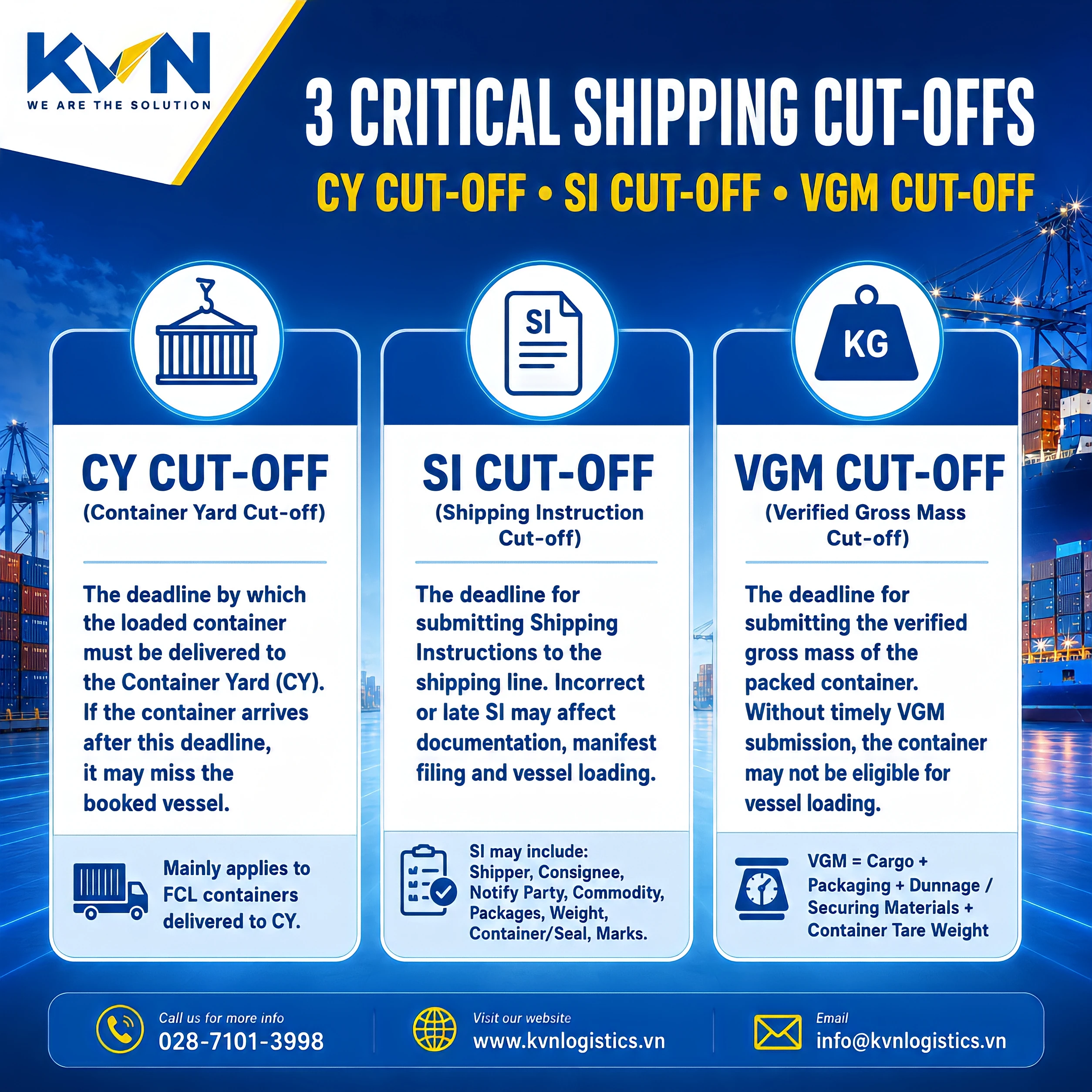
A “cut-off” is the deadline by which a specific shipment requirement must be completed.
There is no single universal sea freight cut-off.
A shipment may have several different deadlines.
What Is CY Cut-Off?
CY stands for Container Yard.
For FCL shipments, CY cut-off generally refers to the deadline by which the laden container must be accepted at the designated terminal or container yard under the booking conditions.
A typical FCL sequence may look like:
Empty Pickup → Factory → Stuffing → Seal → VGM → Customs → Port → CY Gate-In
If the container arrives after the CY cut-off, the shipper may need to request late gate-in, amend the booking or move the shipment to another sailing, depending on carrier and terminal policies.
What Is CFS Cut-Off?
CFS stands for Container Freight Station.
For LCL shipments, the shipper usually delivers individual packages to a CFS rather than delivering an entire container to the terminal.
The consolidator then needs time to:
- receive the cargo;
- inspect the shipment;
- measure and weigh packages;
- check cargo compatibility;
- coordinate customs;
- prepare the consolidation plan;
- stuff the container;
- complete documentation;
- deliver the consol container to the terminal.
For this reason:
For LCL cargo, CFS cut-off may be more operationally important than the vessel ETD.
KVN Logistics’ current Master Consolidation guide also emphasizes cargo receiving schedules, CFS cut-off, stuffing plans and documentation cut-offs as key milestones in an organized consolidation program.
For a deeper explanation of LCL structures, businesses can read What Is Master Consolidation? Direct Consol vs Co-load Guide.
What Is SI Cut-Off?
SI – Shipping Instruction contains the information required by the carrier or freight forwarder to prepare the Bill of Lading and relevant transportation data.
Shipping Instructions commonly include:
- Shipper;
- Consignee;
- Notify Party;
- POL;
- POD;
- final destination;
- cargo description;
- number of packages;
- gross weight;
- container and seal number, where applicable;
- shipping marks;
- freight terms;
- Bill of Lading instructions;
- destination-specific information.
The SI cut-off is the deadline for submitting these instructions.
It is important not to assume a universal rule such as “SI must always be submitted 24 hours before ETD.”
Cut-offs vary by trade lane and carrier. For example, Maersk’s current Vietnam export guidance sets different SI cut-offs depending on destination and service and states that documentation and CY cut-offs are also shown on the Booking Confirmation.
The practical rule is therefore:
Always follow the cut-off shown on the actual Booking Confirmation or the carrier’s latest instructions.
What Is VGM Cut-Off?
VGM – Verified Gross Mass is the verified gross weight of a packed container.
Under SOLAS requirements, the shipper is responsible for providing the VGM sufficiently in advance for the vessel stowage plan, and a verified gross mass is a condition for loading a packed container onto a ship.
VGM may be established through two recognized approaches:
- Weighing the entire packed container.
- Weighing the cargo, packages, pallets, dunnage and securing materials and adding the container tare weight, using an approved method.
The exact VGM submission deadline depends on the carrier, terminal and booking.
For LCL cargo, the shipper normally provides accurate package weights to the consolidator, while VGM for the final packed consol container is handled at the container level by the party responsible under the carrier arrangement.
5. Prepare SI and Shipping Documents Before the Deadline
One of the most effective ways to reduce booking risk is to avoid waiting until the cut-off date to begin preparing documentation.
Once the booking has been confirmed, the export team should begin reviewing:
- Commercial Invoice;
- Packing List;
- Sales Contract, where required;
- HS Code;
- Certificate of Origin requirements;
- Shipping Instructions;
- export permits;
- specialized inspection documents;
- destination filing requirements.
Information across the Commercial Invoice, Packing List, customs declaration and Shipping Instructions should be consistent.
Common documentation problems include:
- incorrect consignee details;
- incorrect package quantity;
- inconsistent weights;
- wrong container or seal numbers;
- inconsistent cargo descriptions;
- incorrect or unclear HS Code;
- missing destination filing information;
- missing permits or certificates.
For shipments involving more complex import-export requirements, businesses can combine booking preparation with KVN Logistics Customs & Docs services.
KVN’s current Customs & Docs portfolio focuses on customs clearance, document review and import-export documentation support, helping businesses align documentation with the transportation plan.
6. Empty Container Pickup, Stuffing and VGM for FCL
Once a booking is confirmed, the factory schedule must be coordinated with inland trucking and equipment availability.
A typical FCL process is:
Empty Pickup → Factory → Container Inspection → Stuffing → Seal → VGM → Customs → Terminal Gate-In
Inspect the Empty Container Before Loading
Before stuffing begins, the shipper should check:
- container number;
- booked container type;
- floor condition;
- walls and roof;
- doors;
- door seals;
- water ingress;
- holes;
- odor;
- cleanliness;
- structural condition;
- suitability for the commodity.
If the equipment is not suitable, the issue should be resolved before cargo is fully loaded.
Replacing an empty container is much easier than dealing with a rejected or damaged laden container.
Plan Trucking Backward From the CY Cut-Off
A common operational mistake is scheduling the truck based only on ETD.
A better approach is to plan backward:
CY Cut-Off
→ minus Terminal Gate-In Time
→ minus Customs Processing Buffer
→ minus VGM Arrangement
→ minus Stuffing Time
→ determine Empty Pickup Time
This is particularly important for factories located outside major port areas.
KVN Logistics provides Inland Trucking services connecting ports, factories, warehouses and industrial zones across Vietnam.
7. Deliver the Cargo to CY or CFS on Time
This is where the booking plan becomes a physical logistics operation.
For FCL Cargo
The shipper or logistics coordinator should verify:
- container gate-in status;
- terminal acceptance;
- VGM status;
- customs status;
- correct booking connection;
- planned vessel/voyage.
For LCL Cargo
Important status points include:
- cargo received at CFS;
- actual weight and CBM;
- warehouse discrepancy, if any;
- customs status;
- stuffing status;
- consol container number;
- planned vessel;
- final consolidation status.
Delivering cargo to a CFS does not mean the shipment has already departed.
The cargo still needs to be consolidated, stuffed into the container, moved to the terminal and ultimately loaded on board.
This operating structure is explained in more detail in KVN Logistics’ Master Consolidation and Direct Consol guide.
8. Complete Customs Requirements Before Vessel Loading
Depending on the commodity and applicable regulations, the shipper may need to complete customs and specialized procedures before the cargo becomes eligible for export.
Documents may include:
- Commercial Invoice;
- Packing List;
- Sales Contract;
- HS Code information;
- Certificate of Origin;
- export permits;
- quarantine documents;
- quality inspection documents;
- product-specific certificates.
For machinery, industrial materials, chemicals, cosmetics, food-related products, medical equipment or other regulated cargo, the documentation should ideally be reviewed before the booking timeline becomes critical.
Discovering a missing permit close to CY or CFS cut-off creates a significant risk of missing the sailing.
This is why booking, trucking and customs documentation should not be managed as completely separate processes.
9. Check the On-Board Status — Gate-In Does Not Mean Loaded
Once a container has entered the terminal, the shipment should still be monitored.
A typical status progression may look like:
Booking Confirmed → Empty Released → Gate-In → Customs Cleared → Load Planned → Loaded → Vessel Departed
Status terminology differs between carriers and terminals, but the key questions remain the same:
- Was the container actually loaded on the planned vessel?
- Has the vessel actually departed?
- Has the vessel or voyage changed?
- Has the routing or transshipment plan changed?
- What are the latest ETD and ETA?
A container that has been gated into the terminal should therefore not automatically be reported to the buyer as:
“Cargo has shipped.”
The more accurate milestone is the confirmed vessel loading or actual departure status.
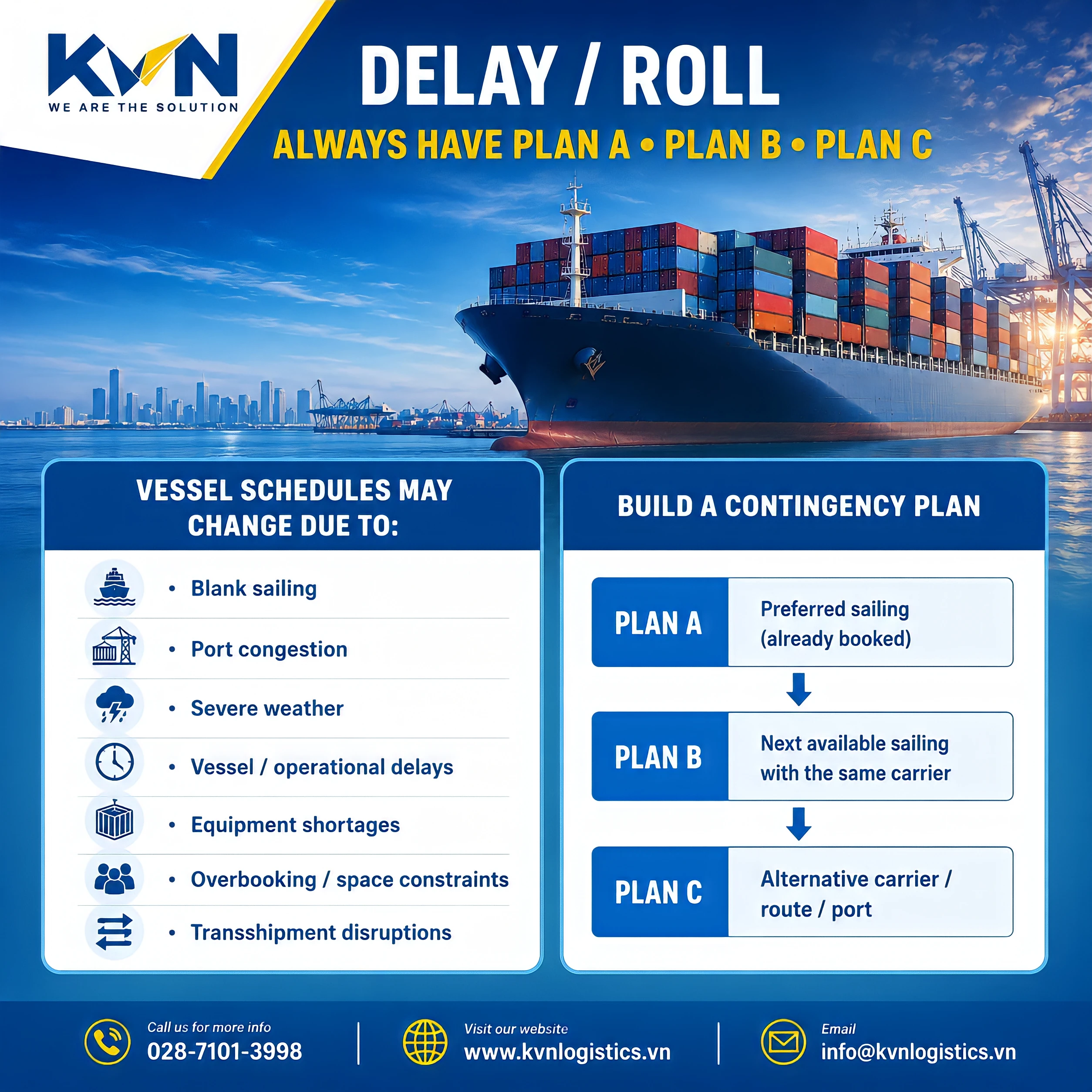
10. What Is Rolling in Sea Freight?
Rolling, or being “rolled,” occurs when a shipment does not move on its originally planned vessel or voyage and is transferred to a later sailing or alternative service.
Possible causes include:
- vessel overbooking;
- capacity changes;
- blank sailings;
- port congestion;
- vessel operational issues;
- late gate-in;
- missing SI or documentation;
- missing VGM;
- customs issues;
- routing changes;
- carrier operational decisions.
A rolled shipment does not automatically mean that one specific party is responsible.
The first step is to determine the actual cause and then assess the recovery options.
11. Build a Contingency Plan for Delay, Rolling or Booking Changes
A well-managed booking should always include a Plan B, especially for cargo connected to production schedules, project deadlines or contractual delivery commitments.
Scenario 1: Vessel Delayed but Cut-Off Has Not Passed
Check immediately:
- revised ETD;
- whether CY/CFS cut-off has changed;
- SI and VGM deadlines;
- trucking schedule;
- empty pickup plan;
- factory loading time;
- free time.
A critical rule is:
Do not assume that a delayed vessel automatically means the cut-offs have also been extended.
Cut-offs should be reconfirmed.
Scenario 2: The Container Is Rolled
Confirm:
- replacement vessel;
- new voyage;
- revised ETD;
- revised ETA;
- whether the booking number changes;
- whether SI requires amendment;
- whether VGM needs to be re-submitted;
- storage implications;
- free-time implications;
- buyer notification requirements.
Scenario 3: CY Cut-Off Is Missed
Possible recovery options may include:
- requesting late gate-in;
- rebooking onto the next sailing;
- checking another suitable vessel;
- changing the booking;
- assessing trucking and container storage costs.
The shipper should not simply send the container to the terminal because the vessel has not yet departed. Terminal acceptance must follow the applicable booking instructions.
Scenario 4: CFS Cut-Off Is Missed
For LCL cargo, the shipment may:
- miss the planned consol container;
- move to the next consolidation;
- require a different routing;
- be transferred to another consol service;
- incur additional CFS or storage charges.
This is why LCL shipment planning should normally be built around the CFS/cargo cut-off, not just vessel ETD.
Scenario 5: The Cargo Is Production-Critical or Extremely Urgent
When missing a vessel may stop a production line or trigger substantial delivery penalties, alternative solutions may include:
- another ocean sailing;
- another carrier;
- another port;
- alternative LCL/FCL arrangement;
- multimodal transport;
- sea-air;
- air freight for critical components;
- splitting the shipment.
The objective is not necessarily to find the cheapest freight rate.
The better question is:
Which recovery option creates the lowest total business impact?
Reference Sea Freight Booking Timeline
The timeline below is for planning purposes only.
Actual cut-offs must always be checked against the current Booking Confirmation and carrier instructions.
| Reference Time | Main Activity |
|---|---|
| T-21 to T-14 | Define cargo readiness, route, equipment and delivery requirements |
| T-14 to T-7 | Obtain quotations, compare routing and sailing schedules, place booking |
| T-7 to T-5 | Receive Booking Confirmation and review all cut-offs |
| T-5 to T-3 | Prepare SI, Invoice, Packing List and customs documents |
| T-3 to T-2 | Empty pickup/FCL stuffing or LCL delivery to CFS |
| T-2 to T-1 | VGM, customs processing, CY gate-in/CFS handling |
| T0 | Planned ETD |
| T0 / T+1 | Check on-board status and actual departure |
| After Departure | Final B/L, pre-alert and ETA monitoring |
T = planned ETD.
Lead time may need to be significantly longer during peak periods, equipment shortages or capacity constraints.
KVN Logistics also publishes market and booking updates to help businesses assess schedule changes and booking risks. Its August 2026 update, for example, tracked freight rates, vessel schedules and booking conditions across major trades.
Sea Freight Booking Checklist
Before finalizing a booking, businesses can use the following checklist.
Cargo Information
- Commodity confirmed
- HS Code estimated
- Package quantity
- Package dimensions
- Gross weight
- CBM
- DG / Non-DG status
- Cargo Ready Date
Routing
- POL
- POD
- Final destination
- Direct or transshipment service
- Transit time
- ETD
- ETA
Equipment
- 20DC / 40DC / 40HC / OT / FR / Reefer
- Container quantity
- Empty-container depot
- Export terminal
- Empty release timing
- Container free time
Cut-Offs
- CY cut-off
- CFS cut-off for LCL
- SI cut-off
- VGM cut-off
- Documentation cut-off
- Customs-related deadline, if applicable
- Destination-specific filing deadline
Documentation
- Commercial Invoice
- Packing List
- Shipping Instruction
- HS Code
- Certificate of Origin
- Permits
- Specialized documents
- Bill of Lading instructions
Operations
- Trucking arranged
- Empty container inspected
- Stuffing scheduled
- Seal recorded
- VGM completed
- Customs completed
- CY gate-in/CFS received
- On-board status confirmed
- Actual vessel departure confirmed
Contingency Planning
- Alternative vessel
- Alternative carrier
- Next available sailing
- Potential rolling/storage costs
- Backup trucking arrangement
- Alternative transport mode for urgent cargo
- Buyer communication plan
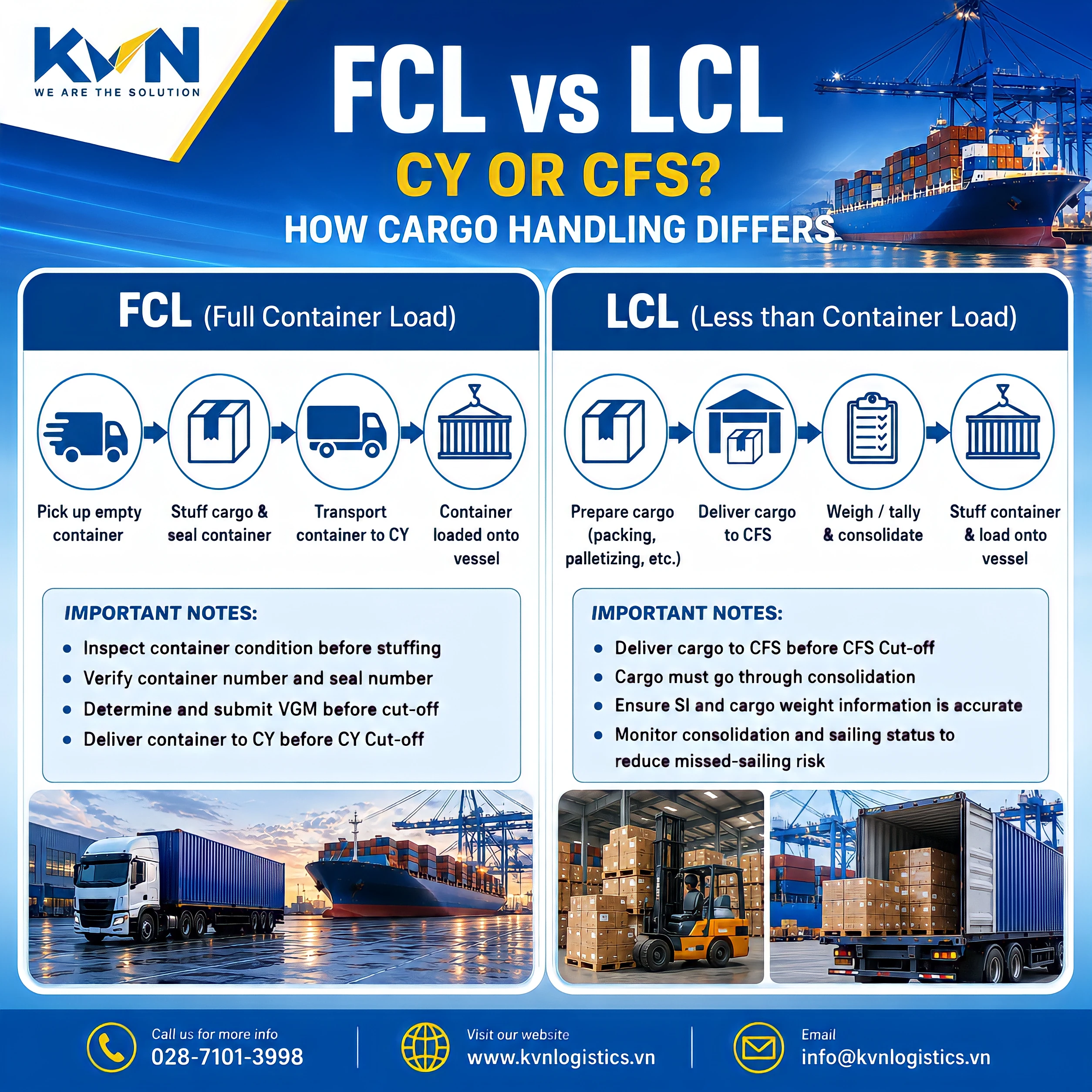
FCL vs LCL: How Does the Booking Process Differ?
| Area | FCL | LCL |
|---|---|---|
| Container Use | Dedicated container for the shipment | Multiple shipments share one container |
| Main Origin Facility | CY / terminal | CFS / consolidation warehouse |
| Critical Cargo Deadline | CY cut-off | CFS / cargo cut-off |
| VGM | Required for the packed container | Managed at consol-container level by the responsible party |
| Stuffing | Factory, warehouse or designated facility | CFS / consolidation warehouse |
| Handling Stages | Generally fewer | Additional consolidation/deconsolidation |
| Main Sailing Risk | Missed CY, documentation or VGM deadline | Missed CFS, consol box or documentation deadline |
| Typical Charges | Container and terminal-related charges | CFS, handling and consolidation charges |
For smaller but recurring shipments, businesses do not necessarily need to wait until there is enough cargo for a full container.
Master Consolidation or Direct Consol can provide a structured approach to smaller shipments based on cargo-ready dates and purchase-order schedules.
Example: FCL Export Booking From Vietnam
Assume a manufacturer in Ninh Binh needs to export 1 × 40HC to Europe.
The planned vessel ETD is Friday.
However, the Booking Confirmation shows:
SI Cut-Off: Wednesday
VGM Cut-Off: Thursday
CY Cut-Off: Thursday
ETD: Friday
The manufacturer cannot wait until Friday to complete the shipment.
The operational plan may instead look like this:
Monday: Complete cargo and documentation
Tuesday: Pick up the empty container
Wednesday: Stuff and seal the container; submit SI
Wednesday/Thursday: Complete VGM and customs procedures
Thursday: Gate in before CY cut-off
Friday: Monitor loading and vessel departure
If the container misses the Thursday CY cut-off, it may still miss the vessel even though the vessel itself does not depart until Friday.
The fundamental planning principle is:
Build the shipment timeline backward from the cut-offs — not forward from the ETD.
Connect Sea Freight Booking With Door-to-Door Logistics
For manufacturing companies, a sea freight booking is only one part of the total shipment.
A complete transport chain may look like:
Factory → Inland Trucking → Container → Export Customs → Port → Sea Freight → Import Customs → Destination Trucking → Customer
If every stage is managed independently, a change to the vessel booking can trigger problems across the supply chain:
- trucking must be rescheduled;
- factory loading plans change;
- documents require amendment;
- warehouse appointments move;
- consignee receiving schedules change.
This is why integrated logistics planning becomes important for manufacturers.
KVN Logistics’ guide to Door-to-Door Logistics for Manufacturing Companies explains how factory pickup, inland trucking, customs clearance, international freight, warehousing and final delivery can be coordinated under one operating plan.
Frequently Asked Questions About the Sea Freight Booking Process
What is a sea freight booking?
A sea freight booking is the process of reserving cargo space with an ocean carrier, either directly or through a freight forwarder, for a specific routing or sailing.
Once the booking is accepted, the shipper receives a Booking Confirmation containing operational information and applicable deadlines.
What is a Booking Note?
A Booking Note or Booking Confirmation is the document confirming the shipping arrangement.
It may include the booking number, vessel/voyage, routing, equipment, ETD, empty-container instructions and relevant cut-offs.
What does cut-off mean in sea freight?
A cut-off is a deadline by which a particular shipping requirement must be completed.
A single booking may include separate CY, CFS, SI, VGM and documentation cut-offs.
What is the difference between CY cut-off and CFS cut-off?
CY cut-off generally applies to the deadline for delivering an FCL container to the designated terminal or container yard.
CFS cut-off generally applies to the deadline for delivering LCL cargo to the consolidation facility.
What is SI in shipping?
SI stands for Shipping Instruction.
It contains the information used by the carrier or freight forwarder to prepare the transport documentation and Bill of Lading.
What is VGM?
VGM stands for Verified Gross Mass.
It is the verified gross weight of a packed container. Under SOLAS, verified gross mass is a condition for loading a packed container onto a ship.
Does gate-in mean the container is definitely on board?
No.
Gate-in means the terminal has accepted the container.
The shipment may still be affected by customs status, documentation issues, operational changes, vessel capacity or rolling.
What does “rolled” mean in shipping?
A shipment is rolled when it does not move on the originally planned vessel or voyage and is transferred to a later sailing or another service.
If the vessel is delayed, will the cut-off automatically be extended?
Not necessarily.
Some cut-offs may remain unchanged even when the vessel’s ETD is delayed. Shippers should reconfirm the latest deadlines with the carrier or forwarder.
How early should a business book sea freight?
There is no universal booking lead time.
The appropriate timing depends on:
- trade lane;
- season;
- vessel capacity;
- container availability;
- cargo type;
- destination;
- shipment urgency;
- carrier conditions.
For peak-season or production-critical cargo, businesses should normally plan earlier and identify at least one backup sailing.
KVN Logistics: From Sea Freight Booking to Trucking and Documentation
A successful sea freight booking is not simply about obtaining space on a vessel.
The shipment needs to move through the entire sequence:
Cargo Ready → Booking → Cut-Off → Customs → CY/CFS → On Board → Delivery
KVN Logistics focuses on integrated capabilities across Sea Freight, Inland Trucking and Customs & Documentation, allowing the shipping schedule to be coordinated with container operations, inland transportation and import-export documentation. Its English service pages currently position Sea Freight across FCL, LCL, Master Consolidation, Bulk Cargo and Project Cargo, with Inland Trucking connecting factories, warehouses and ports across Vietnam.
For each shipment, the appropriate solution may involve evaluating:
- FCL versus LCL;
- container type;
- sailing schedule;
- routing;
- cut-offs;
- inland trucking;
- customs documentation;
- local charges;
- Master Consolidation;
- Door-to-Door requirements;
- contingency plans for schedule changes.
Instead of asking only:
“Which booking has the lowest freight rate?”
businesses should ask:
“Which booking provides the best balance of cost, cut-off feasibility, transit time, schedule reliability and delivery requirements?”
That is the basis of effective sea freight planning — from the moment the cargo becomes ready until the shipment is actually confirmed on board.
KVN LOGISTICS – WE ARE THE SOLUTION