

In import and export operations, many businesses often focus mainly on international freight rates while overlooking the fact that total logistics cost is not limited to ocean freight, air freight or trucking fees. In reality, a shipment may involve many additional charges such as THC, CIC, D/O fee, local charges, storage, demurrage, detention, peak season surcharge and other port handling costs.
These are the hidden logistics surcharges that often cause unexpected cost increases after cargo has arrived at the port or during the customs clearance and delivery process. Understanding each type of logistics surcharge helps businesses estimate costs more accurately, control budgets and reduce unexpected expenses.
What are logistics surcharges?
Logistics surcharges are additional costs charged on top of the main freight cost. They may arise during transportation, cargo handling, warehousing, documentation, customs clearance, container use and cargo delivery.
These charges may be collected by:
- Shipping lines
- Airlines
- Seaports
- Container depots
- CFS warehouses
- Freight forwarders
- Inland trucking providers
- Local agents at origin or destination
For import and export shipments, logistics surcharges are often shown in quotations as local charges, meaning charges incurred locally at the origin or destination.
One important point for businesses to remember is: a low freight rate does not always mean the most cost-effective logistics solution. Without checking all related surcharges carefully, the final total logistics cost may be much higher than expected.
Common logistics surcharges businesses should know
1. What is THC?
THC stands for Terminal Handling Charge. It refers to the handling fee charged by the port or terminal.
This charge covers activities such as:
- Loading containers onto the vessel or unloading containers from the vessel
- Moving containers within the port area
- Stacking containers at the yard
- Operating terminal handling equipment
In ocean freight, THC usually appears at both ends of the shipment:
- Origin THC: terminal handling charge at the port of loading
- Destination THC: terminal handling charge at the port of discharge
For example, when a business exports cargo from Vietnam to the United States, THC may be charged at Cat Lai Port or Hai Phong Port. When the cargo arrives at the destination port, the consignee may also need to pay destination THC depending on the Incoterms and the shipping line’s policy.
Why is THC often overlooked?
Many businesses focus only on ocean freight and do not carefully review the local charges. However, THC is almost always applied to containerized shipments. If not calculated in advance, it may cause budget deviations, especially for shipments involving a large number of containers.
2. What is CIC?
CIC stands for Container Imbalance Charge. It is commonly understood as a surcharge caused by the imbalance of empty containers between different regions.
CIC is applied by shipping lines when there is an imbalance in the supply and demand of empty containers. For example, a country that imports much more than it exports may have a surplus of empty containers. On the other hand, a strong export market may face a shortage of empty containers for loading cargo. Shipping lines must reposition containers between regions, and this cost may be reflected in CIC.
When does CIC usually occur?
CIC may arise in situations such as:
- Shortage of empty containers on certain trade lanes
- Peak export seasons
- Trade imbalance between two regions
- Lack of suitable containers at ports or depots
- Shipping lines needing to reposition containers from other locations
For exporters, CIC can significantly increase total logistics costs, especially on high-demand routes such as Asia – United States, Asia – Europe, Vietnam – India or Vietnam – Middle East during certain periods.
3. What is the D/O fee?
D/O stands for Delivery Order.
The D/O fee is the charge businesses pay to receive the delivery order from the shipping line or its agent. This document is then used to complete the process of collecting cargo from the port or warehouse.
For import shipments, the D/O is a very important document. Without the D/O, the consignee cannot complete the cargo release process, even if the shipment has already arrived at the port.
What does the D/O fee cover?
The D/O fee is usually related to:
- Import documentation handling
- Issuance of the delivery order
- Verification of bill of lading information
- Confirmation of the consignee’s right to receive the cargo
- Coordination with the port, warehouse or depot for cargo release
The D/O fee may vary depending on the shipping line, trade lane, cargo type and agent policy at each point in time.
4. What are local charges?
Local charges are local costs incurred at the origin port or destination port. This is one of the most important cost categories in a logistics quotation because local charges can have a major impact on the final logistics cost.
Common local charges include:
- THC
- D/O fee
- CFS fee for LCL shipments
- Documentation fee
- Seal fee
- Telex release fee
- AMS, ACI or ENS fee depending on the market
- Handling fee
- Cleaning fee
- Lift on/lift off fee
- Container maintenance fee
When receiving a quotation from a freight forwarder or shipping line, businesses should request a clear breakdown of:
- Main freight cost
- Origin local charges
- Destination local charges
- Possible surcharges
- Quotation validity period
- Applicable conditions
This helps businesses avoid comparing quotations incorrectly. A quotation with low freight but high local charges may not be more cost-effective than another quotation with slightly higher freight but more transparent and stable total costs.
5. What is storage?
Storage charge is a warehousing or yard storage fee charged when cargo or containers remain at the port, warehouse or terminal beyond the allowed free period.
Storage often occurs when:
- Customs clearance has not been completed
- Documents are missing or incorrect
- The consignee has not completed payment
- The shipment is subject to inspection or specialized checking
- Trucking arrangements are delayed
- The receiving warehouse is not ready
For import shipments, storage can increase quickly day by day if documents and delivery plans are not handled on time.
What is the difference between storage and demurrage?
Storage is a charge for keeping cargo or containers at the port or warehouse. Demurrage, on the other hand, is usually related to containers remaining at the port beyond the free time allowed by the shipping line.
These two charges may occur at the same time if the container stays at the port for too long and also exceeds the shipping line’s free time.
6. What is demurrage?
Demurrage is the charge applied when a container remains at the port after the shipping line’s free time has expired.
For example, a shipping line gives the consignee 5 free days at the destination port. If the container is not picked up after 5 days, demurrage may start from the 6th day.
Demurrage often occurs due to:
- Delayed customs clearance
- Late receipt of original documents
- Payment disputes between buyer and seller
- Specialized inspection requirements
- The consignee being unable to arrange trucking on time
- Cargo arriving during holidays or long weekends
Demurrage is one of the most costly logistics surcharges because it can increase day by day and container by container.
7. What is detention?
Detention is the charge applied when a container is kept outside the port beyond the free period allowed by the shipping line.
If demurrage applies when the container is still inside the port, detention usually applies after the container has been picked up from the port but has not been returned empty to the depot on time.
For example, a business imports one container and moves it to its warehouse for unloading. The shipping line allows 7 free days for container use outside the port. If the empty container is returned on the 10th day, the business may have to pay detention for the 3 extra days.
Detention may occur when:
- Warehouse unloading is delayed
- There is not enough labor for cargo handling
- Trucking is not arranged in time
- Cargo requires special checking or processing
- The depot is overloaded
- Container damage needs to be inspected or confirmed
8. What is Peak Season Surcharge?
Peak Season Surcharge, often abbreviated as PSS, is a surcharge applied during high-demand shipping periods.
Shipping lines or airlines may apply PSS when transportation demand increases significantly and available capacity becomes tight. This surcharge often appears during periods such as:
- Before Lunar New Year
- Before Christmas and New Year
- Peak export seasons for garments, furniture and electronics
- Periods of container shortage or vessel space shortage
- Major market disruptions affecting shipping supply and demand
PSS may change quickly by week or by sailing schedule. Therefore, businesses should always check quotation validity and secure bookings early during peak season.
Why do businesses often face unexpected logistics surcharges?
There are several reasons why businesses face extra logistics costs beyond their original estimates. The most common reasons include:
1. Only comparing the main freight rate
Many businesses choose a logistics provider based only on the lowest freight rate. However, without reviewing local charges and related surcharges, the final total cost may not actually be cheaper.
2. Not understanding Incoterms clearly
Incoterms directly affect the cost responsibilities of the buyer and seller. For example, under FOB, CIF, EXW or DDP, each party is responsible for different cost items.
Without a clear understanding of Incoterms, businesses may misunderstand who should pay local charges, origin fees, destination fees or inland delivery costs.
3. Documents are not ready
Errors in the bill of lading, invoice, packing list, certificate of origin or specialized documents may delay customs clearance. When cargo stays at the port longer than expected, storage, demurrage and detention may arise.
4. Free time is not monitored properly
Free time is the period during which containers can remain at the port or outside the port without extra charges. If businesses do not track this deadline carefully, charges can increase quickly after free time expires.
5. Trucking and warehouse plans are not well coordinated
Even after cargo has cleared customs, extra charges may still arise if there is no truck available, the warehouse is not ready to receive the cargo, or there is not enough labor for unloading.
How businesses can optimize logistics costs
1. Request a detailed quotation with clear cost breakdown
Businesses should ask freight forwarders or shipping lines to provide detailed quotations, including:
- Ocean freight or air freight
- Origin local charges
- Destination local charges
- Documentation fees
- Handling fees
- Trucking fees
- Customs clearance fees
- Possible surcharges
- Free time at port and outside port
- Quotation validity period
The more transparent the quotation is, the easier it is for businesses to control logistics costs.
2. Compare total logistics cost, not just freight
When evaluating multiple quotations, businesses should calculate the total logistics cost instead of focusing only on the main freight rate.
A good quotation should balance:
- Freight rate
- Sailing schedule
- Transit time
- Booking stability
- Local charges
- Free time
- Documentation support
- Ability to handle unexpected issues
3. Check free time carefully before booking
Free time is especially important for import shipments, cargo requiring specialized inspection or shipments that need to be unloaded at a private warehouse.
Businesses should clarify:
- How many free demurrage days are included?
- How many free detention days are included?
- Is additional free time available?
- What tariff applies after free time?
- Are weekends and public holidays counted in free time?
4. Prepare documents before cargo arrival
To avoid storage, demurrage and detention, businesses should prepare key documents early, such as:
- Sales contract
- Commercial invoice
- Packing list
- Bill of lading
- Certificate of origin, if applicable
- Import license, if required
- Specialized inspection documents
- Payment information and delivery order requirements
For import shipments, documents should be checked before the vessel arrives instead of waiting until the cargo reaches the port.
5. Work with a freight forwarder with real operational capability
A reliable freight forwarder does more than provide a freight quotation. It helps businesses control the entire logistics process, from booking, documentation and customs clearance to trucking and issue resolution.
For urgent shipments, peak season cargo or cost-sensitive shipments, businesses should work with a provider that can:
- Recommend suitable shipping routes
- Warn about possible surcharges in advance
- Track vessel schedules and cargo arrival
- Coordinate documentation
- Arrange trucking and warehouse delivery on time
- Support free time extension when necessary
- Provide transparent cost breakdowns from the beginning
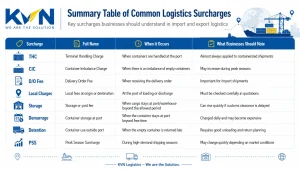
Summary table of common logistics surcharges
Frequently asked questions about logistics surcharges
Are logistics surcharges mandatory?
Yes. If the surcharge is applied according to the tariff of the shipping line, port, warehouse or logistics provider, the business must pay it to continue the transportation, cargo release or container return process.
Are THC and local charges the same?
Not exactly. THC is a specific type of charge within the broader group of local charges. Local charges include many local cost items such as THC, D/O fee, documentation fee, CFS fee, handling fee and other related charges.
What is the difference between demurrage and detention?
Demurrage is charged when a container stays inside the port beyond the free time. Detention is charged when a container is kept outside the port beyond the free time. Both charges may occur if the business does not control cargo pickup, unloading and empty container return properly.
Is Peak Season Surcharge fixed?
No. Peak Season Surcharge may change depending on the period, shipping route, shipping line or airline. Businesses should confirm this surcharge again before making a booking.
How can businesses avoid unexpected logistics surcharges?
Businesses should request transparent quotations, check free time carefully, prepare documents early, monitor vessel schedules, arrange trucking on time and work with an experienced freight forwarder.
KVN Logistics helps businesses control logistics costs
In a market where international freight costs continue to fluctuate, understanding and controlling logistics surcharges is essential for businesses that want to optimize import and export budgets.
KVN Logistics provides comprehensive logistics solutions for businesses, including:
- FCL and LCL ocean freight
- Consolidation cargo
- Air freight
- Customs clearance
- Inland trucking
- Import and export documentation consulting
- Route optimization
- Local charges and surcharge control
With experience in handling multiple international trade lanes, KVN Logistics helps businesses build logistics plans that are transparent, cost-effective and suitable for each cargo type, market and delivery condition.
KVN Logistics – We are the Solution.