

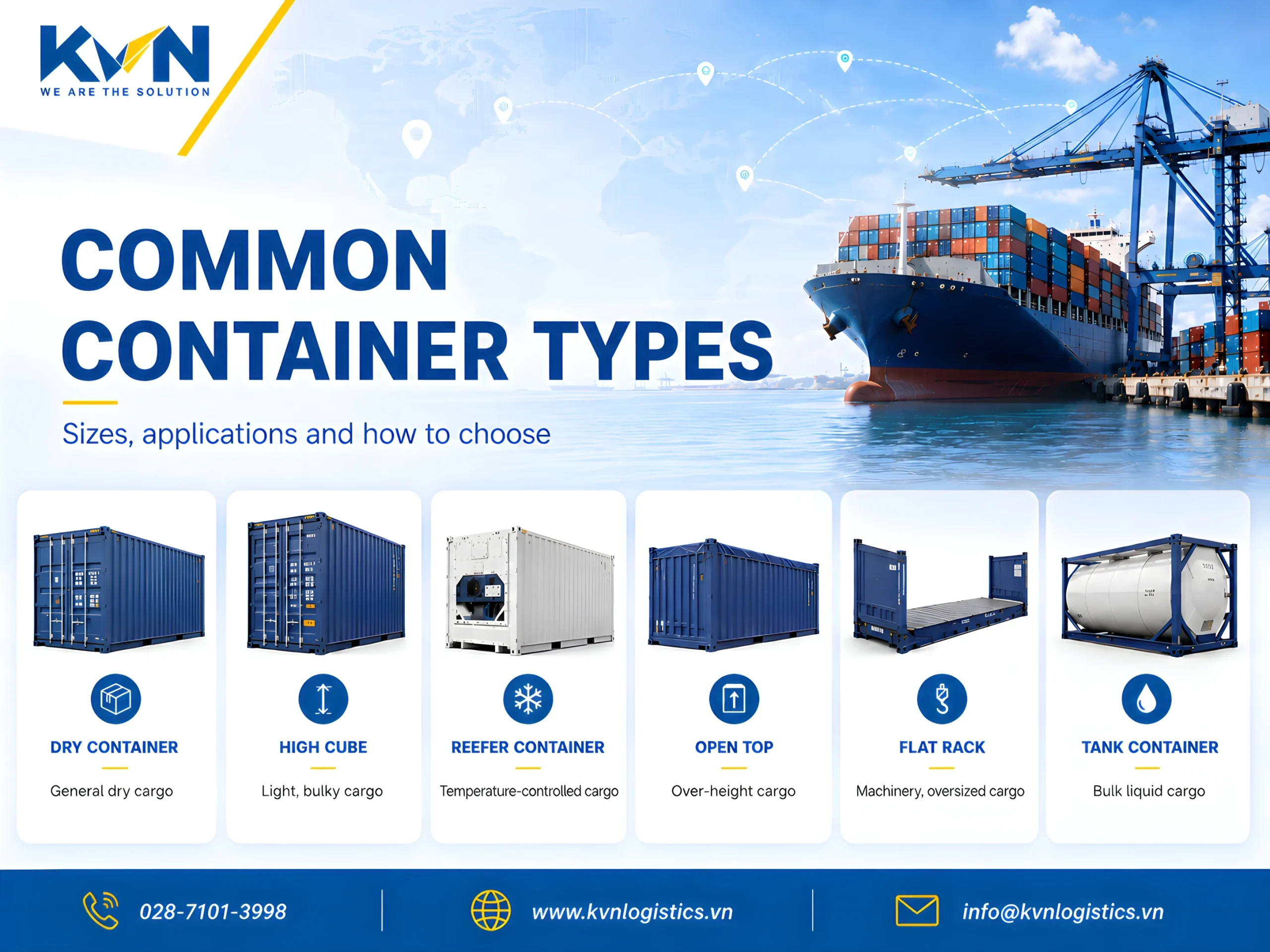
Shipping containers are not limited to standard 20-foot and 40-foot units. Depending on cargo dimensions, weight, storage requirements and loading method, a shipment may require a Dry Container, High Cube Container, Reefer Container, Open Top Container, Flat Rack or Tank Container.
As a quick rule of thumb, standard dry cargo generally moves in Dry Containers; lightweight but bulky cargo often benefits from a 40HC; temperature-sensitive cargo requires Reefer equipment; over-height cargo or cargo that must be loaded from above may require an Open Top; oversized machinery may need a Flat Rack; and bulk liquids are generally transported in suitable Tank Containers. Container specifications and acceptance requirements vary by carrier, equipment series and trade lane, so final equipment details should always be confirmed before loading.
Choosing the wrong container can waste usable space, create loading problems, trigger booking amendments or turn what was expected to be standard cargo into an Out-of-Gauge shipment. Selecting the right equipment should therefore be part of shipment planning from the beginning, particularly for FCL Sea Freight. KVN Logistics currently provides ocean freight solutions for FCL, LCL, bulk cargo and project cargo.
Quick Comparison of Common Shipping Container Types
The dimensions below are approximate internal dimensions based mainly on technical specifications published by CMA CGM. Actual dimensions, tare weight and payload may vary depending on container manufacturer, series and carrier equipment.
| Container Type | Approx. Internal Dimensions | Best Suited For |
|---|---|---|
| 20ft Dry / 20DC | 5.90 × 2.35 × 2.39 m | Dry cargo, dense and relatively heavy cargo |
| 40ft Dry / 40DC | 12.03 × 2.35 × 2.40 m | Higher-volume general dry cargo |
| 40ft High Cube / 40HC | 12.03 × 2.35 × 2.70 m | Lightweight, bulky or taller cargo |
| 20ft Open Top | 5.90 × 2.35 × 2.35 m | Machinery and over-height cargo |
| 40ft Open Top | 12.03 × 2.35 × 2.35 m | Long or over-height equipment |
| 20ft Reefer | 5.46 × 2.29 × 2.27 m | Temperature-controlled cargo |
| 40ft HC Reefer | 11.58 × 2.29 × 2.56 m | Larger-volume refrigerated cargo |
| 20/40ft Flat Rack | Open-sided platform configuration | Machinery and Out-of-Gauge cargo |
| Tank Container | Usually ISO-frame equipment | Bulk liquids and suitable chemical or food-grade products |
CMA CGM publishes nominal capacities of approximately 33.2 m³ for a 20ft Standard, 67.8 m³ for a 40ft Standard and 76.4 m³ for a 40ft High Cube. These figures represent nominal container volume; actual usable space depends on package dimensions, pallet configuration, stacking pattern and cargo securing requirements.
1. 20ft Dry Container – A Practical Choice for Dry and Dense Cargo
The 20ft Dry Container, commonly referred to as a 20DC or 20GP, is one of the most widely used container types in international sea freight.
CMA CGM lists approximate internal dimensions of 5.90 m long × 2.35 m wide × 2.39 m high, with a nominal capacity of approximately 33.2 m³.
A 20DC can accommodate cartons, bags, pallets, cases, drums and many other types of general dry cargo. It is particularly useful when cargo has relatively high density and reaches its weight limit before filling the entire available cubic capacity.
Typical applications may include industrial raw materials, plastic resins, spare parts, metal products, bagged commodities and compact machinery.
One important point is that container selection should not be based on CBM alone. Cargo weight, floor loading, package dimensions, road weight restrictions and the payload of the specific container must also be checked before booking.
For example, CMA CGM lists a maximum payload of approximately 28.25 tonnes for its reference 20ft Standard equipment, while Maersk publishes around 28.3 tonnes for a standard 20ft steel container. Actual limits remain equipment- and country-dependent.
2. 40ft Dry Container – More Space for Higher-Volume Cargo
A 40ft Dry Container or 40DC provides nearly twice the internal length of a standard 20ft unit while maintaining broadly similar width and standard height.
Reference internal dimensions are approximately 12.03 × 2.35 × 2.40 m, with nominal capacity around 67.8 m³.
This makes the 40DC suitable when volume rather than cargo weight is the main constraint.
Common cargo may include finished manufactured products, packaging materials, palletized goods, consumer products, industrial components and certain machinery shipments.
However, a common misconception is that a 40ft container can carry twice the cargo weight of a 20ft container.
That is not the case.
CMA CGM’s reference specifications show a maximum payload of approximately 28.25 tonnes for a 20ft Standard and around 26.76–28.78 tonnes for different 40ft Standard units. Maersk similarly publishes payload limits in roughly the same range.
In other words, a 40ft container primarily provides additional cubic capacity rather than double the weight capacity.
3. 40ft High Cube – Ideal for Lightweight but Bulky Cargo
A 40ft High Cube Container, or 40HC, has approximately the same length and width as a 40DC but provides additional internal height.
According to CMA CGM’s reference specifications, internal height increases from approximately 2.395 m in a 40ft Standard to 2.70 m in a 40HC, increasing nominal capacity from around 67.8 m³ to 76.4 m³.
This extra height is particularly valuable for cargo that cubes out before it weighs out — meaning the shipment fills the available volume before reaching the container’s maximum payload.
Typical examples include packaging products, finished FIBC or bulk bags, textiles, furniture, plastic products, lightweight cartons and taller palletized cargo. Maersk similarly describes 40HC equipment as well suited to lighter cargo that benefits from additional cubic capacity.
This is especially relevant for packaging cargo. KVN Logistics has previously highlighted that products such as FIBC bags are often lightweight but bulky, meaning container utilization and loading configuration can significantly affect logistics cost per unit. See: Shipping Packaging and FIBC Cargo to the USA: Booking, Container Loading and Export Documents.
Therefore, when comparing 40DC vs. 40HC, businesses should look beyond the difference in freight rate. If a 40HC allows more units to be loaded per shipment, the logistics cost per product may ultimately be lower.
4. Reefer Container – For Temperature-Controlled Cargo
A Reefer Container, or refrigerated container, is designed to maintain controlled environmental conditions during transportation.
It is not simply a standard container with an air-conditioning unit. Reefer equipment integrates insulation, refrigeration technology and controlled airflow, while certain systems may also manage humidity, fresh-air exchange or atmospheric conditions depending on the cargo.
CMA CGM lists Reefer configurations including 20ft, 40ft High Cube and 45ft units. Reference internal dimensions include:
20ft Reefer: approximately 5.456 × 2.294 × 2.273 m
40ft HC Reefer: approximately 11.584 × 2.294 × 2.557 m.
The internal space is smaller than that of equivalent Dry Containers because the walls, insulation and refrigeration equipment occupy additional space.
Reefers are commonly used for food products, fruit and vegetables, seafood, pharmaceuticals and other temperature-sensitive products. CMA CGM states that Reefer settings can involve temperature, humidity, fresh-air exchange and controlled atmosphere depending on cargo requirements.
The temperature capability also varies by equipment. Hapag-Lloyd, for example, states that its Reefer fleet can maintain temperatures between approximately -35°C and +30°C, while other specialized equipment can operate outside that range.
For that reason, businesses should not simply book a “Reefer container” and assume one temperature setting works for every product. Set point, ventilation, humidity, pre-cooling requirements and loading configuration should be determined according to the specific cargo. Hapag-Lloyd also advises shippers to ensure the correct carrying temperature, humidity and ventilation settings before transport.
5. Open Top Container – For Over-Height or Top-Loaded Cargo
An Open Top Container is similar to a standard dry container but does not have a permanently rigid steel roof. Depending on the equipment design, the top may use removable roof bows and a tarpaulin cover.
This configuration allows cargo to be lowered into the container from above using a crane when loading through the rear doors is impractical.
CMA CGM publishes reference internal dimensions of approximately:
20ft Open Top: 5.898 × 2.352 × 2.348 m
40ft Open Top: 12.032 × 2.352 × 2.348 m.
Open Top containers are commonly considered for industrial machinery, tall equipment, heavy finished products and cargo that requires overhead lifting.
A key distinction is whether the cargo is In-Gauge (IG) or Out-of-Gauge (OOG).
If the cargo extends beyond the equipment’s permitted dimensional envelope, it must be declared accordingly. Maersk notes that accurate dimensions, gross weight, packing configuration and lashing-related protrusions are important when planning OOG shipments because dimensional discrepancies can affect terminal handling, stowage and even cargo acceptance.
6. Flat Rack Container – For Machinery and Out-of-Gauge Cargo
A Flat Rack Container is designed for cargo that cannot be accommodated within the side walls of a conventional container.
Unlike a Dry Container, a Flat Rack has an open-sided structure, typically with end walls or collapsible ends. This allows cargo to extend beyond the normal width or height of standard equipment when approved as OOG cargo.
Flat Racks are commonly used for:
- Heavy industrial machinery
- Energy equipment
- Steel structures
- Construction equipment
- Vehicles
- Plant components
- Large modules and other OOG cargo
CMA CGM lists reference maximum payloads of approximately 31.25 tonnes for certain 20ft Flat Rack equipment and up to 47.4 tonnes for certain 40ft units. These are equipment references rather than universal loading limits; terminal acceptance, road transportation and individual container specifications must still be checked.
For machinery and project cargo, dimensions and weight alone may not be sufficient. Forwarders and carriers may also need information such as centre of gravity, lifting points, packing drawings, cargo photos, lashing requirements and proposed handling methods before confirming the transportation plan.
For shipments beyond standard container capabilities, businesses can explore KVN ProjectCargo – Heavy Lift & Project Cargo Transportation Service. KVN ProjectCargo focuses on project-based transportation involving cargo assessment, route planning, port conditions, specialized equipment and operational coordination.
7. Tank Container – For Bulk Liquids
A Tank Container consists of a specialized tank mounted within an ISO container framework and is designed for the transportation of suitable liquid cargo.
Depending on specification and certification, Tank Containers can be used for liquid chemicals, food-grade liquids, industrial materials and other compatible bulk products. CMA CGM describes Tank Containers as equipment for hazardous or non-hazardous liquids, while Maersk lists 20ft and 40ft shipper-owned tank containers among the equipment it can carry.
Unlike standard Dry Containers, Tank Container selection cannot be based on volume alone.
Shippers may need to verify:
- Commodity characteristics
- Dangerous Goods classification, where applicable
- Tank specification and material compatibility
- Cleaning requirements
- Previous cargo requirements
- Operating pressure
- Required certificates and technical documentation
These conditions should be confirmed with the carrier and relevant technical parties before booking.
20ft vs. 40ft vs. 40HC: Which One Should You Choose?
For dense, relatively heavy cargo that does not require much cubic space, a 20DC is often a practical starting point.
For general dry cargo requiring significantly more volume, a 40DC may be more suitable.
For lightweight or bulky products that fill the container before reaching its weight limit, a 40HC is usually worth considering. This distinction is consistent with carrier guidance: Maersk describes 40ft containers as suitable for more voluminous cargo and 40HC equipment as particularly useful for lighter cargo requiring additional space.
However, businesses should avoid selecting equipment simply because the shipment has a certain total CBM.
The calculation should also include:
Package dimensions + gross weight + pallet arrangement + stacking restrictions + door opening + payload + loading method.
That combination provides a much more realistic basis for equipment selection than CBM alone.
Open Top vs. Flat Rack: How Do You Decide?
If the cargo mainly exceeds standard height or needs to be lifted vertically into the container, an Open Top is usually one of the first options to assess.
If the shipment exceeds width, is oversized in several directions or requires an open platform for securing, a Flat Rack may be more appropriate.
CMA CGM specifically uses Open Top and Flat Rack equipment for OOG solutions where cargo dimensions exceed standard container limits.
If neither Open Top nor Flat Rack can safely or operationally accommodate the shipment, the cargo may need to move as Breakbulk or Project Cargo.
This approach is also relevant for manufacturing companies, where machinery logistics may combine container selection, specialized lifting, trucking and final delivery within a broader Door-to-Door Logistics solution.
Five Factors to Check Before Choosing a Container
Before requesting a booking, businesses should prepare five core pieces of cargo information:
- Commodity and cargo characteristics
- Packed dimensions: L × W × H
- Gross weight per package and total shipment weight
- Number of packages, crates or pallets
- Any special temperature, lifting, securing or handling requirements
For machinery and OOG cargo, additional information such as drawings, centre of gravity, lifting points and cargo photographs can significantly improve the accuracy of equipment and route assessment. Accurate declaration is particularly important for OOG cargo because changes in dimensions or securing materials can affect carrier stowage planning.
With this information, a freight forwarder can evaluate not only whether the cargo physically fits but also equipment availability, handling requirements, inland transport feasibility and overall logistics cost.
Container Selection Must Also Consider Inland Transportation
A container that works for the ocean leg may not automatically work for the entire door-to-door journey.
The shipment may still be affected by total truck height, road weight limits, factory access, turning radius, loading equipment, delivery restrictions and local operating conditions.
This is especially important for Flat Rack, Open Top and heavy machinery shipments.
Sea Freight and domestic trucking should therefore be planned as connected stages rather than completely separate bookings. KVN Logistics’ Inland Trucking solutions connect ports, factories and warehouses across Vietnam and also include dedicated arrangements for heavy equipment and project cargo.
The Right Container Can Improve Both Cost and Operational Efficiency
Container type directly affects loading efficiency, equipment availability, handling requirements, trucking arrangements and total logistics cost.
A lightweight shipment may achieve better utilization with a 40HC. A compact but dense shipment may be better suited to a 20DC. Tall machinery may require an Open Top, while equipment exceeding standard width may need a Flat Rack. Temperature-sensitive cargo should not be placed into a standard Dry Container simply because the freight rate appears lower.
The better question is therefore not:
“Which container is the cheapest?”
It is:
“Which container best matches the cargo dimensions, weight, characteristics and complete transportation journey?”
That change in perspective helps businesses optimize not only ocean freight but the shipment as a whole.
KVN Logistics – Container Selection and Sea Freight Solutions for Each Shipment
KVN Logistics provides Sea Freight solutions covering FCL, LCL, Master Consolidation, Bulk Cargo and Project Cargo, allowing businesses to select different transportation structures according to shipment volume and cargo characteristics.
For containerized shipments, KVN Logistics can assess cargo volume, weight, packing configuration, route requirements and operational conditions before determining an appropriate equipment and booking solution.
For specialized machinery or oversized equipment, businesses can explore KVN ProjectCargo. For factory-to-port or port-to-factory transportation, the shipment can be integrated with KVN Inland Trucking. Import-export procedures and shipment documentation can also be coordinated through KVN Customs & Docs.
KVN Logistics – We are the Solution.
Frequently Asked Questions About Shipping Container Types
How much cargo can a 20ft container hold?
A standard 20ft Dry Container has a nominal capacity of approximately 33.2 m³ according to CMA CGM’s reference specifications. Actual usable volume is usually lower because package dimensions, pallets, stacking patterns and required clearance affect how much cargo can physically be loaded.
What is the difference between a 40ft container and a 40HC?
A 40ft Standard and a 40HC have broadly similar length and width, but the 40HC provides additional internal height. CMA CGM lists approximately 2.395 m internal height and 67.8 m³ capacity for a 40ft Standard, compared with approximately 2.70 m and 76.4 m³ for a 40HC.
Should machinery be shipped in an Open Top or Flat Rack?
An Open Top is often suitable when the cargo primarily exceeds standard height or needs to be loaded from above. A Flat Rack is generally more suitable when machinery exceeds standard width, is oversized in multiple directions or requires an open platform for securing. The final choice depends on the actual dimensions, weight and handling requirements.
Can a 40ft container carry twice the weight of a 20ft container?
No. A 40ft container offers nearly twice the nominal cubic capacity, but maximum payload does not increase proportionally. Carrier reference specifications place standard 20ft and 40ft container payloads within broadly similar ranges.
Are container dimensions exactly the same across all shipping lines?
Not necessarily. Container dimensions and technical specifications follow common industry standards, but exact internal dimensions, tare weight, payload and equipment configuration can vary by manufacturer and container series. Hapag-Lloyd explicitly notes that published specifications are examples and individual containers may differ.
Which container is best for lightweight but bulky cargo?
A 40ft High Cube is often a strong option because it provides additional cubic capacity without substantially changing the container footprint. This makes it especially suitable for cargo such as packaging, textiles, furniture and other products that reach their volume limit before their weight limit.
References
- CMA CGM – Containers: technical specifications for Dry, High Cube, Open Top, Flat Rack and Tank Containers.
- CMA CGM – Reefer Container Shipping Solutions: Reefer specifications and temperature-controlled cargo requirements.
- Maersk – Container Types and Sizes / Special Cargo: equipment types, cargo weight limits and OOG shipment guidance.
- Hapag-Lloyd – Reefer Cargo & Container Fleet: Reefer operating ranges and equipment specification guidance.