

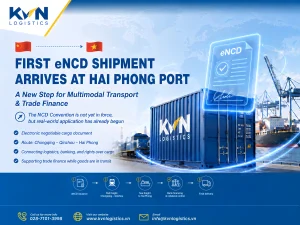
On May 13, 2026, a Negotiable Cargo Document, commonly referred to as an NCD, was issued for a shipment transported from Chongqing, China, to Hai Phong, Vietnam.
The significance of the shipment extended beyond its combined rail and sea journey. An electronic Negotiable Cargo Document, or eNCD, was reportedly used to establish control over the cargo, facilitate the transfer of rights, support the pledging of the document, and enable bank financing while the goods were still in transit.
The transaction took place before the United Nations Convention on Negotiable Cargo Documents was opened for signature or entered into force.
This development suggests that practical innovation in logistics, digital trade, and supply chain finance may be progressing faster than the corresponding international legal framework.
Key Takeaways
- An NCD is a negotiable document that may represent rights over goods while they are being transported.
- It can be issued in paper or electronic form.
- It is designed for sea, rail, road, air, and multimodal transport.
- Transferring an NCD may also transfer certain rights relating to the underlying cargo.
- An eNCD may support trade finance and the management of cargo used as collateral.
- As of July 2026, the United Nations NCD Convention has been adopted but has not yet entered into force.
- The eNCD shipment from Chongqing to Hai Phong represents a notable real-world application involving Vietnam.
What Is a Negotiable Cargo Document?
NCD stands for Negotiable Cargo Document.
It is a new type of document designed to represent rights over goods while those goods are being transported, regardless of the mode of transport used.
Under the framework established by the United Nations Convention on Negotiable Cargo Documents, an NCD may potentially be used for:
- Sea freight;
- Rail freight;
- Road transportation;
- Air freight;
- Single-mode transportation;
- Multimodal transportation;
- Paper-based documentation;
- Electronic documentation through an eNCD.
The central concept is that the lawful holder of an NCD may exercise the rights incorporated in the document.
When an NCD is properly transferred, rights associated with the goods may also be transferred to the new lawful holder.
Under the Convention framework, transferring an NCD may have legal effects comparable to the physical delivery of the goods for the purpose of transferring rights over the cargo. The lawful holder may also be entitled to demand delivery of the goods at the destination.
Why Does International Trade Need an NCD?
In maritime transportation, a negotiable Bill of Lading has traditionally performed three major functions:
- It confirms that the carrier has received the goods;
- It provides evidence of the contract of carriage;
- It may function as a document of title representing rights over the goods.
However, transport documents used for rail, road, and air freight, such as rail consignment notes, road consignment notes, and air waybills, generally do not perform the same negotiable document-of-title function.
This limitation becomes particularly significant in multimodal transportation.
For example, a container may follow the journey:
Factory → Truck → Rail Terminal → Seaport → Vessel → Consignee’s Warehouse
Different transport documents may be issued for different stages of the journey. At the same time, banks and other financing institutions need a reliable mechanism to identify which party controls the rights over the cargo.
The NCD framework is intended to address this gap by creating a negotiable document that can potentially cover an entire transportation journey, including combinations of rail, road, sea, and air freight.
The development is particularly relevant to businesses using multimodal logistics solutions between China, Vietnam, Europe, and other international markets.
What Is the United Nations NCD Convention?
The full official name is:
United Nations Convention on Negotiable Cargo Documents.
It is also known as the Accra Convention on Negotiable Cargo Documents.
The United Nations General Assembly adopted the Convention on December 15, 2025.
Its purpose is to establish a harmonized and technology-neutral legal framework for issuing, using, and transferring Negotiable Cargo Documents in both paper and electronic formats.
The Convention is intended to support four principal objectives:
- Facilitating the sale and transfer of goods while they remain in transit;
- Improving access to trade finance;
- Supporting multimodal transportation;
- Accelerating the digitalization of international trade and global supply chains.
Has the NCD Convention Entered into Force?
No.
As of July 2026, the Convention has been adopted by the United Nations but has not yet entered into force.
It is expected to be opened for signature in Accra, Ghana, on October 26, 2026.
After being opened for signature, the Convention will need to receive the required number of ratifications, acceptances, approvals, or accessions before it can enter into force.
This means that, as of July 2026:
- The Convention has been adopted by the United Nations;
- The Convention text has been published;
- Initial trials and practical applications have been reported;
- The Convention has not yet become a generally enforceable international legal framework.
This distinction is important.
The use of a document described as an NCD or eNCD in a pilot transaction does not automatically mean that it will be recognized and enforced in the same manner in every jurisdiction.
The legal effect of each transaction must still be evaluated based on factors such as:
- The agreement between the parties;
- The governing law;
- Recognition of electronic transferable records;
- Rules governing secured transactions;
- The electronic control mechanism;
- Acceptance by banks, carriers, ports, customs authorities, and logistics providers.
The Journey of the First Reported eNCD Shipment to Hai Phong
According to information published by the Vietnam Logistics Business Association, the NCD issued on May 13, 2026, was used for a shipment following the route:
Luoqi Railway Station, Chongqing → Rail transport to Qinzhou → Sea freight to Hai Phong, Vietnam
The route represents a typical multimodal logistics journey involving:
- Inland transportation and rail freight in China;
- Cargo transfer through the Qinzhou port area;
- International sea transportation to Vietnam;
- Cargo delivery and handling in Hai Phong.
The consignee was reportedly identified on the document as “To Order,” an important characteristic of a negotiable transport or cargo document.
Through the electronic platform, the participating bank reportedly used the eNCD to:
- Receive the document as collateral;
- Provide financing for the transaction;
- Monitor rights over the cargo;
- Supervise the collateral while the goods remained in transit.
The model connects four activities that have traditionally been managed through separate procedures:
- Cross-border multimodal transportation;
- Transport document management;
- Transfer of rights over the goods;
- Trade finance and collateral management.
The shipment is also relevant to the broader development of trade between China and Vietnam.
Businesses may learn more about the operational complexity of large-volume China–Vietnam movements through KVN Logistics’ case study on handling 160 containers of industrial machinery on the China–Vietnam route.
How Is an NCD Different from a Bill of Lading?
| Criteria | Bill of Lading | Standard Consignment Note | Negotiable Cargo Document |
|---|---|---|---|
| Main mode of application | Primarily sea freight | Road, rail, or air freight | Potentially all transport modes |
| Multimodal coverage | Available under certain arrangements | Usually limited to an individual transport leg | Designed to cover multimodal journeys |
| Negotiability | Available for negotiable Bills of Lading | Generally non-negotiable | Designed to be negotiable |
| Representation of rights over goods | Yes, when legally applicable | Generally no | Yes, under the Convention framework |
| Electronic format | Increasingly available through electronic Bills of Lading | Data can be digitalized | Specifically accommodates eNCDs |
| Trade finance application | Widely used in maritime trade | More limited | Designed to support multimodal trade finance |
An NCD is not necessarily intended to replace the Bill of Lading.
The Convention allows parties to choose whether to use an NCD while preserving the existing legal regimes that govern carrier liability and contracts of carriage.
In some circumstances, an existing transport document may be converted into an NCD. In other cases, a separate NCD may be issued if the required conditions are satisfied.
How Could eNCDs Transform Multimodal Transportation?
One Negotiable Document for an Entire Journey
Instead of relying on separate documents for rail, road, and sea transport, an NCD may provide a single negotiable document covering the entire logistics journey.
This could be particularly useful for routes such as:
- China–Vietnam rail and sea transportation;
- Vietnam–China–Europe rail freight;
- Sea–rail connections between seaports and inland industrial areas;
- Door-to-door logistics combining trucking, rail, sea freight, and warehousing.
A more unified documentation framework may reduce fragmentation and improve coordination between the parties involved in multimodal transportation.
Goods May Be Traded While in Transit
Subject to applicable laws and acceptance by the relevant parties, an NCD may allow businesses to:
- Sell goods while they are still in transit;
- Transfer the right to receive the cargo;
- Transfer rights over the goods;
- Use the cargo as collateral;
- Access financing before the goods arrive at their destination.
This may shorten working-capital cycles, particularly for cargo transported over long international routes.
For companies moving goods over extended sea journeys, understanding transit times, documentation requirements, and commercial risks remains essential. Businesses can refer to KVN Logistics’ guide on sea freight to Europe, including transit times, costs, and risks.
Closer Integration Between Logistics and Banking
Under paper-based documentation procedures, banks may need to review documents received through multiple parties and communication channels.
Transferring, verifying, and reconciling paper documents can take time and may create risks relating to:
- Document loss;
- Unauthorized alteration;
- Delayed presentation;
- Inconsistent document versions;
- Fraudulent duplication.
With an eNCD, control of the document may be managed electronically, allowing banks and authorized parties to track its status and transfer history more efficiently.
A Broader Role for Freight Forwarders
Under an eNCD-based model, freight forwarders and multimodal transport operators may become more than booking and transportation coordinators.
They may serve as the central connection between:
- Exporters;
- Importers;
- Carriers;
- Shipping lines;
- Rail operators;
- Ports;
- Customs authorities;
- Banks;
- Insurance providers;
- Digital document platforms.
This reflects the wider transformation of the freight forwarding industry.
Businesses can explore this topic further in KVN Logistics’ article: What Does a Freight Forwarder Do in B2B Trade?
Potential Benefits of eNCDs for Vietnamese Businesses
Faster Document Processing
Electronic documents may reduce the time required to deliver physical document sets between exporters, importers, forwarders, carriers, and banks.
A shared electronic environment may also reduce the risk of different parties relying on inconsistent versions of the same document.
Improved Access to Trade Finance
Because an NCD may represent rights over goods, it could provide banks with an additional mechanism for assessing and controlling cargo used as collateral.
This may be particularly valuable for:
- Small and medium-sized enterprises;
- Exporters;
- Trading companies;
- Businesses requiring working capital while goods remain in transit.
Greater Support for Multimodal Transportation
Businesses increasingly need to balance:
- Transportation costs;
- Transit times;
- Service reliability;
- Geopolitical risks;
- Port and inland connectivity;
- Sustainability objectives;
- Supply chain resilience.
As a result, multimodal solutions combining sea, rail, road, and air freight are receiving greater attention.
The NCD framework could provide a more consistent legal and documentary foundation for these complex transportation journeys.
More Transparent Control Over Cargo
A properly designed eNCD system must clearly identify which party has exclusive control over the electronic record at any given time.
This could reduce risks such as:
- Delivery to the wrong party;
- Duplicate transfers;
- Using the same cargo as collateral for multiple obligations;
- Disputes concerning the right to receive the goods;
- Inconsistencies between documents and the physical movement of cargo.
Stronger Connections Between Transportation and Warehousing
The value of digital logistics data does not end when a shipment reaches the port.
Information from transport documents may also be connected with:
- Warehouse receiving procedures;
- Inventory management;
- Cargo separation;
- Order fulfillment;
- Inland distribution;
- Supply chain reporting.
This creates opportunities to build more connected supply chains, from international transportation and customs clearance to storage and final delivery.
Why Is Hai Phong an Important Destination for This Shipment?
Hai Phong is one of the most important logistics and import-export gateways in northern Vietnam.
The city and its port system connect international shipping routes with:
- Hanoi;
- Quang Ninh;
- Hai Duong;
- Bac Ninh;
- Bac Giang;
- Hung Yen;
- Ninh Binh;
- Northern industrial zones;
- Vietnam–China transport corridors.
The arrival of an eNCD pilot shipment in Hai Phong indicates that Vietnam is already becoming involved in practical experiments connecting multimodal transport, digital documents, cargo rights, and trade finance.
Hai Phong’s wider strategic importance can also be understood through KVN Logistics’ overview of the seven largest seaports in Vietnam and their role in import-export logistics.
However, large-scale implementation of eNCDs will require coordinated participation from:
- Government agencies;
- Banks;
- Logistics companies;
- Seaports;
- Customs authorities;
- Carriers;
- Cargo owners;
- Technology platform providers.
What Must Vietnam Prepare Before eNCDs Can Be Widely Adopted?
Legal Recognition of Electronic Transferable Records
Not every electronic document qualifies as an electronic transferable record.
The legal framework must define the conditions under which an electronic record can:
- Replace an original paper document;
- Identify the party with exclusive control;
- Be legally transferred;
- Prevent unauthorized duplication;
- Be recognized in legal proceedings;
- Support the transfer of rights over goods.
Rules for Secured Transactions
When cargo in transit is used as collateral, banks need reliable mechanisms to determine:
- The legal status of the goods;
- The party controlling the document;
- Whether the goods have been pledged to another party;
- The rights available if the borrower defaults;
- The procedures for delivering the cargo to the lawful holder.
Interoperability Between Systems
An eNCD can only deliver its full value when information can be exchanged between:
- Transport management platforms;
- Port systems;
- Customs systems;
- Banking platforms;
- Insurance providers;
- Warehousing systems;
- Exporters and importers;
- Freight forwarders and carriers.
A standalone platform with limited industry acceptance is unlikely to create sufficient practical value.
Data Security and Identity Verification
When an electronic document represents rights over high-value cargo, cybersecurity becomes essential.
Businesses and platform operators must control:
- Access permissions;
- User authentication;
- Electronic signatures;
- Transfer history;
- Audit trails;
- Data backup;
- Fraud prevention;
- Incident management.
Governing Law and Dispute Resolution
A shipment may pass through several jurisdictions, while its electronic document may be governed by the law of only one jurisdiction.
Businesses must therefore review:
- Governing law provisions;
- Jurisdiction clauses;
- Dispute resolution mechanisms;
- Transfer requirements;
- Carrier liability;
- Rights and obligations of the document holder;
- Conditions for cargo delivery.
What Should Vietnamese Businesses Do Now?
The fact that the Convention has not entered into force does not mean businesses should ignore the development.
Standardize Data and Documentation
Information contained in contracts, commercial invoices, packing lists, bookings, customs declarations, transport documents, and banking records should be consistent from the beginning.
Businesses should work toward a “capture once, use throughout the process” data model instead of repeatedly entering the same information across different departments and platforms.
Review Cargo Release and Document Procedures
Companies should clearly determine who has the authority to:
- Request document issuance;
- Approve document content;
- Transfer control of the document;
- Change the consignee;
- Demand delivery of the cargo;
- Correct errors;
- Handle lost access or system failures.
Engage with Banks at an Early Stage
Not all banks have the same level of readiness to accept eNCDs or electronic transferable trade documents.
Businesses should discuss:
- Whether the bank accepts an eNCD;
- Authentication requirements;
- Financing conditions;
- Collateral control procedures;
- Approved technology platforms;
- Dispute and exception management processes.
Select a Forwarder with Integrated Capabilities
In multimodal transportation, a documentation error during one transport leg may affect the entire shipment.
The logistics provider should therefore be capable of coordinating:
- International transportation;
- Inland trucking;
- Rail freight;
- Sea freight;
- Port operations;
- Overseas agents;
- Warehousing;
- Customs clearance;
- Import-export documentation.
Choosing a forwarder should not be based solely on freight rates. Businesses also need to evaluate the provider’s operational controls, documentation capabilities, communication processes, and risk management systems.
Begin with a Controlled Pilot Shipment
During the initial adoption stage, businesses should avoid using eNCDs immediately for transactions with excessive legal or operational complexity.
A suitable pilot shipment should involve:
- Trusted commercial partners;
- A clearly defined transport route;
- Prior agreement from the financing bank;
- An appropriate cargo value;
- Agreed contingency procedures;
- Clearly identified governing law and jurisdiction.
KVN Logistics’ Perspective
The arrival of an eNCD shipment in Hai Phong demonstrates that logistics is moving beyond the digitalization of individual processes.
The industry is gradually connecting three major flows:
- The physical flow of goods;
- The digital flow of information;
- The financial flow associated with international trade.
In the future, the competitiveness of a logistics company will not be measured solely by freight rates or the number of routes it can offer.
Customers and partners will increasingly evaluate whether a provider can:
- Design multimodal transportation solutions;
- Standardize logistics data;
- Control documentation;
- Track cargo movements;
- Coordinate with banks and insurance providers;
- Manage cross-border risks;
- Improve visibility throughout the supply chain.
KVN Logistics provides integrated solutions covering:
- Sea freight;
- Rail freight;
- Inland transportation;
- Customs clearance;
- Import-export documentation;
- Warehousing;
- Supply chain coordination.
With its positioning as a next-generation logistics solutions partner, KVN Logistics focuses on evaluating the entire journey of each shipment rather than offering isolated transportation services.
As the legal framework for NCDs and eNCDs continues to develop, businesses should monitor the progress of the Convention, standardize internal procedures, and work with logistics partners capable of connecting transportation, documentation, data, and risk management.
Conclusion
An NCD is not simply a new name for a Bill of Lading.
It represents a broader effort to transform transport documentation into a tool that can connect cargo rights, multimodal transportation, and trade finance within a unified legal framework.
The use of an eNCD for a shipment from Chongqing to Hai Phong before the Convention enters into force demonstrates that market demand for paperless trade already exists.
However, businesses should not assume that an eNCD can automatically be used in every transaction or recognized in every jurisdiction.
Each application must be carefully assessed in relation to:
- Governing law;
- Recognition of electronic transferable records;
- Transfer of exclusive control;
- Banking requirements;
- Collateral arrangements;
- Customs and port procedures;
- Coordination between all parties in the logistics chain.
In the long term, NCDs could become an important component of the digital supply chain, enabling goods, information, ownership rights, and financial flows to move together with greater transparency and efficiency.
KVN Logistics – We are the Solution.
Contact KVN Logistics for tailored advice on sea freight, rail freight, multimodal transportation, customs clearance, and import-export documentation for your international shipments.
Frequently Asked Questions About NCDs and eNCDs
What Is an NCD?
An NCD is a Negotiable Cargo Document that may represent rights over goods while they are being transported. It is designed for use across different modes of transport, including multimodal journeys.
What Is an eNCD?
An eNCD is the electronic form of a Negotiable Cargo Document. Control and transfer of the document are carried out through an electronic system designed to ensure integrity, authentication, and exclusive control.
Is an NCD the Same as a Bill of Lading?
An NCD performs some functions similar to a negotiable Bill of Lading, but it has a broader intended scope because it may apply to sea, road, rail, air, and multimodal transportation.
Has the NCD Convention Entered into Force in Vietnam?
No. As of July 2026, the Convention has been adopted by the United Nations but has not yet entered into force. It is expected to be opened for signature in Accra on October 26, 2026.
Can Businesses Use eNCDs Now?
Businesses may participate in pilot transactions based on contractual agreement and applicable law. However, recognition by banks, customs authorities, ports, carriers, or courts must be assessed for each transaction.
Can an eNCD Be Used to Obtain Financing?
In principle, an eNCD may support the use of cargo in transit as collateral. Actual financing will depend on the participating bank, secured transaction laws, the technology platform, and the ability to establish lawful and exclusive control over the document.
References
- Vietnam Logistics Business Association – VLA;
- United Nations Commission on International Trade Law – UNCITRAL;
- United Nations Treaty Collection;
- International Federation of Freight Forwarders Associations – FIATA.
Disclaimer: This article is provided for general information regarding international logistics and trade developments. It does not constitute legal advice for any specific transaction.