

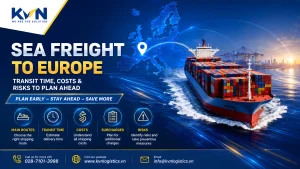
Sea freight to Europe remains one of the most important transportation options for Vietnamese exporters. With its ability to handle large cargo volumes at a relatively competitive cost per unit, ocean shipping is widely used for packaging products, raw materials, plastic resins, furniture, textiles, machinery, components, chemicals and industrial cargo.
However, shipping goods to Europe involves much more than finding a low ocean freight rate and booking space with a carrier.
Businesses must also consider the port of loading, port of discharge, transshipment arrangements, sailing schedules, container availability, customs clearance, origin and destination charges, inland transportation and possible disruptions along the Asia–Europe maritime route.
KVN Logistics currently provides integrated Sea Freight services for FCL, LCL, Master Consolidation, bulk cargo and project cargo, supported by inland trucking, customs documentation, warehousing and final delivery solutions.
Quick Answer: How Long Does Sea Freight to Europe Take?
Sea freight from Vietnam to Europe generally requires approximately 30 to 55 days port-to-port, depending on:
- The port of loading and port of discharge
- The shipping line and service selected
- Direct or transshipment routing
- The number of transshipment points
- Port congestion
- Container and vessel capacity
- Weather conditions
- Maritime route changes
- Customs and terminal operations
Door-to-door lead time will be longer because it also includes cargo collection, export customs clearance, waiting time before vessel departure, import clearance and inland delivery in Europe.
During periods of route diversion or market disruption, Vietnam–Europe transit time may move toward the upper end of the range. KVN Logistics’ market analysis has recorded planning ranges of approximately 40–55 days when Asia–Europe routes are affected by longer sailing distances and less predictable vessel schedules.
Sea Freight to Europe at a Glance
| Category | Planning Information |
|---|---|
| Main shipping methods | FCL, LCL, Master Consolidation, bulk and project cargo |
| Common ports of loading | Hai Phong, Lach Huyen, Cat Lai and Cai Mep |
| Major European gateways | Rotterdam, Hamburg, Antwerp-Bruges, Le Havre, Bremerhaven, Genoa, Barcelona and Valencia |
| Indicative port-to-port time | Approximately 30–55 days |
| Suitable cargo | Large-volume, heavy, bulky or non-urgent cargo |
| Main cost categories | Origin charges, ocean freight, surcharges, destination charges and inland delivery |
| Main operational risks | Vessel delay, rollover, transshipment delay, blank sailing, DEM/DET and documentation errors |
| Recommended planning approach | Book early and maintain a backup routing option |
These figures should only be used for initial planning. Actual transit time and cost must be confirmed against the specific booking, carrier, service, cargo readiness date and prevailing market conditions.
What Is Sea Freight to Europe?
Sea freight to Europe is the transportation of goods from Vietnam or another country to European destinations by ocean vessel.
Most commercial cargo is transported in containers. Depending on shipment volume, cargo characteristics and delivery requirements, businesses may choose FCL, LCL or consolidation services.
FCL – Full Container Load
FCL means that one shipper uses an entire container exclusively for its cargo.
Common equipment includes:
- 20-foot dry containers
- 40-foot dry containers
- 40-foot high-cube containers
- Reefer containers
- Open-top containers
- Flat-rack containers
FCL is normally suitable when the business:
- Ships large or regular volumes
- Requires dedicated container space
- Wants to reduce cargo handling
- Needs better control over container loading
- Handles sensitive, valuable or specialized cargo
- Has a stable production and export schedule
The KVN OceanPro FCL service is designed for full-container shipments requiring stable schedules, cost control and integrated international transportation.
LCL – Less than Container Load
LCL is used when a shipment does not require a full container. Cargo from several shippers is consolidated into one container at a CFS warehouse.
The shipper generally pays according to cargo volume or chargeable weight rather than the full container rate.
LCL can be suitable for:
- Small-volume exports
- Trial orders
- Product samples
- Irregular shipments
- Businesses entering a new market
- Shipments that cannot wait until a full container is available
However, LCL normally requires additional time for cargo receiving, consolidation, container loading, deconsolidation and destination handling.
Businesses may explore KVN LCLConnect for international LCL shipping from Vietnam to markets including the Netherlands and Germany.
Master Consolidation
Master Consolidation is an LCL model in which the consolidator directly organizes the container, controls the consolidation process, coordinates the CFS operation and works with destination agents.
Compared with a booking that passes through several intermediaries, a well-managed Master Consolidation service may provide:
- Greater schedule visibility
- Better control over cargo consolidation
- More transparent routing
- Faster issue resolution
- More stable destination handling
- Lower operational risk
KVN Logistics operates Master Consolidation solutions supported by its overseas agent network and specialized LCL handling capabilities.
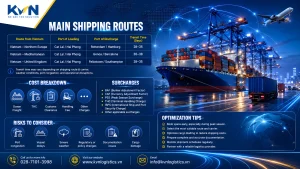
Main Sea Freight Routes from Vietnam to Europe
Cargo may depart from northern or southern Vietnam depending on factory location, available vessel services, inland transportation costs and the required European destination.
Shipping from Hai Phong and Lach Huyen
Hai Phong and Lach Huyen are important gateways for exporters located in:
- Hanoi
- Hai Phong
- Quang Ninh
- Bac Ninh
- Bac Giang
- Hung Yen
- Hai Duong
- Thai Nguyen
- Other northern industrial zones
Depending on the carrier and service, containers may connect with a mother vessel through a regional hub before continuing to Northern Europe, the Mediterranean or the United Kingdom.
Shipping from Cat Lai and Cai Mep
Cat Lai and Cai Mep are commonly selected for cargo originating from:
- Ho Chi Minh City
- Dong Nai
- Binh Duong
- Tay Ninh
- Ba Ria–Vung Tau
- Long An
- Other southern manufacturing areas
Cai Mep can accommodate large container vessels and offers access to long-haul international services. Nevertheless, whether a shipment moves directly or via transshipment depends on the specific carrier and sailing service.
Major Ports in Northern Europe
Common European gateways include:
- Rotterdam, the Netherlands
- Hamburg, Germany
- Antwerp-Bruges, Belgium
- Bremerhaven, Germany
- Le Havre, France
- Felixstowe, the United Kingdom
- London Gateway, the United Kingdom
- Southampton, the United Kingdom
Major Mediterranean Ports
Common Mediterranean gateways include:
- Genoa, Italy
- Barcelona, Spain
- Valencia, Spain
- Piraeus, Greece
- Fos-sur-Mer, France
- La Spezia, Italy
The most suitable port of discharge is not always the port closest to the final consignee.
In some cases, using a major European gateway and arranging cross-border trucking, rail or barge transportation may provide a better balance of vessel frequency, transit time and total cost.
Sea Freight Transit Time from Vietnam to Europe
Transit time normally refers to the period from vessel departure at the port of loading to vessel arrival at the port of discharge.
It does not automatically include factory pickup, export customs clearance, waiting time before departure, import clearance or final delivery.
| Shipping Scenario | Indicative Transit Time |
|---|---|
| Favorable service with limited transshipment | Approximately 30–40 days |
| Service requiring one or more transshipments | Approximately 35–50 days |
| Rerouted or disrupted maritime service | Approximately 40–55 days or longer |
| LCL with consolidation and deconsolidation | Usually longer than comparable FCL movement |
| Door-to-door delivery to an inland EU location | Port-to-port time plus customs and inland delivery |
Businesses should review the latest Sea Freight Schedule and confirm the specific ETD, ETA, cut-off and routing before arranging production or container loading. Published schedules may change according to actual carrier operations.
How to Calculate Total Door-to-Door Lead Time
A more realistic lead-time calculation is:
**Cargo collection and inland transportation in Vietnam
- container loading and export customs clearance
- waiting time before vessel departure
- port-to-port transit time
- destination handling and import clearance
- inland delivery to the consignee**
For example, a booking may show a port-to-port transit time of 38 days, but the complete movement from a factory in Vietnam to a consignee’s warehouse in Germany may take considerably longer.
What Can Change Sea Freight Transit Time?
Port of Loading and Port of Discharge
A Hai Phong–Hamburg service may have a different transit time from a Cai Mep–Rotterdam or Cat Lai–Genoa service.
Businesses should also calculate the time required to move cargo from the factory to the selected Vietnamese port.
Direct Service or Transshipment
A lower-priced booking involving several transshipment points may carry a higher delay risk than a more expensive service with fewer connections.
The quotation should clearly indicate:
- Expected transshipment ports
- Number of transshipments
- Planned connection time
- Carrier and service name
- Port rotation
- Estimated transit time
Connection Time at the Transshipment Port
When the first vessel arrives late, the container may miss its connecting vessel and have to wait for the next sailing.
This can result from:
- Vessel schedule changes
- Port congestion
- Limited feeder capacity
- Container rollover
- Terminal handling delays
- Changes in vessel rotation
Changes to the Asia–Europe Maritime Route
Security concerns and operational disruptions around major maritime corridors may cause carriers to modify their routes.
Longer sailing distances can affect:
- Transit time
- Fuel consumption
- War-risk or emergency surcharges
- Vessel availability
- Schedule reliability
- Equipment circulation
KVN Logistics has highlighted route reconfiguration and less predictable transit times as major considerations for businesses shipping between Vietnam and Europe.
Peak Season and Limited Capacity
During peak periods, exporters may face:
- Limited vessel space
- Shortage of empty containers
- Booking rejection
- Container rollover
- Blank sailings
- Peak Season Surcharge
- General Rate Increase
- Longer booking confirmation time
Businesses shipping to Europe should therefore avoid relying on last-minute bookings, especially for fixed-deadline contracts or seasonal products.
What Does the Cost of Sea Freight to Europe Include?
A complete sea freight quotation consists of more than the ocean freight rate.
The total cost can be divided into four main categories.
1. Origin Charges in Vietnam
Origin costs may include:
- Factory pickup
- Empty-container pickup
- Container trucking
- CFS handling for LCL shipments
- Terminal Handling Charge
- Documentation fee
- Seal fee
- VGM declaration
- Customs declaration
- Container loading
- Palletization and packaging
- Fumigation
- Specialized inspection
- Customs inspection
- Port or depot handling
KVN Logistics can connect international shipping with Inland Trucking to coordinate container pickup, factory loading, port delivery and vessel cut-off requirements.
2. International Ocean Freight and Surcharges
The international freight section may include:
- Basic Ocean Freight
- BAF – Bunker Adjustment Factor
- LSS – Low Sulphur Surcharge
- PSS – Peak Season Surcharge
- GRI – General Rate Increase
- War-risk or emergency surcharge
- Equipment imbalance surcharge
- Dangerous goods surcharge
- Reefer surcharge
- Out-of-gauge cargo surcharge
Ocean freight rates may change according to the trade lane, carrier, container type, cargo type, vessel capacity, equipment availability and booking date.
Businesses should always check the validity period of the quotation rather than using an expired rate for a new shipment.
3. Destination Charges in Europe
Depending on the Incoterms and commercial agreement, destination costs may include:
- Destination THC
- Delivery Order fee
- Destination documentation fee
- Customs brokerage
- Import duty
- Import VAT
- Terminal or port charges
- Specialized inspection
- CFS handling for LCL cargo
- Inland delivery
- Empty-container return
- Cross-border delivery within Europe
The seller and buyer should agree in advance on which party is responsible for each destination charge.
4. Unplanned or Risk-Related Costs
Unexpected costs may include:
- Storage
- Demurrage
- Detention
- Container cleaning
- Container repair
- Amendment fees
- Booking cancellation
- Change of destination
- Customs inspection
- Documentation correction
- Truck waiting time
- Failed delivery
- Additional delivery attempts
- Late empty-container return
Businesses can review KVN Logistics’ guide to THC, CIC, D/O fees, storage, demurrage, detention and PSS before comparing quotations.
A low basic freight rate does not necessarily represent the lowest total logistics cost. Origin charges, destination charges and operational surcharges can materially change the final amount.
FCL or LCL: Which Is More Cost-Effective for Europe?
There is no single cargo-volume threshold that applies to every shipment.
The decision should be based on:
- Total CBM
- Gross weight
- Cargo density
- Package dimensions
- Number of packages
- Destination local charges
- Cargo sensitivity
- Required delivery date
- Frequency of export
- Available container space
- Risk of co-loading with other cargo
LCL is generally appropriate for smaller shipments because the shipper pays only for the space or weight used.
However, as cargo volume increases, FCL may become more economical because LCL shipments can incur CFS, handling and destination charges for each shipment.
The best approach is to request two complete calculations:
- Total LCL cost, including origin and destination charges
- Total FCL cost, including container trucking and local charges
The comparison should be based on the full door-to-door cost rather than ocean freight alone.
Key Risks When Shipping Goods to Europe
Vessel Schedule Changes
ETD and ETA are estimates rather than absolute guarantees.
Vessel schedules may change because of:
- Weather conditions
- Port congestion
- Route adjustments
- Equipment shortages
- Terminal delays
- Carrier network changes
- Operational disruptions
Businesses should build a reasonable buffer into production and delivery plans.
Rollover and Transshipment Delays
A container may not be loaded onto the planned vessel because of:
- Vessel overbooking
- Allocation changes
- Late gate-in
- Missed cut-off
- Incomplete documentation
- Weight discrepancies
- Missed transshipment connection
When evaluating a booking, businesses should ask about the number of transshipments and the available alternative sailings.
Surcharge Changes
PSS, GRI, BAF and emergency surcharges may change during volatile periods.
A professional quotation should clearly state:
- Rate validity
- Included charges
- Excluded charges
- Applicable surcharge conditions
- Currency
- Payment terms
- Free-time conditions
- Carrier and routing
Demurrage and Detention
Demurrage and detention can increase rapidly if the consignee cannot clear the cargo, collect the container or return the empty equipment within the permitted free time.
Before confirming the booking, businesses should check:
- Free demurrage period
- Free detention period
- Combined or separate free time
- Starting point for charge calculation
- Daily tariff after free time
- Empty-container return location
- Possibility of purchasing additional free time
Customs and Documentation Errors
A typical export document set may include:
- Sales Contract
- Commercial Invoice
- Packing List
- Bill of Lading
- Export customs declaration
- Certificate of Origin
- Product specifications
- Fumigation certificate
- Phytosanitary certificate
- Inspection certificate
- Dangerous Goods Declaration, where applicable
Incorrect cargo description, consignee information, package quantity, weight, HS code or certificate details may result in customs delays or additional charges.
KVN Logistics provides Customs and Import–Export Documentation services covering customs brokerage, documentation review and import consulting.
Rules of Origin and EVFTA Documentation
Goods exported from Vietnam to the European Union may qualify for preferential tariff treatment when they meet the applicable rules of origin and documentation requirements.
However, preferential duty is not automatically granted to every shipment.
Exporters should verify:
- Product-specific rules of origin
- Applicable HS code
- Origin of raw materials
- Manufacturing process
- Required Certificate of Origin
- Statement on origin requirements
- Consistency among all commercial documents
Any discrepancy between the Certificate of Origin, invoice, packing list, customs declaration and Bill of Lading may affect preferential tariff treatment or delay clearance.
Incoterms-Related Risks
Responsibilities differ significantly under EXW, FOB, CFR, CIF, DAP and DDP.
Before signing the sales contract, both parties should confirm:
- Who arranges ocean freight
- Who pays origin charges
- Who purchases cargo insurance
- Who pays destination charges
- Who performs import customs clearance
- Who pays duty and VAT
- Where risk transfers from seller to buyer
- Who bears additional charges caused by delay
Cargo Damage and Moisture Risk
A shipment to Europe may remain inside the container for several weeks and be exposed to vibration, humidity and temperature changes.
Depending on the cargo, exporters should consider:
- Container desiccants
- Moisture barriers
- Palletization
- Lashing and securing
- Dunnage
- Anti-slip materials
- Protective wrapping
- Container inspection before loading
- Cargo insurance
- Loading supervision
How to Optimize Sea Freight Costs to Europe
Compare Total Logistics Cost, Not Only Ocean Freight
A lower ocean freight rate may come with:
- More transshipments
- Shorter free time
- Higher destination charges
- Less reliable scheduling
- Longer transit time
- Greater rollover risk
A more useful formula is:
Total logistics cost = Origin charges + International freight + Destination charges + Inventory cost + Risk-related cost
Request More Than One Routing Option
A well-prepared proposal should include:
- A time-priority option
- A cost-priority option
- A backup route
- An alternative carrier
- An alternative port of discharge where appropriate
For cargo requiring faster delivery, businesses may also compare Sea Freight and Rail Freight to Europe.
Sea freight is normally more cost-efficient for large-volume and non-urgent cargo, while rail freight may offer shorter lead times for shipments requiring better schedule control.
Book Before the Cargo-Ready Date
For Europe-bound shipments, exporters should submit their estimated shipping plan early, particularly when handling:
- Peak-season cargo
- Dangerous goods
- Reefer cargo
- Oversized cargo
- Project cargo
- Special container equipment
- Fixed delivery deadlines
- Direct or limited-transshipment services
Early booking improves the ability to compare routes, secure equipment and prepare backup options.
Optimize Container Loading
Better packaging dimensions and loading arrangements can:
- Increase container utilization
- Reduce unused space
- Reduce the number of containers required
- Improve weight distribution
- Limit cargo movement
- Reduce damage risk
- Lower cost per unit
Container selection should consider both volume and cargo weight. A 40-foot container may provide more cubic capacity, but a dense cargo may reach its weight limit before the container is physically full.
Check Documents Before Cut-Off
Businesses should review the following before vessel cut-off:
- Shipper and consignee details
- Notify party
- Cargo description
- HS code
- Package quantity
- Gross and net weight
- CBM
- Shipping marks
- VGM
- Certificate of Origin
- Manifest requirements
- Draft Bill of Lading
Early document review reduces the risk of amendment fees, manifest errors and delayed cargo release.
Integrate Trucking, Customs, Warehousing and Sea Freight
Using different providers for every stage may create communication gaps and make it difficult to identify responsibility when a problem occurs.
An integrated logistics solution can connect:
- Factory pickup
- Container positioning
- Container loading
- Inland trucking
- Export customs clearance
- Sea freight booking
- Shipment tracking
- Import coordination
- Warehousing
- Final delivery
KVN Logistics’ door-to-door model combines inland transport, customs clearance, international freight, warehousing and final delivery within a coordinated supply chain solution.
Information Required for a Sea Freight Quotation
To receive an accurate quotation, the shipper should provide:
- Pickup address or port of loading
- Port of discharge or final delivery address
- Commodity name
- HS code, where available
- Number and type of packages
- Dimensions of each package
- Total gross weight
- Total CBM
- Packaging type
- FCL or LCL requirement
- Required container type
- Cargo-ready date
- Incoterms
- Dangerous, refrigerated or oversized cargo status
- Required free time
- Cargo insurance requirement
- Contractual delivery deadline
Complete information allows the forwarder to compare carriers, routes, schedules and total costs more accurately.
KVN Logistics – Sea Freight Solutions from Vietnam to Europe
KVN Logistics provides international Sea Freight solutions for:
- FCL shipments
- LCL shipments
- Master Consolidation
- Bulk cargo
- Oversized and project cargo
- Multimodal transportation
- Door-to-door delivery
Depending on the shipment, KVN Logistics can support businesses with:
- Route and port analysis
- Carrier and schedule comparison
- FCL, LCL and consolidation planning
- Booking and container coordination
- Inland trucking
- Customs declaration
- Import–export documentation
- Cargo tracking
- Warehousing and distribution
- Cargo insurance
- Alternative Sea, Rail or Air Freight planning
KVN Logistics also provides Warehousing and Supply Chain solutions covering storage, inventory management, distribution, cargo tracking and value-added services.
Rather than simply providing a freight rate, a professional freight forwarder coordinates carriers, bookings, customs procedures, documentation, shipment monitoring and communication among all parties involved in the cargo journey.
KVN Logistics – We are the Solution.
Frequently Asked Questions About Sea Freight to Europe
How long does sea freight from Vietnam to Europe take?
Port-to-port transit time is generally planned at approximately 30–55 days. The actual duration depends on the origin port, destination port, carrier, service, transshipment plan, congestion and current maritime route conditions.
How much does sea freight to Europe cost?
There is no fixed rate for all European destinations. The cost depends on the port pair, container type, cargo volume, cargo characteristics, carrier, booking date, available capacity and applicable surcharges.
Does a sea freight quotation include import duty and VAT?
Import duty and VAT are not normally included in a standard port-to-port freight quotation unless the proposal specifically covers customs clearance and duty-paid delivery.
The responsible party depends on the agreed Incoterms.
Is FCL or LCL better for shipping to Europe?
LCL is generally suitable for smaller shipments, while FCL is often more efficient for larger, regular or sensitive cargo.
Businesses should compare total origin, freight and destination costs for both options before deciding.
How can businesses reduce demurrage and detention?
Businesses should:
- Confirm free time before booking
- Prepare documents before vessel arrival
- Coordinate early with the consignee
- Arrange customs clearance in advance
- Schedule container pickup promptly
- Return the empty container within the permitted period
Is Sea Freight or Rail Freight better for Europe?
Sea Freight is generally more suitable for large-volume and non-urgent cargo where cost optimization is the main priority.
Rail Freight may be considered when the cargo must arrive faster than ocean shipping but does not justify the cost of Air Freight.
What documents are required for shipping to Europe?
The basic document set commonly includes a Commercial Invoice, Packing List, Bill of Lading, customs declaration and Certificate of Origin. Additional certificates may be required depending on the product and importing country.
Conclusion
Sea freight to Europe remains a practical and cost-efficient solution for Vietnamese businesses exporting large-volume, heavy or non-urgent cargo.
However, a successful shipment cannot be planned solely around the basic ocean freight rate.
Businesses should evaluate:
- Total door-to-door lead time
- Direct and transshipment routes
- Origin and destination charges
- Carrier surcharges
- Free time
- Demurrage and detention risks
- Customs and origin documentation
- Cargo protection
- Backup transportation options
An effective sea freight strategy balances cost, transit time and operational risk.
By planning early, comparing complete logistics costs and working with a solution-oriented freight forwarder, businesses can improve shipment visibility, control unexpected expenses and build a more resilient supply chain between Vietnam and Europe.