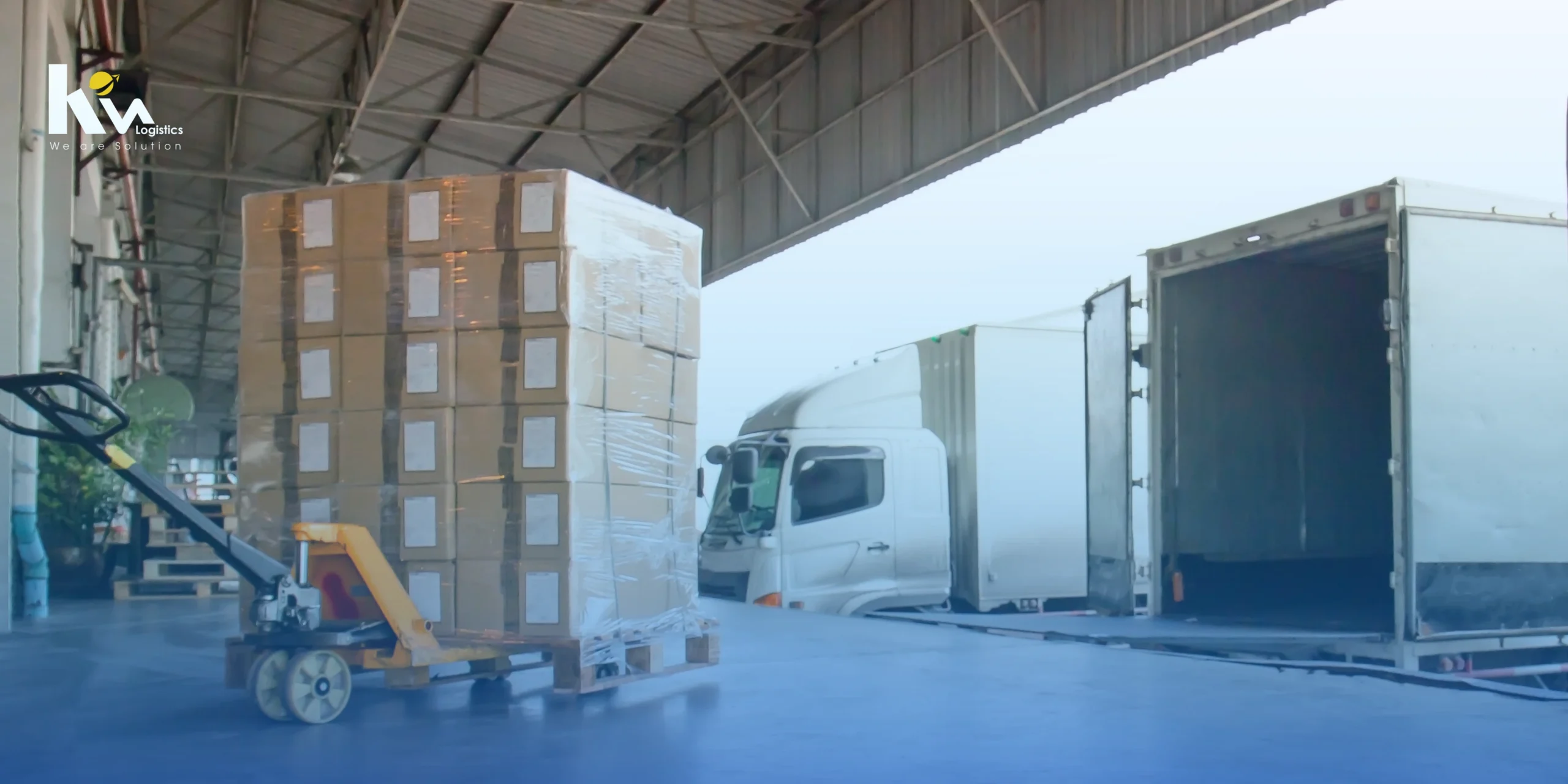


In international freight forwarding, Freehand Cargo and Nominated Cargo are two terms frequently used among shippers, consignees, freight forwarders, shipping lines, airlines and overseas agents.
However, many businesses still assume that Freehand Cargo always means Freight Prepaid, while Nominated Cargo always means Freight Collect. Some also believe that one shipment type automatically receives higher loading priority from the carrier.
In practice, the most important distinction is determined by one question:
Which party has the authority to appoint the freight forwarder and control the international transportation arrangement?
Understanding the difference between Freehand and Nominated Cargo helps businesses clarify decision-making authority, operational responsibilities, freight payment arrangements and the appropriate response when delays or additional charges arise.
Quick Answer: What Is the Difference Between Freehand and Nominated Cargo?
- Freehand Cargo: The forwarder’s direct customer has the authority to select the freight forwarder, carrier, schedule, routing and logistics solution.
- Nominated Cargo: The forwarder or local handling agent has already been appointed by another party, usually the buyer, seller or an overseas logistics agent.
- Freehand and Nominated are not Incoterms® rules.
- Freight Prepaid and Freight Collect relate to freight payment but are not identical to Freehand and Nominated.
- Neither Freehand nor Nominated Cargo is automatically given higher loading priority by a shipping line or airline.
What Is Freehand Cargo?
Freehand Cargo, also known as a Freehand Shipment, is a shipment for which the customer working directly with the freight forwarder has the authority to select the logistics provider and determine the transportation arrangement.
For an export shipment originating in Vietnam, the cargo is generally considered Freehand Cargo for the Vietnamese forwarder when the shipper has the authority to:
- Select the freight forwarder;
- Request and compare freight quotations;
- Negotiate freight rates and service terms;
- Choose the shipping line or airline;
- Compare available sailing or flight schedules;
- Select a direct or transshipment route;
- Decide between FCL, LCL, consolidation or air freight;
- Arrange inland transportation and customs clearance;
- Request shipment tracking and operational updates;
- Approve alternative solutions when disruptions occur.
For example, a Vietnamese exporter sells goods under CIF terms and appoints KVN Logistics to arrange trucking, customs clearance, booking, ocean freight and shipment tracking. From KVN Logistics’ perspective, this shipment is generally considered Freehand Cargo.
Businesses that wish to control carrier selection, routing and shipping schedules can explore KVN Logistics’ international sea freight services, covering FCL, LCL, master consolidation, bulk cargo and project cargo.
Main Characteristics of Freehand Cargo
Freehand shipments typically have the following characteristics:
- The forwarder works directly with the party controlling the freight arrangement;
- The forwarder can actively propose different logistics options;
- Multiple carriers and routes may be compared;
- Freight rates and service conditions can be negotiated;
- The booking may be adjusted more easily before final confirmation;
- Communication is generally more direct;
- The forwarder has greater responsibility for consultancy, cost optimization and shipment management.
Advantages of Freehand Cargo
Freehand Cargo gives the shipper or consignee greater control over the transportation process.
Instead of choosing a service based only on the lowest ocean or air freight rate, businesses can evaluate:
- Transit time;
- Schedule reliability;
- Number of transshipment points;
- Container availability;
- Free time at origin and destination;
- Origin and destination local charges;
- Carrier delay and rollover policies;
- Documentation support;
- The capability of the destination agent;
- Cargo visibility and communication quality.
The appointed forwarder can also develop an integrated solution involving inland trucking between factories, warehouses and ports, customs clearance, international transportation, warehousing and final delivery.
Limitations of Freehand Cargo
Greater control also means greater responsibility.
The business appointing the forwarder must carefully:
- Compare freight quotations;
- Evaluate the forwarder’s operational capability;
- Review the proposed routing;
- Confirm cut-off times;
- Monitor additional charges;
- Prepare documents on schedule;
- Approve booking changes;
- Follow the shipment throughout its journey.
Choosing a forwarder solely because of a low base freight rate may lead to unexpected charges, including THC, CIC, documentation fees, CFS fees, D/O fees, storage, demurrage and detention.
Businesses should therefore review the article Hidden Logistics Surcharges Explained: THC, CIC, D/O Fee, Storage, Demurrage and PSS to understand the total logistics cost rather than focusing only on the quoted ocean or air freight rate.
What Is Nominated Cargo?
Nominated Cargo, also known as a Nominated Shipment or Routing Order Shipment, is a shipment for which the freight forwarder, carrier or local handling agent has already been appointed by another party.
For exports from Vietnam, a common situation occurs when an overseas buyer appoints a freight forwarder in the destination country. That overseas forwarder then nominates its Vietnamese agent to contact the shipper, issue booking instructions, coordinate cargo handling and prepare shipment documents.
In this arrangement:
- The buyer or overseas agent controls the main transportation;
- The Vietnamese shipper does not independently select the international forwarder;
- The local forwarder handles the cargo under a nomination or routing order;
- The carrier and routing may already have been selected;
- The shipper is primarily responsible for completing its origin-side obligations;
- Operational updates may need to be reported to both the shipper and the overseas nominating agent.
For example, a Vietnamese supplier sells goods to a U.S. buyer under FOB terms. The buyer appoints a U.S.-based freight forwarder, which then nominates a Vietnamese agent to handle the export shipment. For the Vietnamese agent, this is Nominated Cargo.
Main Characteristics of Nominated Cargo
Nominated shipments commonly involve the following characteristics:
- The local forwarder operates according to an overseas nomination;
- The carrier and routing may already be fixed;
- The main international freight rate is usually negotiated by the nominating party;
- The shipper must follow the booking and shipping instructions provided;
- Communication may involve several parties;
- Cargo cut-off, SI cut-off and VGM cut-off must be closely controlled;
- Origin local charges must be confirmed before cargo delivery;
- Changes may require approval from the buyer or overseas agent.
Advantages of Nominated Cargo
For exporters, Nominated Cargo can reduce the workload associated with searching for and negotiating international transportation services.
Potential benefits include:
- The shipper does not need to select the shipping line or airline;
- The shipper does not directly negotiate the main freight rate;
- The shipment follows an agreed logistics system;
- It is suitable for international buyers with global freight contracts;
- Multiple suppliers can be coordinated through one logistics network;
- The buyer can centrally manage inbound schedules and freight costs;
- The shipper can focus on production, packing and origin delivery obligations.
Limitations of Nominated Cargo
The main limitation is that the shipper has less control over the international transportation arrangement.
Common difficulties may include:
- Slow responses from the nominated forwarder;
- A sailing schedule that does not match the production plan;
- Routing with several transshipment points;
- Booking changes that cannot be approved locally;
- Unclear origin local charges;
- Short cargo preparation time before cut-off;
- Limited ability to switch carriers;
- Communication delays between the shipper, consignee and overseas agent;
- Disputes over charges or documentation responsibilities.
Even when the shipper does not control the main freight arrangement, it should still carefully check:
- Booking confirmation;
- Cargo cut-off time;
- SI and VGM deadlines;
- Empty container pick-up location;
- Container return location;
- Origin local charges;
- Bill of lading instructions;
- Free time;
- Procedures in the event of delay or rollover.
KVN Logistics provides customs clearance and import-export documentation services for both Freehand and Nominated shipments, helping businesses review documents, complete declarations and coordinate with relevant parties.
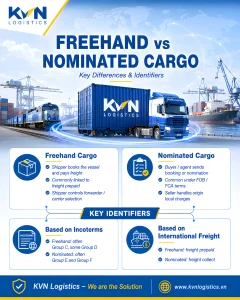
Freehand Cargo vs Nominated Cargo: Comparison Table
| Criterion | Freehand Cargo | Nominated Cargo |
|---|---|---|
| Common description | Independently controlled shipment | Appointed or routing order shipment |
| Who selects the forwarder? | The forwarder’s direct customer | The buyer, seller or overseas logistics agent |
| Carrier selection | Controlled by the direct customer or proposed by the forwarder | Usually determined by the nominating party |
| Schedule selection | Several schedules may be compared | Usually follows the nominated booking |
| International freight negotiation | Conducted by the direct customer or local forwarder | Usually conducted by the buyer or overseas agent |
| Level of control | Higher | Lower for the party not controlling the freight |
| Communication structure | Usually more direct | May involve several parties |
| Common freight term | Often Freight Prepaid, but not always | Often Freight Collect, but not always |
| Common export Incoterms | CFR, CIF, CPT or CIP | EXW, FCA or FOB |
| Ability to change carrier or routing | More flexible before booking confirmation | Requires approval from the nominating party |
| Forwarder’s main role | Consultancy, quotation and solution optimization | Compliance with nomination and operational coordination |
| Key risk | Selecting an unsuitable solution or failing to control total cost | Limited control, delayed communication and unexpected local charges |
Are Freehand and Nominated Cargo Incoterms?
No.
Freehand and Nominated Cargo are not Incoterms® rules.
They are forwarding terms used to describe which party controls the freight arrangement and appoints the logistics service provider.
Incoterms®, by contrast, define matters such as:
- The obligations of the seller and buyer;
- The allocation of transportation costs;
- Export and import clearance responsibilities;
- The point at which cargo risk transfers;
- Which party must arrange transportation;
- Whether insurance must be arranged under the selected rule.
Businesses should therefore not use “Freehand” or “Nominated” as substitutes for an Incoterms® rule in a sales contract.
The Relationship Between Freehand Cargo, Nominated Cargo and Incoterms
Certain patterns are commonly seen in international trade.
Export Shipments from Vietnam
- CFR, CIF, CPT and CIP: The seller normally arranges the main international transportation. The shipment is therefore often Freehand Cargo for the shipper or its appointed forwarder in Vietnam.
- FOB, FCA and EXW: The buyer normally controls the main transportation. The shipment is therefore often handled as Nominated Cargo at origin.
Import Shipments into Vietnam
- FOB and FCA: The Vietnamese buyer normally appoints the forwarder and arranges the main transportation. The shipment may therefore be Freehand Cargo for the consignee or its Vietnamese forwarder.
- CFR, CIF, CPT and CIP: The overseas seller normally arranges the main transportation. The Vietnamese forwarder may therefore receive the shipment under an overseas nomination.
These are common operational patterns rather than absolute rules.
The parties may agree on different arrangements for forwarder selection, freight payment or shipment coordination, provided that responsibilities are clearly stated in the sales contract and shipping instructions.
Does Freehand Cargo Always Mean Freight Prepaid?
No.
Freight Prepaid means that the main freight charge is paid or settled at origin.
Freight Collect means that the main freight charge is collected at destination.
In practice:
- Export Freehand Cargo is often associated with Freight Prepaid;
- Export Nominated Cargo is often associated with Freight Collect.
However, the concepts describe different aspects of the shipment:
- Freehand or Nominated identifies who controls and appoints the freight arrangement;
- Prepaid or Collect identifies where or how the freight is collected.
It is therefore possible to have:
- Freehand Cargo with Freight Collect;
- Nominated Cargo with certain charges paid at origin;
- Main freight paid by one party while trucking, customs clearance or local charges are paid by another.
Businesses should review the sales contract, Incoterms®, booking confirmation, debit note and forwarding instructions before determining responsibility for each charge.
Which Receives Higher Priority: Freehand or Nominated Cargo?
There is no general rule stating that Freehand Cargo or Nominated Cargo automatically receives higher loading priority from a shipping line, airline, terminal or port.
Carrier loading and space confirmation generally depend on:
- Booking status;
- Vessel or flight capacity;
- Container and equipment availability;
- Empty container pick-up timing;
- Cargo delivery time;
- Terminal cut-off;
- Cargo characteristics;
- Dangerous goods or special handling requirements;
- The service level purchased;
- Carrier operating policies;
- Port and terminal conditions.
The difference lies not in whether one cargo type is more important, but in the operational priorities assigned to each type of shipment.
Operational Priorities for Freehand Cargo
For Freehand Cargo, the forwarder should prioritize:
- Developing suitable transportation options;
- Comparing freight rates and schedules;
- Reserving cargo space;
- Selecting an appropriate routing;
- Controlling the total logistics cost;
- Providing proactive shipment updates;
- Monitoring schedule changes;
- Offering backup options when disruptions occur.
Operational Priorities for Nominated Cargo
For Nominated Cargo, the forwarder should prioritize:
- Following the nomination and routing order;
- Contacting the shipper on time;
- Issuing accurate booking instructions;
- Controlling cargo and documentation deadlines;
- Coordinating SI and VGM submission;
- Reporting shipment status to the overseas agent;
- Collecting only approved local charges;
- Avoiding discrepancies among the shipper, consignee and nominating agent.
The key difference is therefore who has decision-making authority and which tasks the forwarder must prioritize, rather than which cargo is more important.
Should Businesses Prioritize Freehand or Nominated Cargo?
There is no single option suitable for every business.
The right arrangement depends on the company’s logistics capability, negotiation power, international customer requirements and desired level of supply chain control.
Freehand Cargo May Be More Suitable When the Business:
- Wants to control the sailing or flight schedule;
- Has regular import or export volume;
- Can negotiate competitive freight rates;
- Needs control over routing and transshipment;
- Wants integrated trucking, customs and international freight services;
- Has a trusted forwarder in Vietnam;
- Wants greater transparency over local charges;
- Needs flexibility during market disruptions;
- Requires regular shipment visibility and updates.
Nominated Cargo May Be Suitable When:
- The customer operates a global logistics network;
- The buyer requires the use of an appointed forwarder;
- The goods are sold under FOB or FCA terms;
- The buyer has a more competitive global freight contract;
- The shipper wants to focus on production and origin delivery;
- Several suppliers need to be coordinated under one inbound logistics system;
- The consignee needs centralized control over arrival schedules.
Information to Check Before Handling Nominated Cargo
As soon as the shipper receives a nomination or routing order, it should confirm:
- The nominated forwarder’s name and contact details in Vietnam;
- The overseas nominating agent’s details;
- The shipping line or airline;
- The port or airport of loading;
- The destination port or airport;
- The estimated departure date;
- The estimated transit time;
- The cargo cut-off time;
- The SI and VGM deadlines;
- The empty container pick-up location;
- The laden container return location;
- Origin local charges;
- Free time at origin and destination;
- Bill of lading requirements;
- Responsibility for amendment fees;
- The procedure in the event of a rollover or delay;
- Documents required by the overseas agent.
Businesses can also review KVN Logistics’ sea freight sailing schedules to plan cargo preparation, inland trucking and documentation more proactively.
Information Required When Requesting a Freehand Freight Quotation
To develop an accurate transportation proposal, the forwarder normally requires:
- Commodity name;
- HS code;
- Number of packages;
- Gross and net weight;
- Cargo dimensions or total volume;
- Type and quantity of containers;
- Port or airport of loading;
- Port or airport of destination;
- Cargo pick-up address;
- Incoterms® rule;
- Cargo ready date;
- Required transit time;
- Required free time;
- Dangerous goods or special cargo details;
- Temperature-control requirements;
- Customs clearance requirements;
- Inland trucking requirements;
- Delivery address at destination.
For smaller shipments that do not require a full container, businesses may also review What Is Consolidation? A Smart Logistics Strategy to Reduce Cost and Improve Export Performance or explore KVN Logistics’ Vietnam–India Consol Shipping solution.
How Does KVN Logistics Handle Freehand and Nominated Cargo?
As a new-generation logistics solution partner, KVN Logistics supports both Freehand and Nominated Cargo with a focus on transparency, coordination and risk control.
For Freehand Cargo
KVN Logistics supports businesses with:
- Shipment and Incoterms consultation;
- Carrier and routing comparison;
- FCL, LCL, consolidation and air freight quotations;
- Sailing and flight schedule evaluation;
- Booking arrangements;
- Inland trucking;
- Export and import customs clearance;
- Shipping documentation;
- Cargo tracking;
- Origin and destination coordination;
- Alternative solutions when disruptions occur.
For Nominated Cargo
KVN Logistics supports:
- Receipt and verification of nominations;
- Communication with the shipper;
- Issuance of booking instructions;
- Container and trucking coordination;
- Cargo cut-off monitoring;
- Customs clearance assistance;
- SI, VGM and bill of lading coordination;
- Status reporting to the overseas agent;
- Booking amendment management;
- Transparent collection of approved origin charges;
- Coordination among the shipper, consignee and destination agent.
KVN Logistics provides integrated solutions covering sea freight, air freight, inland trucking, railway freight, customs clearance, documentation, warehousing and end-to-end supply chain coordination.
Conclusion
The fundamental difference between Freehand Cargo and Nominated Cargo does not relate to the type, size or loading priority of the goods.
It relates to who has the authority to appoint the freight forwarder and control the transportation arrangement.
- Freehand Cargo gives the forwarder’s direct customer greater control over freight rates, carriers, schedules and routing;
- Nominated Cargo is handled according to instructions issued by a buyer, seller or overseas logistics agent;
- Freight Prepaid and Freight Collect are related concepts but are not identical to Freehand and Nominated;
- Neither shipment type is automatically given carrier loading priority;
- Businesses should carefully review Incoterms®, booking instructions, local charges, cut-off times and the responsibilities of each party.
Whether a shipment is Freehand or Nominated, working with a forwarder that has strong documentation capability, an international agent network and effective multi-party coordination remains essential to maintaining schedule reliability, cost transparency and operational control.
KVN Logistics – We are the Solution.
Hotline: (+84) 28 7101 3998
Email: info@kvnlogistics.vn
Frequently Asked Questions
What is Freehand Cargo?
Freehand Cargo is a shipment for which the forwarder’s direct customer has the authority to select the freight forwarder, carrier, schedule, routing and logistics arrangement.
What is Nominated Cargo?
Nominated Cargo is a shipment for which the freight forwarder or local handling agent has already been appointed by the buyer, seller or another overseas logistics party.
Is an FOB shipment Freehand or Nominated?
For exports under FOB terms, the buyer normally arranges the main international transportation. The shipment is therefore commonly handled as Nominated Cargo at origin. However, the actual arrangement should always be confirmed through the sales contract and routing instructions.
Is a CIF shipment always Freehand Cargo?
An export shipment under CIF terms is commonly Freehand Cargo for the seller because the seller arranges the main transportation and insurance. However, forwarder selection still depends on the agreement between the parties.
Does Freehand Cargo always mean Freight Prepaid?
No. Freehand describes who controls the freight arrangement, while Freight Prepaid describes where or how the main freight is paid. They often occur together but are not identical.
Does Nominated Cargo always mean Freight Collect?
No. The main freight for a nominated export shipment is often collected at destination, but the shipper may still be responsible for origin local charges, trucking, customs clearance or documentation fees.
Is Freehand Cargo prioritized by shipping lines?
No. Loading priority depends on booking status, capacity, cut-off compliance, equipment availability, cargo characteristics and carrier policies, not solely on whether the shipment is Freehand or Nominated.
Should a business choose Freehand or Nominated Cargo?
Freehand Cargo is more suitable when the business wants control over freight rates, routing, schedules and logistics providers. Nominated Cargo is appropriate when the buyer has an established logistics network or requires the use of an appointed forwarder.