

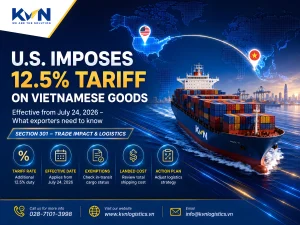
Starting July 24, 2026, the United States officially introduced new additional import tariffs on goods originating from 60 economies following investigations conducted under Section 301 of the U.S. Trade Act of 1974.
In its final action announced on July 23, the Office of the United States Trade Representative, or USTR, placed Vietnam in the group subject to an additional tariff rate of 12.5%. The measure applies to a broad range of products, although certain goods and specific circumstances remain eligible for exemptions. (ustr.gov)
This is an important development for companies exporting goods to the United States, particularly as the U.S. remains one of Vietnam’s largest and most strategically significant export markets.
Key Takeaways for Exporters
- Most goods originating from Vietnam are subject to an additional 12.5% tariff under Section 301.
- The new tariff applies to goods entered for consumption or withdrawn from bonded warehouses for consumption in the United States from July 24, 2026.
- The 12.5% rate is not necessarily the final total tariff payable on a shipment. MFN duties, anti-dumping duties, countervailing duties and other trade measures may also apply.
- Certain raw materials, specialized products, goods already in transit and products subject to Section 232 measures may be exempt or treated under separate mechanisms.
- Exporters should verify HTS classifications, origin documentation, entry dates and contractual responsibility for import duties.
How Are the New Tariffs Applied to the 60 Economies?
According to USTR, the measures were introduced following investigations into 60 major U.S. trading partners that collectively account for approximately 99.4% of total U.S. imports.
The economies covered by the investigations were divided into three main groups:
| Applicable Group | Section 301 Tariff Rate |
|---|---|
| Economies that have adopted, enforced or committed to adopting import bans on goods produced with forced labor | 10% |
| The European Union, Japan, South Korea, Taiwan and Switzerland | A combined tariff rate of 10% or 12.5% after taking MFN duties into account, depending on the product |
| Other covered economies, including Vietnam | 12.5% |
The 10% group includes Argentina, Bangladesh, Cambodia, Canada, Ecuador, El Salvador, Guatemala, Honduras, India, Indonesia, Jordan, Malaysia, Mexico, Pakistan, Sri Lanka, Trinidad and Tobago, and the United Kingdom.
Vietnam, China, the Philippines, Thailand and several other economies fall within the group subject to the additional 12.5% tariff. (ustr.gov)
Is 12.5% the Total Import Duty on Vietnamese Goods?
No.
The 12.5% announced by USTR is an additional tariff imposed under Section 301. It is not the final total import duty applied uniformly to every Vietnamese product entering the United States.
The total duties and charges payable may include:
- Basic import duties determined by the product’s HTS classification and MFN rate;
- The additional 12.5% Section 301 tariff;
- Anti-dumping or countervailing duties if the product is subject to a trade remedy investigation;
- Section 232 tariffs applicable to certain products;
- Customs processing fees and other import-related charges.
Under USTR’s tariff schedule, goods originating from Vietnam are associated with Chapter 99 code 9903.05.84, which carries an additional duty rate of 12.5%, unless the product falls within an exemption or a separate treatment mechanism. (ustr.gov)
Businesses should therefore not use the 12.5% figure alone when calculating selling prices or landed costs. The specific HTS classification of each product remains a key factor in determining the final import duty payable in the United States.
When Does the New Tariff Take Effect?
According to the official notice, the additional tariff applies to goods that are:
- Entered for consumption in the United States; or
- Withdrawn from bonded warehouses for consumption,
from 12:01 a.m. Eastern Time on July 24, 2026.
This effective date coincides with the expiry of the temporary 10% import surcharge previously imposed by the United States under Section 122 of the Trade Act.
The two measures have different legal foundations. The previous 10% surcharge was a temporary measure applied for 150 days, while the new tariffs are imposed under Section 301. (ustr.gov)
Are Goods Already in Transit Exempt?
USTR provides a relatively narrow transitional exemption.
Goods may avoid the new additional tariff only when both of the following conditions are met:
- The goods were loaded onto a vessel at the port of origin and were already in transit on their final mode of transportation to the United States before 12:01 a.m. Eastern Time on July 24, 2026; and
- The goods are entered for consumption or withdrawn from a bonded warehouse for consumption before 12:01 a.m. Eastern Time on July 28, 2026.
Therefore, the fact that a shipment departed Vietnam before July 24 does not automatically qualify it for exemption.
Exporters and U.S. importers must verify both the date on which the goods were loaded onto the final mode of transportation and the date on which the import entry was completed. (ustr.gov)
For shipments currently in transit, exporters should promptly coordinate with consignees, importers of record and customs brokers in the United States to determine whether the transitional exemption applies.
Which Products May Be Exempt?
USTR indicates that certain categories of products may be excluded from the additional tariff, including:
- Raw materials for which tariffs could create shortages in the U.S. market;
- Products whose inclusion could cause widespread economic disruption;
- Goods that cannot be produced in sufficient quantities or at commercially reasonable prices in the United States;
- Certain products exempted to encourage economies to fulfil commitments related to forced-labor restrictions;
- Informational materials, humanitarian relief goods, accompanied baggage and certain other special categories;
- Products and components already subject to Section 232 measures, including certain steel, aluminium, copper and automotive products.
Exemptions are determined according to specific tariff classifications rather than general commercial product names.
Businesses must therefore review the applicable HTS codes and relevant Chapter 99 provisions before concluding whether a shipment qualifies for an exemption. (ustr.gov)
Why Has the United States Introduced These Measures?
According to USTR, the investigations focused on whether trading partners had failed to adopt or effectively enforce import restrictions on goods produced using forced labor.
The investigations were initiated in March 2026 under Section 301 of the Trade Act of 1974. During the review process, USTR held several public hearings, received more than 2,100 submissions across different stages and consulted with more than 45 governments.
USTR maintains that the absence of effective mechanisms to prevent the importation of goods produced with forced labor creates unfair trading conditions and disadvantages U.S. businesses. (ustr.gov)
It is important to note that the measure is based on USTR’s assessment of policies and regulatory mechanisms at the economy-wide level.
It does not mean that every individual shipment from Vietnam has been determined to involve forced labor.
How Has Vietnam Responded?
Before USTR announced its final action, Vietnam stated that the investigation findings did not fully reflect the country’s actual situation or its efforts to prevent and reduce forced labor.
Notably, on July 22, 2026, the Vietnamese Government issued Decree No. 292/2026/ND-CP. The decree includes in the prohibited import category products and goods that are extracted, produced or manufactured, either wholly or partly, through forced-labor practices by relevant companies, countries or territories. (baochinhphu.vn)
However, in its final decision announced on July 23, USTR continued to classify Vietnam within the group subject to the 12.5% additional tariff.
Businesses should continue monitoring discussions between the two governments and any potential policy adjustments or exemption updates.
How Will the New Tariff Affect Vietnamese Exporters?
Higher Landed Costs in the United States
The most immediate impact is an increase in the total cost of bringing Vietnamese goods into the U.S. market.
U.S. importers may ask Vietnamese suppliers to:
- Reduce export prices;
- Share part of the additional tariff burden;
- Revise delivery terms;
- Extend payment periods;
- Or shift sourcing to countries subject to lower tariff rates.
The extent of the impact will depend on profit margins, base tariff rates, product categories, market competition and the availability of alternative suppliers.
Businesses may also refer to KVN Logistics’ analysis, Exporting to the U.S. After the 150-Day Tariff Period: Three Scenarios and Logistics Solutions for Businesses, when developing pricing and shipping strategies.
Contracts and Incoterms Should Be Reviewed
Import duties are generally declared and paid by the importer of record in the United States.
However, the party that ultimately bears the financial cost depends on the sales contract and the agreed Incoterms.
Under DDP terms, exporters may assume greater responsibility for import duties, customs clearance and delivery costs in the United States.
Under FOB, CFR or CIF terms, the importer will generally handle import clearance but may still request price renegotiation.
Businesses should clearly determine:
- Who will act as the importer of record;
- Which party is responsible for import duties;
- Whether the selling price includes duties;
- Whether the contract contains a price-adjustment clause for changes in tariff policy;
- Who bears additional costs if the shipment is held or customs clearance is delayed.
Shipping and Customs-Clearance Timing Becomes More Important
Section 301 tariffs are not ocean-freight surcharges.
However, tariff changes can encourage businesses to accelerate or delay shipments, revise inventory levels and change import schedules.
This may result in:
- Fluctuating booking demand on U.S.-bound shipping routes;
- Changes to container-loading schedules;
- Greater pressure on bonded warehouses and distribution facilities;
- Additional storage, demurrage or detention charges if customs matters are not resolved promptly.
When estimating the total logistics budget, businesses should also review common logistics surcharges that companies often overlook rather than focusing solely on ocean freight.
Greater Scrutiny of Origin and Supply-Chain Documentation
Although the measure applies at the economy-wide level, the context of the investigation indicates that the United States is increasing its expectations regarding supply-chain transparency.
Exporters should proactively maintain:
- Raw-material origin records;
- Supplier lists;
- Production-process documentation;
- Certificates and evidence of origin;
- Employment contracts and labor policies;
- Supplier-assessment records;
- Statements of compliance with labor and social-responsibility requirements.
These documents may not be mandatory customs documents for every shipment. However, they can help exporters respond more quickly when customers, customs brokers or authorities request further clarification.
Six Immediate Actions for Exporters
1. Confirm the Correct HTS Classification
Businesses should not rely only on Vietnam’s six-digit HS code when estimating U.S. import duties.
Exporters should work with the importer or a U.S. customs broker to determine the full HTS classification and the applicable Chapter 99 codes.
2. Review the Exemption Lists
Each product classification should be checked individually to determine whether it falls within a Section 301 exemption, Section 232 treatment or another special mechanism.
3. Recalculate the Total Landed Cost
Landed-cost calculations should include basic customs duties, additional tariffs, customs fees, freight, insurance, local charges, warehousing and inland delivery costs in the United States.
4. Review Shipments Already in Transit
Businesses should verify loading dates, bills of lading, estimated arrival dates and expected customs-entry dates to determine whether the transitional exemption may apply.
5. Renegotiate Contracts Where Necessary
Exporters and buyers should agree in writing on how the additional tariff will be allocated, whether selling prices will be adjusted and whether Incoterms should be revised.
6. Continuously Monitor USTR and CBP Announcements
Trade policies may be updated through customs guidance, revised exemption lists or the results of government-level negotiations.
Businesses exporting to the United States for the first time may refer to KVN Logistics’ guide to shipping goods from Vietnam to the United States by FCL and LCL, including customs procedures for a more comprehensive preparation process.
KVN Logistics Supports Businesses on the Vietnam–U.S. Trade Lane
As tariff policies and import regulations continue to evolve, shipping goods to the United States involves much more than booking space and loading a container onto a vessel.
Exporters must coordinate production plans, bookings, shipping documents, vessel schedules, importers, customs brokers and destination agents in the United States.
KVN Logistics provides:
- Sea freight services for both FCL and LCL shipments;
- Advice on shipping solutions based on cargo volume and operational requirements;
- Support in reviewing export documentation;
- Vessel-schedule and shipment tracking;
- Coordination with consignees and destination agents;
- Inland transportation and door-to-door logistics solutions;
- Support in controlling potential logistics costs and surcharges.
Businesses may also review Shipping to the United States in 2026: Key Changes Exporters Need to Know to reassess their documentation, customs procedures and shipping plans.
KVN Logistics recommends that businesses should not make export decisions based solely on freight quotations.
Before each shipment, exporters should evaluate the product’s HTS classification, applicable duties, import requirements, Incoterms, customs-clearance timeline and total landed cost.
KVN Logistics – We are the Solution.
Frequently Asked Questions
Are Vietnamese goods subject to a total tariff of 12.5% in the United States?
No. The 12.5% rate is an additional tariff imposed under Section 301. The total duty payable depends on the product’s HTS classification, basic import duty and any other applicable trade measures.
Are all Vietnamese products subject to the new tariff?
The measure has a broad scope, but certain products and special cases are exempt. Businesses must check the applicable HTS classification for each product.
Is a shipment exempt if it departed Vietnam before July 24?
Not automatically. The shipment must satisfy both the requirement concerning when it was loaded onto its final mode of transportation and the requirement to complete import entry before the transitional deadline of July 28, 2026.
Will the 12.5% tariff increase ocean-freight rates?
Import tariffs are not part of ocean-freight charges. However, the policy may affect booking demand, inventory planning, customs-clearance timelines and overall supply-chain costs.
Who pays import duties in the United States?
The importer of record is responsible for declaring and paying duties to U.S. Customs and Border Protection. The party that ultimately bears the cost depends on the sales contract and the agreed Incoterms.
Does the 12.5% tariff mean that Vietnamese goods are considered to involve forced labor?
No. USTR’s measure is based on its assessment of import-control policies and regulatory mechanisms at the economy-wide level. It is not an individual determination against every Vietnamese exporter or shipment.