

The United States remains one of Vietnam’s most important export markets, especially for product categories such as garments, furniture, wooden products, electronics, processed agricultural goods, consumer goods, and cross-border e-commerce.
In 2026, shipping to the USA is no longer just about booking space and moving cargo from port to port. It has become a more complex logistics challenge involving freight costs, documentation, customs compliance, trade regulations, delivery timelines, and risk management.
For Vietnamese manufacturers, exporters, trading companies, and e-commerce businesses, understanding the latest changes in USA-bound logistics is essential. A well-prepared shipping plan can help businesses reduce unexpected costs, avoid customs delays, improve delivery reliability, and strengthen competitiveness in the global market.
USA Logistics Trends in 2026
The logistics landscape for shipments to the United States in 2026 continues to be shaped by changing trade policies, tighter import controls, fluctuating freight rates, and increasing demand for supply chain transparency.
One of the most notable trends is the growing importance of compliance. Exporters are expected to provide clearer and more accurate information about product descriptions, HS codes, declared value, origin of goods, and importer details. This is especially important for small shipments, e-commerce orders, and goods entering the U.S. under stricter customs supervision.
At the same time, U.S. authorities continue to pay close attention to issues such as origin fraud, intellectual property protection, forced labor compliance, product safety, and illegal transshipment. This means Vietnamese exporters need to prepare not only for transportation, but also for documentation accuracy and trade compliance.
As a result, logistics to the U.S. is no longer simply a matter of finding the cheapest freight rate. Businesses need a logistics partner that can support them with route planning, documentation review, cost control, customs coordination, and risk handling throughout the shipment journey.
FCL and LCL Shipping to the USA: What Is the Difference?
When shipping goods to the USA by sea, businesses usually choose between two main options: FCL and LCL.
FCL, or Full Container Load, means that one shipper uses an entire container for its own cargo. This option is suitable for larger shipments that can fill a 20-foot, 40-foot, or 40HC container. FCL usually offers better control over the shipment, fewer handling points, lower risk of cargo mixing, and a more predictable schedule.
However, FCL is most cost-effective when the business has enough cargo volume or regular export plans.
LCL, or Less than Container Load, means that cargo from different shippers is consolidated into one container. This option is suitable for smaller shipments, sample orders, trial export shipments, or businesses that do not yet have enough volume to book a full container.
LCL allows exporters to save initial shipping costs because they only pay based on the cargo volume or chargeable weight. However, the transit process may take longer due to consolidation, CFS handling, deconsolidation at destination, and dependency on consol schedules.
For USA-bound shipments, the decision between FCL and LCL should not be based on freight rate alone. Businesses should also consider cargo value, delivery deadline, destination in the U.S., Incoterms, documentation requirements, and the buyer’s receiving capacity.
If the cargo is high-value, time-sensitive, or requires better control, FCL is often the safer option. If the shipment is small, flexible, or part of a market-testing phase, LCL can be a practical and cost-efficient solution.
Export Customs Procedures for Shipping to the USA
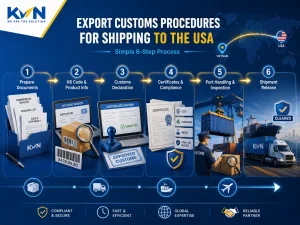
Export customs procedures for USA-bound shipments should be prepared carefully from the beginning. Even small errors in documentation may lead to delays, additional costs, or problems at the destination port.
A typical export document set may include:
| Document | Purpose |
|---|---|
| Commercial Invoice | Shows seller, buyer, product details, and transaction value |
| Packing List | Shows packing details, number of packages, weight, and volume |
| Sales Contract / Purchase Order | Provides commercial basis between buyer and seller |
| Bill of Lading | Transport document issued by the carrier or freight forwarder |
| Customs Declaration | Required for export customs clearance |
| Certificate of Origin | Required when requested by buyer or relevant regulations |
| Fumigation Certificate | Often required for wooden goods, pallets, or wood packaging |
| MSDS / COA / Test Report | Required for chemicals, ingredients, or technical products |
| FDA / USDA / TSCA / CPSIA-related documents | Required depending on the product category |
For shipments to the United States, businesses should pay special attention to HS code classification, product description, declared value, and origin of goods. These details affect not only export procedures in Vietnam, but also import procedures in the U.S.
For specific product groups such as food, cosmetics, medical devices, chemicals, wooden products, children’s products, food-contact materials, or e-commerce goods, businesses should check additional U.S. regulatory requirements before shipping.
A common mistake is preparing documents only based on Vietnam’s export requirements without checking U.S. import requirements. This can result in cargo being held at destination, requests for additional documents, customs inspections, storage fees, or delivery delays.
Common Risks When Shipping Goods to the USA
Shipping to the USA offers strong business opportunities, but it also involves several risks if exporters do not prepare properly.
The first risk is schedule fluctuation. USA-bound routes are long and depend on the port of loading, transshipment port, destination port, carrier schedule, and port congestion. During peak seasons, exporters may face limited space, rolled bookings, or delayed sailings.
The second risk is unexpected costs. Charges such as THC, CIC, D/O fee, AMS, ISF, CFS fee, demurrage, detention, storage, and destination handling charges can significantly affect total logistics costs.
The third risk is documentation errors. Incorrect product names, package quantity, HS codes, consignee information, declared value, or missing specialized documents may lead to customs delays or additional charges.
The fourth risk is origin and trade compliance. As the United States continues to strengthen control over origin fraud and illegal transshipment, exporters need to make sure their supply chain, production process, and documents are transparent and consistent.
The fifth risk is choosing the wrong shipping method. A small shipment shipped by FCL may create unnecessary cost. On the other hand, a time-sensitive shipment shipped by LCL may take longer than expected because of consolidation and deconsolidation.
Optimized Logistics Solutions for Shipping to the USA
To optimize shipping to the USA in 2026, businesses should approach logistics as an end-to-end process instead of simply comparing freight rates.
First, exporters should clearly define their cargo profile, including product type, volume, weight, value, packaging, storage requirements, documentation needs, destination, and delivery deadline. Based on this information, the logistics partner can recommend the most suitable solution, such as FCL, LCL, air freight, or a combined transport plan.
Second, businesses should plan shipments early, especially during peak seasons such as pre-holiday periods, back-to-school season, year-end sales season, or periods when U.S. buyers increase inventory. Early planning helps secure better schedules, more stable rates, and available space.
Third, exporters should standardize their documentation process. Commercial Invoice, Packing List, HS code, Incoterms, consignee information, origin documents, and product-specific certificates should be reviewed before the cargo reaches the port.
Fourth, businesses should work with a logistics partner that understands both freight operations and export requirements. For the U.S. route, a reliable freight forwarder should not only provide rates, but also help evaluate risks, select suitable ports, check surcharges, coordinate documents, and monitor shipment progress.
KVN Logistics – A New-Generation Logistics Solution Partner for USA-Bound Shipments
With the positioning of being “A New-Generation Logistics Solution Partner”, KVN Logistics does not simply move cargo from Vietnam to the United States. We work with businesses throughout the entire export journey.
KVN Logistics supports exporters in selecting the right shipping method, choosing between FCL and LCL, checking vessel schedules, optimizing routes, coordinating documents, monitoring shipments, and handling unexpected issues during transportation.
For the U.S. route, every shipment can be a different logistics challenge.
Some shipments require speed.
Some shipments require cost optimization.
Some shipments require careful documentation handling.
Some shipments require coordination among factories, warehouses, ports, carriers, freight forwarders, customs brokers, and consignees in the United States.
KVN Logistics applies a solution mindset to every shipment, helping Vietnamese businesses become more proactive in export operations and more competitive in international trade.
FAQ – Shipping to the USA
1. How long does shipping from Vietnam to the USA take?
Shipping time depends on the port of loading, port of destination, shipping method, carrier schedule, and whether the cargo is shipped by FCL, LCL, or air freight. Sea freight usually takes several weeks, while air freight is faster but more expensive.
2. Should I choose FCL or LCL for shipping to the USA?
FCL is suitable for larger shipments that require better control, faster handling, and more predictable schedules. LCL is suitable for smaller shipments, sample orders, or businesses that do not have enough cargo to fill a full container.
3. What documents are required for shipping goods to the USA?
Common documents include Commercial Invoice, Packing List, Bill of Lading, customs declaration, Sales Contract or Purchase Order, Certificate of Origin, and product-specific documents if required. Some goods may also require FDA, USDA, TSCA, CPSIA, fumigation certificate, MSDS, COA, or test reports.
4. Why do shipping costs to the USA often increase unexpectedly?
Unexpected costs may come from schedule changes, storage fees, demurrage, detention, CFS handling, destination charges, customs inspections, document amendments, or incorrect shipment planning.
5. What should new exporters prepare before shipping to the USA?
New exporters should identify product type, cargo volume, destination, Incoterms, buyer requirements, required documents, and delivery timeline. They should also work with an experienced freight forwarder to choose the right shipping solution.