

In international trade, accurate and complete export documentation is essential for efficient customs clearance, reliable shipment coordination, and successful cargo delivery.
However, preparing an export documentation checklist involves more than collecting a Commercial Invoice, Packing List, Bill of Lading, or Certificate of Origin.
Exporters must ensure consistency across commercial documents, shipping instructions, customs declarations, and destination-country requirements.
Even minor discrepancies in cargo descriptions, quantities, gross weight, or consignee information can lead to documentation amendments, customs delays, additional handling costs, or missed shipping deadlines.
What documents are required for exporting goods from Vietnam? Which documents are mandatory, and which depend on the shipment, product category, or destination market?
In this comprehensive guide, KVN Logistics explains the key export shipping documents, practical verification procedures, and recommended preparation timelines to help businesses minimize documentation risks.
1. What Documents Are Included in an Export Documentation Checklist?
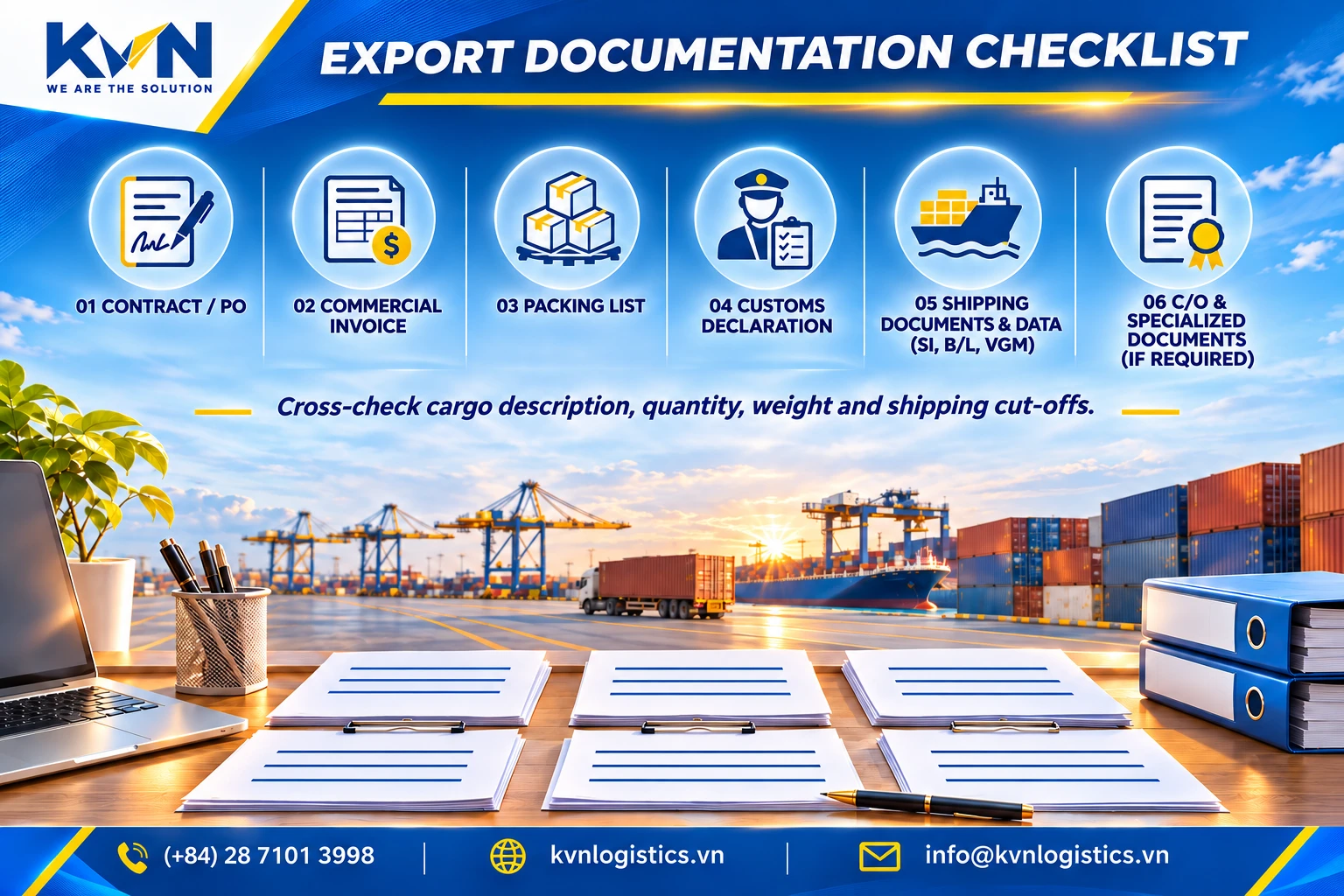
A standard export documentation checklist typically includes a Commercial Invoice, Packing List, Sales Contract or Purchase Order, transport documents such as a Bill of Lading, and an Export Customs Declaration.
Depending on the shipment, exporters may also need a Certificate of Origin (C/O), export license, phytosanitary certificate, health certificate, or other regulatory documents.
For ocean freight shipments, Shipping Instructions (SI) and Verified Gross Mass (VGM) information may also be required.
Complete Export Documentation Checklist
| No. | Document | Main Purpose | When Required |
|---|---|---|---|
| 1 | Sales Contract / Purchase Order | Confirms commercial terms | Depending on the transaction |
| 2 | Commercial Invoice | Provides commercial details and transaction value | Most commercial exports |
| 3 | Packing List | Specifies packaging and cargo details | Commonly used for shipping and cargo verification |
| 4 | Booking Confirmation | Confirms transportation arrangements | When booking freight services |
| 5 | Shipping Instruction (SI) | Provides information for preparing transport documents | According to carrier or forwarder requirements |
| 6 | Bill of Lading (B/L) | Serves as an ocean transport document | Ocean freight shipments |
| 7 | Verified Gross Mass (VGM) | Confirms the verified mass of a packed container | Containers covered by SOLAS requirements |
| 8 | Export Customs Declaration | Supports customs declaration and clearance procedures | According to applicable export regulations |
| 9 | Certificate of Origin (C/O) | Certifies product origin | When required by regulations or commercial arrangements |
| 10 | Export License | Demonstrates export authorization | Restricted or controlled goods |
| 11 | Phytosanitary / Health Certificate | Demonstrates compliance with relevant health or quarantine requirements | Depending on the product and destination |
| 12 | Certificate of Analysis / Quality | Provides product quality information | According to product, contract, or market requirements |
Important: This checklist is designed for export documentation management. It does not mean that every listed document must be submitted to Vietnam Customs for every shipment.
Actual customs documentation requirements depend on the export procedure, product classification, and applicable regulations.
For professional support, businesses can explore KVN Logistics’ Customs & Documentation Services.
2. Sales Contract and Delivery Terms: The Foundation of Export Documentation
Before preparing the Commercial Invoice or Packing List, exporters should verify the fundamental commercial terms of the transaction.
These details influence subsequent documents and transportation arrangements.
Essential Information to Verify
- Seller’s name and registered address.
- Buyer’s name and registered address.
- Product description.
- Quantity and unit price.
- Total contract value.
- Payment currency.
- Incoterms® delivery terms.
- Named delivery location.
- Delivery schedule.
- Payment conditions.
- Required shipping documents.
Why Are Incoterms Important?
Incoterms determine how certain responsibilities, costs, and risks are allocated between buyers and sellers.
For example:
FOB – Free On Board
Under FOB, the seller fulfills its delivery obligations when the goods are delivered on board the vessel at the named port of shipment.
The buyer generally arranges and pays for the main international carriage.
CFR – Cost and Freight
Under CFR, the seller contracts and pays for transportation to the named destination port.
However, the risk transfers according to the CFR delivery rule, rather than when the goods reach the destination.
CIF – Cost, Insurance and Freight
Under CIF, the seller is also required to arrange cargo insurance at the level specified by the applicable Incoterms rule.
Exporters should clearly state the Incoterms version and named location.
Example:
CIF Hamburg Port, Incoterms® 2020.
Incorrect delivery terms may create disputes regarding transportation responsibilities, insurance, and additional costs.
3. Commercial Invoice: Key Information and Verification Checklist
What Is a Commercial Invoice?
A Commercial Invoice is a trade document issued by the seller that identifies the goods, transaction value, quantity, unit price, and relevant commercial terms.
It is commonly used for international payment arrangements, customs declarations, and shipment documentation.
Commercial Invoice Checklist
| Information | Verification Requirement |
|---|---|
| Invoice Number | Correct and uniquely identifiable |
| Invoice Date | Accurate issuance date |
| Seller | Correct company name and address |
| Buyer | Correct buyer information |
| Consignee | Accurate when included |
| Product Description | Clear and consistent |
| Quantity | Matches the actual shipment |
| Unit Price | Agreed commercial price |
| Total Amount | Mathematically accurate |
| Currency | Correct transaction currency |
| Incoterms | Matches the commercial agreement |
| Country of Origin | Correct when stated or required |
Common Commercial Invoice Errors
1. Incomplete Product Descriptions
For example, describing goods only as “Plastic Products” may be insufficient when the shipment contains several products with different materials, specifications, and functions.
Clear descriptions facilitate product identification and customs classification.
2. Incorrect Buyer Information
Company names, addresses, or legal details may differ from the agreed contract.
3. Quantity or Pricing Discrepancies
The Invoice may show quantities or values that do not match the Packing List or customs declaration.
4. Inconsistent Delivery Terms
For example, the Commercial Invoice states CIF while the Sales Contract specifies FOB.
KVN Logistics Recommendation: Exporters should verify the draft Commercial Invoice before submitting customs declarations or preparing related shipping documents.
4. Packing List: Packaging Details and Cargo Verification
What Is a Packing List?
A Packing List is a shipping document that describes how goods are packed, including the number of packages, packaging types, weights, dimensions, and cargo identification details.
While the Commercial Invoice focuses on commercial value, the Packing List focuses on the physical characteristics of the shipment.
Essential Packing List Information
- Shipper’s name.
- Consignee’s name.
- Invoice or order reference.
- Product description.
- Total quantity.
- Number of packages.
- Packaging type.
- Net Weight.
- Gross Weight.
- Package dimensions.
- Total volume (CBM).
- Shipping marks, where applicable.
Commercial Invoice vs. Packing List
| Information | Commercial Invoice | Packing List | Verification |
|---|---|---|---|
| Product Description | Yes | Yes | Must be consistent |
| Product Code | If applicable | If applicable | Must match |
| Quantity | Yes | Yes | Must match |
| Unit of Measurement | Yes | Yes | Must not conflict |
| Weight | May be included | Usually included | Must reflect actual cargo |
| Number of Packages | May be included | Yes | Must be accurate |
| Commercial Value | Yes | Usually unnecessary | Based on Invoice |
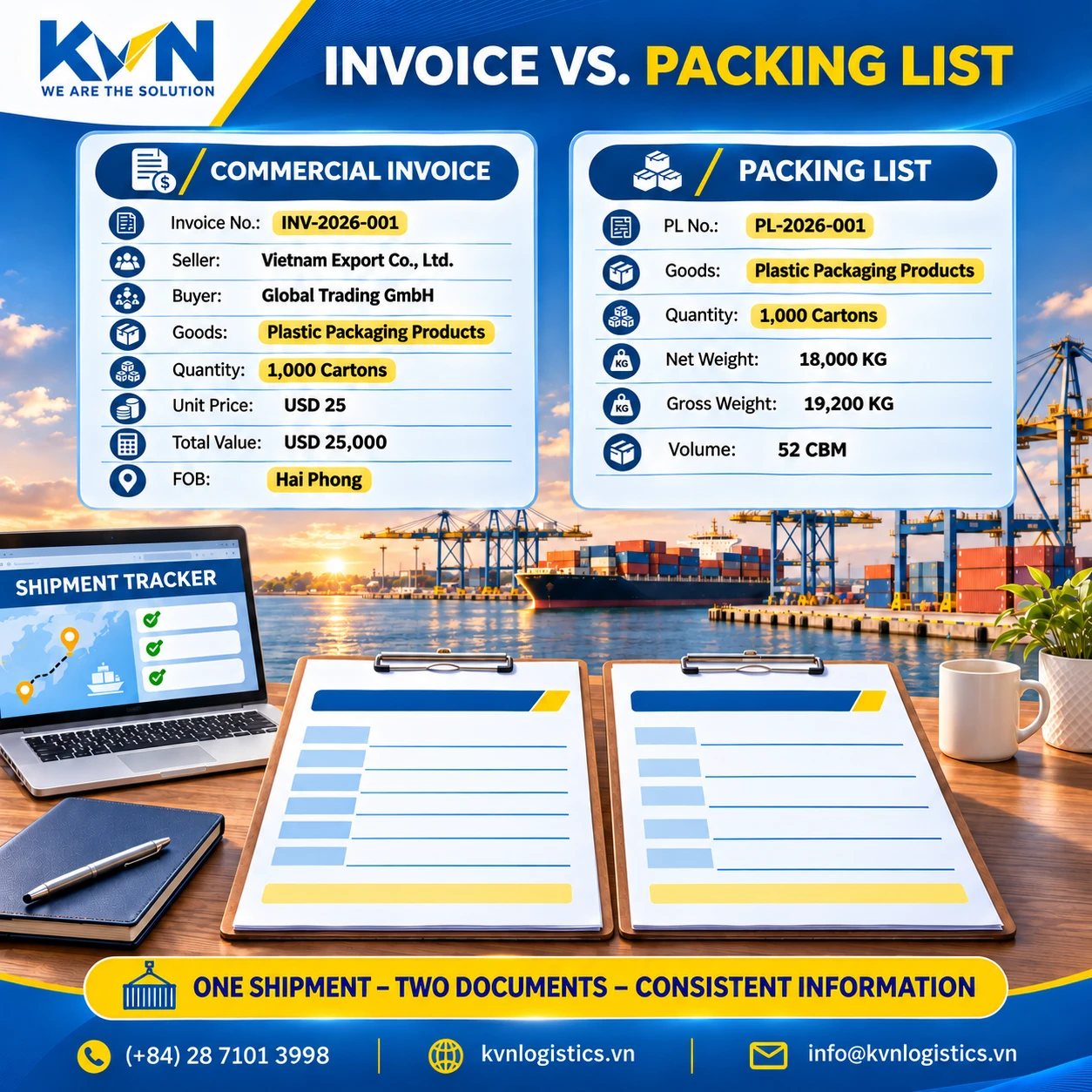
Practical Example
A Vietnamese exporter prepares a shipment containing 1,000 cartons.
The Commercial Invoice states:
- Quantity: 1,000 Cartons.
- Unit Price: USD 25.
- Total Amount: USD 25,000.
The Packing List states:
- Total Packages: 1,000 Cartons.
- Net Weight: 18,000 KG.
- Gross Weight: 19,200 KG.
- Measurement: 52 CBM.
If the Packing List states 980 cartons while the Invoice indicates 1,000 cartons, the discrepancy should be investigated before the documents are used for customs declaration or cargo handover.
Such inconsistencies can affect cargo verification, transport documentation, and shipment coordination.
5. Shipping Instruction and Bill of Lading: Essential Ocean Freight Documents
For ocean freight exports, Shipping Instructions and Bills of Lading are closely related but serve different purposes.
5.1. What Is a Shipping Instruction (SI)?
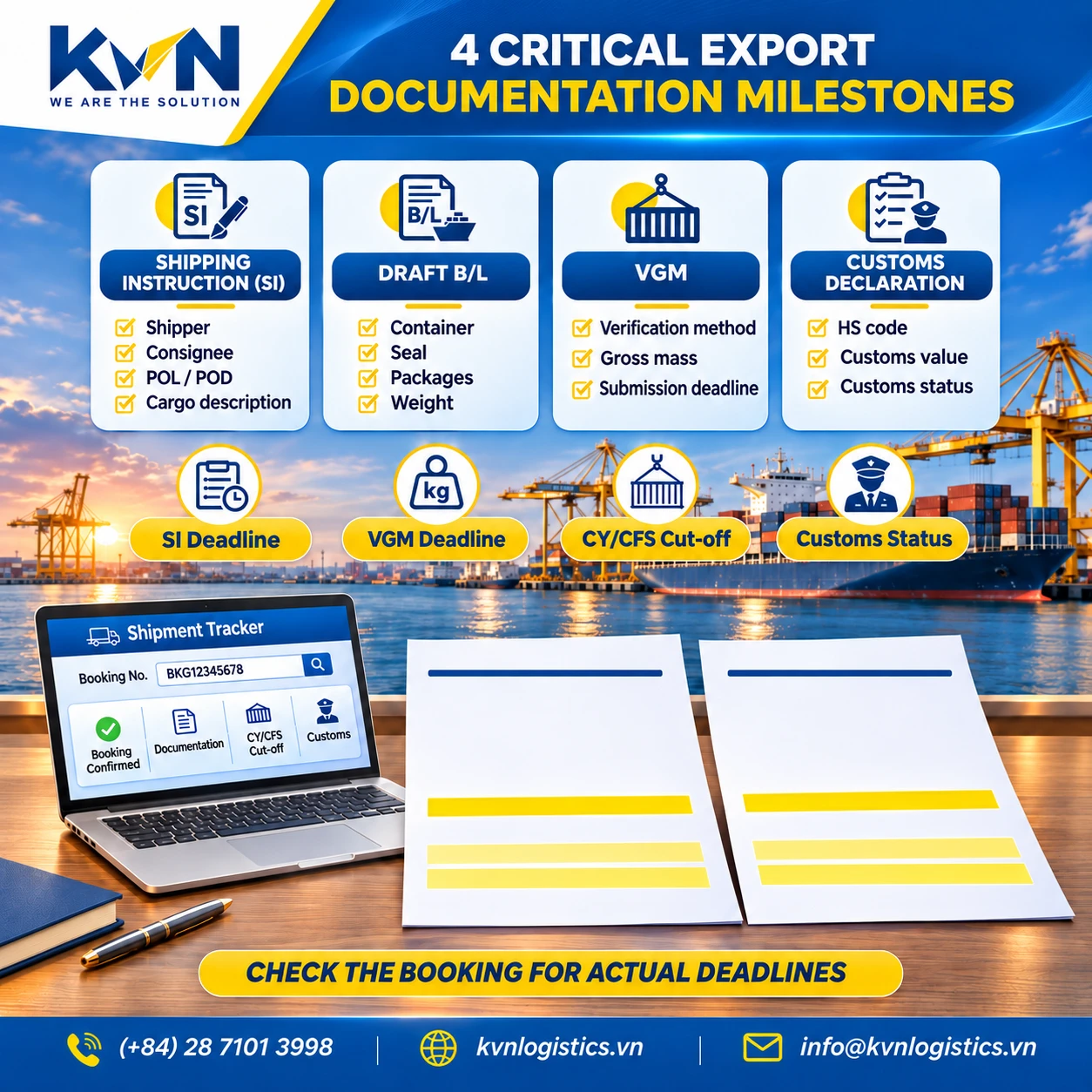
A Shipping Instruction is a set of shipment details provided to a carrier or freight forwarder for preparing transport documentation, including the Bill of Lading.
Typical SI information includes:
- Shipper.
- Consignee.
- Notify Party.
- Vessel and Voyage.
- Port of Loading (POL).
- Port of Discharge (POD).
- Place of Delivery, if applicable.
- Container Number.
- Seal Number.
- Cargo Description.
- Number of Packages.
- Gross Weight.
- Measurement.
Specific information requirements vary by carrier and shipment arrangement.
5.2. What Is a Bill of Lading (B/L)?
A Bill of Lading is an ocean transport document issued by a carrier or its authorized representative, acknowledging receipt or shipment of goods and recording the applicable carriage terms.
Depending on its form, a Bill of Lading may also function as a document of title.
Common transport document arrangements include:
- Original Bill of Lading.
- Sea Waybill.
- Surrendered B/L or telex release arrangements.
- House Bill of Lading (HBL).
- Master Bill of Lading (MBL).
The appropriate document should be selected according to payment arrangements, cargo release procedures, and contractual requirements.
5.3. Draft Bill of Lading Checklist
Before approving the Draft B/L, exporters should verify:
-
Shipper’s information.
-
Consignee’s information.
-
Notify Party.
-
Port of Loading.
-
Port of Discharge.
-
Place of Delivery.
-
Vessel and Voyage.
-
Container Number.
-
Seal Number.
-
Number of Packages.
-
Cargo Description.
-
Gross Weight.
-
Freight Terms.
-
B/L Type and Release Instructions.
5.4. Understanding SI Cut-off
SI cut-off is the deadline established by the carrier or freight forwarder for receiving shipping instructions.
Late or inaccurate SI submissions may delay transport document processing or result in amendment charges.
However, exporters should distinguish among several deadlines:
SI Cut-off: Deadline for submitting shipping instructions.
VGM Cut-off: Deadline for submitting verified container mass information.
CY Cut-off: Deadline for meeting container yard receiving requirements.
CFS Cut-off: Deadline for delivering LCL cargo to the consolidation facility.
These deadlines may differ.
For a detailed explanation, read KVN Logistics’ guide to the Sea Freight Booking Process: Cut-Off, SI, VGM & CY/CFS.
6. VGM and Container Shipping Documentation
What Is VGM?
Verified Gross Mass (VGM) refers to the verified total mass of a packed shipping container under the SOLAS Convention.
It includes the cargo, packaging, pallets, securing materials, and container tare mass.
For containers covered by SOLAS requirements, VGM must be available in accordance with the applicable rules before the container can be loaded onto a vessel.
Two Methods of Determining VGM
Method 1: Weighing the Packed Container
The entire packed and sealed container is weighed using an appropriate method.
Method 2: Calculating the Total Verified Mass
The weights of the cargo, packaging, pallets, and securing materials are added to the container’s tare mass using a method approved by the competent authority.
Understanding Weight Differences
| Term | Meaning |
|---|---|
| Net Weight | Weight of the goods excluding packaging |
| Gross Weight | Weight of the goods including packaging, as defined in the relevant document |
| VGM | Verified total mass of the packed container, including container tare weight |
VGM Checklist
-
Verify actual cargo weight.
-
Confirm packaging and pallet weight.
-
Verify container tare weight.
-
Apply an accepted weighing or calculation method.
-
Submit VGM through the required channel.
-
Meet the VGM cut-off deadline.
VGM does not replace the Packing List or customs declaration.
For additional operational guidance, see Container Haulage Process: Export & Import Guide.
7. Export Customs Declaration: Required Information and Common Risks
The Export Customs Declaration is a core component of export clearance procedures.
Exporters or their authorized customs representatives are responsible for providing accurate information in accordance with applicable customs regulations.
Export Customs Declaration Checklist
| Information Category | Key Details |
|---|---|
| Exporter | Company information |
| Importer | Overseas buyer information |
| Export Procedure | Appropriate customs procedure code |
| Product Description | Accurate cargo identification |
| HS Code | Correct commodity classification |
| Quantity | Quantity and units of measurement |
| Customs Value | Declared value according to customs rules |
| Origin | Relevant origin information |
| Customs Office | Applicable customs processing location |
| Transportation | Shipment and transport information |
| Licenses | Regulatory documents when required |
7.1. Why Is HS Code Classification Important?
The Harmonized System (HS) is an internationally standardized system for classifying traded products.
Correct HS classification requires consideration of the product’s characteristics, composition, function, and applicable classification rules.
Incorrect classification may result in:
- Inappropriate regulatory treatment.
- Incorrect tax assessment.
- Additional documentation requests.
- Customs declaration amendments.
- Post-clearance audit risks.
Exporters should not determine HS codes solely from commercial product names.
7.2. Must All Commercial Documents Be Submitted to Vietnam Customs?
Not necessarily.
Customs document submission requirements depend on the applicable legal framework, customs procedure, and characteristics of the goods.
Certain documents may be used as supporting references or retained for compliance purposes without being required for submission in every declaration.
Businesses should verify the specific requirements applicable when filing the export customs declaration.
Professional Customs Documentation Support
Through KVN CustomsCare – Customs & Documentation Services, KVN Logistics supports businesses with:
- Export and import documentation review.
- HS Code consultation.
- Customs declaration coordination.
- Trade compliance procedures.
- Shipment documentation management.
8. Certificate of Origin (C/O): Requirements and Verification
What Is a Certificate of Origin?
A Certificate of Origin (C/O) is a document certifying the origin of goods under applicable rules of origin.
It may be used for customs procedures, preferential tariff treatment, trade compliance, or commercial requirements.
Depending on the importing market and applicable trade agreements, different types of origin documentation may be available or required.
Common Certificates of Origin Used in Vietnam
| C/O Form | Relevant Trade Framework |
|---|---|
| Form D | ASEAN Trade in Goods Agreement |
| Form E | ASEAN–China Free Trade Agreement |
| Form AK | ASEAN–Korea Free Trade Agreement |
| Form VK | Vietnam–Korea Free Trade Agreement |
| Form EUR.1 | Applicable EVFTA origin certification arrangements |
| Form CPTPP | CPTPP origin certification arrangements |
| Form RCEP | Regional Comprehensive Economic Partnership |
| Form B | Non-preferential Certificate of Origin |
Important: A Certificate of Origin is not mandatory for every export shipment.
Some trade agreements allow origin certification through self-certification or other approved mechanisms.
Exporters should confirm the applicable rules of origin and importing-country requirements.
Certificate of Origin Checklist
-
Confirm the destination market.
-
Identify the applicable trade agreement.
-
Verify the HS Code.
-
Determine the relevant origin criteria.
-
Prepare supporting origin documentation.
-
Check exporter information.
-
Check importer information.
-
Verify cargo descriptions and quantities.
-
Confirm issuance requirements and deadlines.
Common C/O Mistakes
- Selecting an inappropriate C/O form.
- Applying incorrect origin criteria.
- Inconsistent HS classification.
- Inaccurate product descriptions.
- Missing supporting production or material records.
For manufactured goods containing imported materials, businesses should evaluate origin requirements early in the production and export planning process.
9. Export Licenses and Specialized Regulatory Documents
Certain goods may require additional licenses, certificates, or specialized regulatory procedures before export.
These requirements depend on:
- Vietnam’s export regulations.
- Destination-country import requirements.
- Product characteristics and intended use.
- Contractual requirements.
Examples of Specialized Export Documentation
| Product Category | Potential Documentation Requirements |
|---|---|
| Agricultural Products | Phytosanitary certificates, food safety documents, traceability records |
| Seafood | Health certificates, quarantine or destination-specific documents |
| Food Products | Quality and food safety documentation |
| Chemicals | Regulatory classification and relevant compliance documents |
| Machinery | Technical specifications and applicable export controls |
| Dangerous Goods | Dangerous goods classification and transportation safety documentation |
| Timber Products | Legal origin documentation and destination-market requirements |
These are examples of requirements to investigate, not a universal list of mandatory documents for every product in each category.
For instance, exporters shipping agricultural products from Vietnam should verify the destination country’s phytosanitary requirements before finalizing shipping arrangements.
KVN Logistics Recommendation: For regulated cargo, compliance checks should begin during order confirmation rather than immediately before shipment departure.
10. Cross-Checking Export Documents Before Shipment
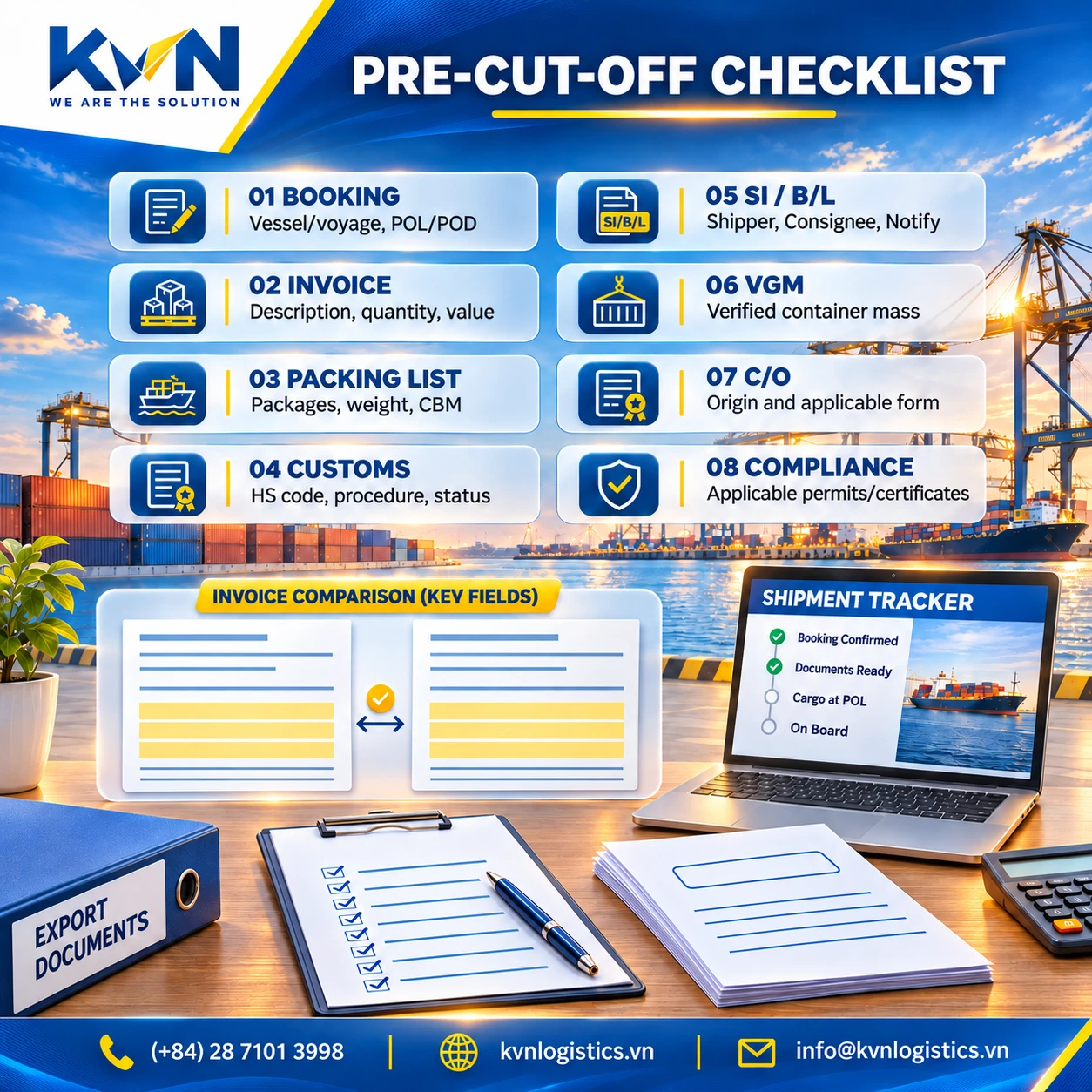
A complete document set may still contain errors if information is inconsistent across individual documents.
Cross-document verification is therefore an important step before shipping.
Ten Critical Items to Cross-Check
| No. | Information | Documents to Compare |
|---|---|---|
| 1 | Exporter Information | Invoice, B/L, C/O, Customs Declaration |
| 2 | Importer Information | Invoice, B/L, C/O |
| 3 | Product Description | Invoice, Packing List, B/L, Customs Declaration |
| 4 | Quantity | Invoice, Packing List, Customs Declaration |
| 5 | Number of Packages | Packing List, B/L |
| 6 | Weight | Packing List, SI, B/L |
| 7 | Commercial Value | Invoice, Contract, Customs Declaration |
| 8 | HS Code | Customs Declaration, Origin Records |
| 9 | Loading and Discharge Ports | Booking Confirmation, SI, B/L |
| 10 | Container and Seal Numbers | SI, B/L, Cargo Handover Records |
Five Documentation Verification Principles
1. Maintain Consistent Core Information
Product descriptions, quantities, and commercial information should accurately reflect the actual shipment.
2. Understand Each Document’s Purpose
The Shipper shown on a Bill of Lading is not necessarily identical to the Seller stated on a Commercial Invoice.
Such differences may be valid depending on the transaction structure.
3. Verify Units of Measurement
Kilograms, metric tons, cartons, pallets, and pieces should be consistently recorded or appropriately converted.
4. Check Container Information
Container and seal numbers must match actual shipping records.
5. Review Destination-Specific Requirements
Certain markets and payment arrangements may require specific wording or additional information on export documents.
11. Export Documentation Timeline Before Shipping Cut-off
Preparing the right documents at the right time is essential for maintaining shipment schedules.
Exporters should coordinate documentation activities with sales, warehouse operations, customs representatives, and transportation providers.
Recommended Export Documentation Timeline
| Suggested Timeline | Main Activities | Responsible Team |
|---|---|---|
| 10–14 days before ETD | Confirm contract, Incoterms, HS Code, and market requirements | Sales / Export |
| 7–10 days before ETD | Prepare draft Invoice and Packing List; review required licenses | Documentation |
| 5–7 days before ETD | Confirm booking, loading schedule, and trucking arrangements | Logistics |
| 3–5 days before ETD | Finalize cargo information and coordinate customs procedures | Customs / Export |
| Before SI Cut-off | Submit Shipping Instructions | Documentation |
| Before VGM Cut-off | Verify and submit VGM | Shipper / Logistics |
| Before CY/CFS Cut-off | Complete relevant cargo or container delivery requirements | Trucking / Warehouse |
| During Draft B/L Review | Verify and approve transport document details | Documentation |
| According to Applicable Deadlines | Finalize C/O and other required documents | Export / Finance |
Note: These are illustrative planning milestones, not mandatory legal deadlines. Actual schedules depend on the shipping line, port, route, cargo type, and booking conditions. Some activities may occur simultaneously or require earlier completion.
Why Does Documentation Timing Matter?
In international shipping, a delay in one activity can affect the entire shipment.
Examples include:
- An unconfirmed Invoice requiring customs data changes.
- A Packing List revised after cargo loading.
- Shipping Instructions submitted close to the deadline.
- A packed container without completed VGM.
- Incomplete customs or terminal requirements.
These issues may increase the risk of missed sailings, booking changes, or additional handling charges.
Exporters should therefore integrate documentation planning with transportation operations.
Businesses can explore KVN Logistics’ Sea Freight Services for international ocean freight solutions.
12. Final Export Documentation Checklist: 15 Steps Before Shipping
The following checklist can be used as a quick reference for export shipments.
A. Commercial Documentation
-
1. Sales Contract or Purchase Order confirmed.
-
2. Incoterms and named delivery location verified.
-
3. Commercial Invoice checked and approved.
-
4. Packing List verified against actual cargo.
B. Transportation Documentation
-
5. Booking Confirmation received.
-
6. Loading and discharge ports verified.
-
7. Container and seal numbers checked, if applicable.
-
8. Shipping Instructions submitted on time.
-
9. VGM completed, where required.
-
10. Draft Bill of Lading reviewed.
C. Customs and Origin Documentation
-
11. HS Code classification verified.
-
12. Export regulations and license requirements checked.
-
13. Customs declaration procedures completed as required.
-
14. C/O and specialized certificates reviewed, where applicable.
D. Final Verification
-
15. All relevant documents cross-checked, deadlines confirmed, and responsible personnel assigned.
Practical Tip: Businesses can maintain a dedicated export documentation checklist for each shipment reference, including document versions, approval dates, and responsible team members.
This improves traceability and simplifies document management when amendments are required.
13. How KVN Logistics Supports Export Documentation and Shipment Coordination
In practice, export documentation cannot be managed effectively in isolation from transportation.
Commercial documents, customs declarations, Shipping Instructions, container operations, and Bills of Lading must be coordinated according to the shipment schedule.
With its brand positioning, “We are the Solution,” KVN Logistics provides integrated logistics services connecting international freight, inland transportation, and customs documentation.
KVN CustomsCare: Customs Clearance & Documentation
Through KVN CustomsCare, KVN Logistics supports businesses with:
- Import-export documentation review.
- HS Code consultation.
- Customs declaration coordination.
- Certificate of Origin documentation assistance.
- Specialized regulatory procedure coordination.
- Cross-document consistency checks.
These services help exporters improve preparation and reduce avoidable documentation risks.
Connecting Documentation with Logistics Operations
KVN Logistics also provides complementary transportation solutions.
Sea Freight
International FCL, LCL, and other ocean freight services tailored to shipment requirements.
Inland Trucking
Transportation connecting factories, warehouses, seaports, and inland distribution facilities.
Customs & Documentation
Coordination of customs procedures, shipping information, and relevant trade documents.
Door-to-Door Logistics
Integrated transportation arrangements connecting multiple logistics stages under the agreed service scope.
For businesses requiring both customs support and physical cargo transportation, combining these activities can improve operational coordination.
Explore KVN Logistics’ solutions:
- Customs & Documentation Services
- Sea Freight Services
- Inland Trucking Services
- Container Haulage Process Guide
Need Assistance Reviewing Your Export Documents?
Are you preparing to export goods from Vietnam?
Whether your shipment requires Commercial Invoice verification, Packing List review, Bill of Lading coordination, Certificate of Origin preparation, or customs documentation support, KVN Logistics is ready to discuss your requirements.
Our team can help assess shipment documentation needs and recommend appropriate logistics arrangements.
KVN Logistics – We are the Solution.
Contact KVN Logistics for Export Documentation & Freight Solutions
14. Frequently Asked Questions About Export Documentation
1. What documents are required for exporting goods from Vietnam?
A typical export shipment may require a Commercial Invoice, Packing List, transport document, and Export Customs Declaration. Additional documents such as a Certificate of Origin, export license, or specialized certificate depend on the product, transaction, and destination-country requirements.
2. What is the difference between a Commercial Invoice and a Packing List?
A Commercial Invoice records the commercial details and value of the goods, while a Packing List describes their physical packaging, quantities, dimensions, and weights. Both documents should contain consistent information about the shipment.
3. Is a Certificate of Origin mandatory for every export shipment?
No. A Certificate of Origin is not universally mandatory. Requirements depend on importing-country regulations, applicable trade agreements, preferential tariff arrangements, and contractual conditions.
4. When is a Bill of Lading issued?
The timing depends on the type of transport document and the carrier’s procedures. Exporters typically review a Draft B/L before final issuance, subject to cargo receipt or loading status and other applicable conditions.
5. Is a Shipping Instruction the same as a Bill of Lading?
No. Shipping Instructions provide the information needed to prepare transport documentation. A Bill of Lading is a transport document issued by the carrier or its authorized representative.
6. Is VGM the same as Gross Weight on a Packing List?
No. Gross Weight on a Packing List generally refers to cargo and packaging weight. VGM represents the verified total mass of the packed container, including the container’s tare weight.
7. Can incorrect Invoice or Packing List information delay customs clearance?
Yes. Incorrect or inconsistent information may require clarification, document amendments, or additional customs procedures, depending on the circumstances.
8. How early should exporters prepare shipping documents?
Preparation timelines depend on the cargo and shipping arrangements. For typical ocean freight shipments, businesses may begin reviewing documentation 7–14 days before the estimated time of departure, while following actual carrier and regulatory deadlines.
9. Can a freight forwarder help prepare export documents?
Yes. Freight forwarders can assist with document review, customs coordination, Shipping Instructions, transport documents, and shipment scheduling within the agreed service scope. Applicable legal responsibilities remain subject to regulations and authorization arrangements.
10. How can exporters reduce documentation errors?
Exporters should use a standardized checklist, assign responsibilities, cross-check information across documents, and complete critical tasks before shipping cut-offs. Early coordination with logistics providers can also help improve documentation planning.
15. Conclusion
An effective export documentation checklist helps businesses understand not only which documents are needed but also how to maintain data accuracy, meet shipping deadlines, and coordinate international cargo movements.
From Commercial Invoices and Packing Lists to Shipping Instructions, Bills of Lading, Certificates of Origin, and customs declarations, each document serves a specific purpose.
Exporters should follow three essential principles:
1. Completeness
Identify the documentation required for each shipment.
2. Accuracy
Maintain consistent and reliable information across relevant documents.
3. Timeliness
Coordinate document preparation with customs procedures, freight bookings, and shipping deadlines.
With integrated international freight and customs documentation capabilities, KVN Logistics supports businesses in developing practical logistics solutions from shipment preparation to cargo delivery.
KVN Logistics – We are the Solution.
Website: https://kvnlogistics.vn
Email: info@kvnlogistics.vn
Hotline: (+84) 28 7101 3998
Disclaimer: This article provides general information for reference purposes and does not replace official regulatory guidance or professional legal advice. Exporters should verify current requirements applicable to their products, shipments, and destination markets.