

Master Consolidation is a logistics model in which multiple Less-than-Container Load (LCL) shipments from different shippers or freight forwarders are consolidated into one container for ocean transportation.
The key distinction is that a Master Consolidator takes a central role in organizing the consolidation process — coordinating cargo receiving, CFS operations, container stuffing, documentation, sailing schedules and destination deconsolidation — rather than simply passing the shipment through multiple intermediate forwarders.
For businesses that ship regularly but do not have enough cargo to fill a full container, understanding the differences between Master Consolidation, Direct Consol, Co-load and standard LCL services can help improve schedule control, reduce unnecessary handling and optimize total logistics costs.
This article explains how Master Consolidation works, when Direct Consol may be the better option, how it differs from Co-load, and what shippers should check before booking.
What Is Master Consolidation?
In ocean freight, a shipment that does not require an entire container is generally transported as LCL – Less than Container Load.
Multiple LCL shipments from different shippers may be delivered to a Container Freight Station (CFS), where they are measured, checked, sorted and consolidated into one container.
A typical consolidation process may include:
- Receiving cargo information from individual shippers or forwarders.
- Confirming package dimensions, gross weight and CBM.
- Checking cargo compatibility.
- Receiving cargo at the designated CFS.
- Consolidating several shipments into one container.
- Preparing shipping and consolidation documentation.
- Transporting the container by sea.
- Deconsolidating the cargo at destination.
- Releasing individual shipments to their respective consignees.
This process is known as consolidation.
A Master Consolidator is the party that organizes the main consolidation operation, receiving cargo from shippers, freight forwarders or co-loaders and combining these shipments into a consol container.
For a broader introduction to the concept, businesses can first read KVN Logistics’ guide: What Is Consolidation (Consol)? A Smart Logistics Strategy to Reduce Cost and Improve Export Performance.
Master Consolidation in Simple Terms
The cargo flow can be illustrated as:
Shipper / Forwarder → Master Consolidator → Consol Container → Ocean Freight → Destination CFS → Consignee
Instead of each shipper booking a separate container, multiple shipments that are compatible and moving toward the same destination are consolidated and share container space.
The objective is not simply to reduce ocean freight costs.
A well-managed Master Consolidation program can also improve control over:
- cargo receiving schedules;
- CFS cut-off;
- stuffing plans;
- documentation cut-off;
- routing;
- House B/L and Master B/L coordination;
- destination agent handling;
- deconsolidation;
- final cargo release
How Does Master Consolidation Work?
A Master Consol shipment normally goes through several operational stages.
Step 1: Shipment Information Is Submitted
The shipper or freight forwarder should provide accurate cargo details, including:
- POL – Port of Loading;
- POD – Port of Discharge;
- commodity;
- number of packages;
- package dimensions;
- gross weight;
- total CBM;
- packaging type;
- cargo ready date;
- Incoterms;
- required delivery timeline;
- documentation requirements;
- special handling requirements, if any.
The more accurate the cargo information is, the easier it becomes to arrange space, plan stuffing and estimate the total logistics cost.
Step 2: Consol Schedule and Cut-off Are Confirmed
For LCL and consolidation shipments, businesses should not focus only on the vessel ETD.
Several deadlines may affect whether the cargo can make the intended consol container:
- cargo cut-off;
- CFS cut-off;
- documentation cut-off;
- customs cut-off;
- stuffing date;
- estimated ETD;
- estimated ETA;
- routing;
- destination deconsolidation time.
Businesses can review current reference schedules through KVN Logistics’ Sea Freight Schedule.
Actual vessel schedules, CFS cut-off times and available consol services should always be reconfirmed when the booking is made.
Step 3: Cargo Is Delivered to the CFS
LCL cargo is generally delivered to a designated Container Freight Station – CFS or consolidation warehouse.
At the CFS, cargo may be:
- counted;
- weighed;
- remeasured;
- inspected for packaging condition;
- checked for shipping marks;
- classified for consolidation;
- prepared for container stuffing.
The actual weight and CBM measured at the CFS are important because LCL charges are often calculated based on chargeable weight or volume.
Step 4: The Container Loading Plan Is Prepared
Not every shipment can be loaded together.
The consolidator must assess factors such as:
- cargo weight;
- stackability;
- packaging strength;
- cargo characteristics;
- risk of leakage;
- odor;
- moisture sensitivity;
- safety requirements;
- compatibility with other cargo.
The objective is to maximize container utilization while maintaining cargo safety and operational compliance.
Step 5: The Consol Container Is Stuffed and Shipped
Once cargo has been received and the stuffing plan is confirmed, multiple LCL shipments are loaded into the same container.
The consolidated container then moves through the ocean freight network as a complete container unit.
Step 6: Cargo Is Deconsolidated at Destination
After arrival, the container is transferred to the destination CFS or designated facility for deconsolidation.
Individual shipments are separated according to their respective House Bills of Lading or shipment documents.
The cargo may then proceed through:
Cargo release → import procedures → inland trucking → consignee warehouse
depending on the agreed logistics scope.
Direct Consol vs Co-load: What Is the Difference?
This is one of the most common areas of confusion in LCL shipping.
Although both models involve consolidated cargo, the operating structure is different.
What Is Direct Consol?
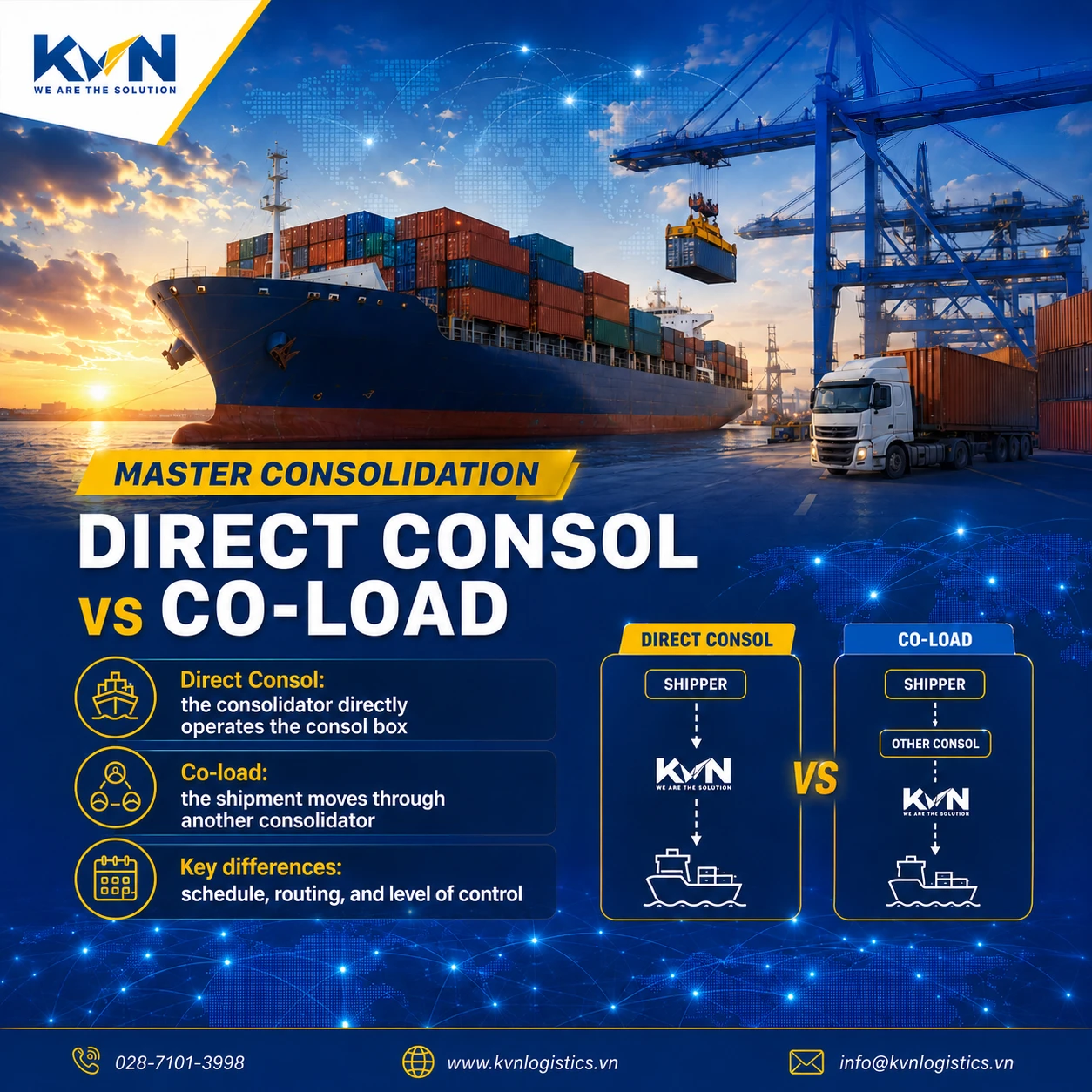
In practical freight forwarding terms, Direct Consol generally refers to a consolidation service where the consolidator directly organizes and operates the consol box for a specific trade lane instead of forwarding the shipment to another intermediary for further consolidation.
A simplified flow may look like this:
Shipper / Forwarder → Master Consolidator → Consol Container → Destination
The key word is direct in the consolidation chain.
However, Direct Consol should not automatically be interpreted as a vessel service with absolutely no transshipment.
A container may still move through a transshipment port depending on the carrier’s routing and service structure.
Therefore, businesses should distinguish between:
- Direct Consol – how the consolidation is organized; and
- Direct vessel service – how the shipping line physically routes the container.
What Is Co-load?
Co-load occurs when a freight forwarder or consolidator does not operate its own consol box for a particular route and therefore sends the shipment to another consolidator.
The flow may look like:
Shipper → Forwarder A → Co-loader / Master Consolidator B → Consol Container → Destination
Co-loading is a normal practice in international freight forwarding.
It can be useful when:
- cargo volume on a route is limited;
- the forwarder does not operate its own consol service;
- another consolidator has a better sailing frequency;
- another consolidation program offers a more suitable routing.
Direct Consol vs Co-load Comparison
| Criteria | Direct Consol | Co-load |
|---|---|---|
| Consol container operation | Operated directly by the Master Consolidator | Shipment is passed to another consolidator |
| Number of intermediaries | Usually fewer | May involve additional parties |
| Control over stuffing schedule | Generally higher | Depends on the co-loader |
| Routing visibility | Often clearer | Depends on the operating consolidator |
| Documentation flow | More direct | May involve another forwarding layer |
| Exception handling | Often easier to trace | May require coordination between more parties |
| Best suited for | Routes with stable consol volume | Routes with lower volume or no direct box |
This does not mean that Direct Consol is always better than Co-load.
A reliable co-load service with strong sailing frequency, efficient routing and transparent destination charges may perform better than a Direct Consol service with inconsistent volume or irregular departures.
Shippers should therefore compare the complete logistics solution based on:
Schedule → Routing → Transit Time → Handling → Cost → Destination Charges → Operational Control
rather than making a decision based only on the name of the service.
What Are the Benefits of Master Consolidation?
1. Ship Without Waiting for a Full Container
One of the most common challenges for exporters is:
“We do not have enough cargo for FCL yet, but our buyer needs regular deliveries.”
Waiting until there is enough cargo to fill a full container may increase inventory time at origin and delay customer deliveries.
Master Consolidation allows businesses to divide cargo into smaller shipments and ship according to:
- individual purchase orders;
- production schedules;
- buyer inventory requirements;
- distribution plans;
- market demand.
This can be especially useful for manufacturers and exporters with regular but relatively small shipment volumes.
2. Optimize Logistics Costs for Smaller Shipments
For relatively small cargo volumes, paying for an entire FCL container may not be economical.
LCL consolidation allows multiple businesses to share container space.
However, the correct comparison should not be limited to the ocean freight rate.
Businesses should evaluate the total logistics cost, which may include:
- trucking;
- CFS charges;
- origin handling;
- documentation;
- customs-related costs;
- ocean freight;
- destination handling;
- destination CFS charges;
- inland delivery;
- inventory carrying time.
As shipment volume increases, there may come a point where FCL becomes more economical than LCL even if the container is not completely full.
The crossover point varies by trade lane, commodity, freight market, container type and local charges.
3. Increase Shipping Frequency
Businesses with many smaller orders may not want to wait until enough cargo accumulates for FCL.
A stable consol program can allow businesses to ship smaller quantities more frequently.
This may be useful for:
- production based on individual POs;
- regular replenishment;
- new export markets;
- distributors ordering smaller batches;
- businesses trying to reduce inventory at destination.
4. Improve Shipment Visibility and Operational Control
A structured Master Consol program can help businesses manage key milestones such as:
Cargo Ready → CFS Cut-off → Stuffing → ETD → ETA → Deconsolidation
within a more coordinated workflow.
Better visibility across these milestones can support production planning, inventory management and delivery commitments to customers.
What Types of Cargo Are Suitable for Master Consolidation?
Master Consolidation is commonly suitable for general dry cargo such as:
- industrial raw materials;
- components;
- spare parts;
- small machinery;
- packaging products;
- consumer goods;
- commercial cargo;
- multiple small purchase orders.
It may be particularly relevant when a business:
- does not have enough cargo for FCL;
- exports regularly;
- needs to split shipments into smaller lots;
- wants to reduce inventory pressure;
- is testing a new export market;
- needs to deliver multiple POs;
- requires more frequent shipment cycles.
For businesses shipping between Vietnam and India, KVN Logistics also provides dedicated content on this trade lane. See: Vietnam–India Consol Shipping: Why More Vietnamese Businesses Are Switching to Consolidation Services.
When Is Master Consolidation Not the Best Option?
Master Consol is not the right solution for every shipment.
Businesses should consider other options in the following situations.
Shipment Volume Is Relatively Large
When the cargo volume approaches the economically viable range of a full container, businesses should compare LCL versus FCL based on total cost.
There is no universal CBM threshold at which every shipment should switch from LCL to FCL.
The result depends on factors such as:
- origin and destination;
- container type;
- freight rate;
- cargo weight;
- commodity;
- origin charges;
- destination charges;
- available space;
- market conditions.
For this reason, the decision should be made shipment by shipment.
The Shipment Is Extremely Urgent
LCL shipments require additional operational steps, including:
- cargo receiving;
- consolidation;
- container stuffing;
- deconsolidation;
- individual cargo release.
If the shipment has a very tight delivery deadline, businesses may need to compare Master Consol with FCL or Air Freight.
Cargo Requires a High Level of Isolation or Control
Some commodities may not be suitable for consolidation because of characteristics such as:
- high value;
- fragility;
- sensitivity to contamination;
- strong odor;
- temperature requirements;
- dangerous goods classification;
- leakage risk;
- strict hygiene requirements;
- restrictions on being loaded with other commodities.
These shipments should be evaluated separately before booking.
CFS, Cut-off and Documentation: Three Factors That Can Delay Consol Cargo
1. CFS – Container Freight Station
The CFS is one of the most important operational points in LCL transportation.
Unlike many FCL shipments, where the container can be stuffed at a factory or designated facility, LCL cargo normally needs to pass through a consolidation facility.
Businesses should check:
- CFS location;
- cargo receiving hours;
- packaging requirements;
- shipping mark requirements;
- cargo cut-off;
- weighing and measurement procedures;
- handling charges.
Incorrect information or late cargo delivery at this stage can affect the entire shipment schedule.
2. Cut-off Time
ETD is not the only deadline that matters.
A vessel may depart at the end of the week, but the CFS may stop receiving cargo several days earlier.
If the shipment misses the CFS cut-off, it may need to wait for the next consol container or sailing.
Businesses should therefore work backward from the planned ETD and confirm all relevant operational cut-offs.
3. Shipping Documentation
Information across shipment documents should be consistent.
Documents and data may include:
- Commercial Invoice;
- Packing List;
- Shipping Instruction;
- Bill of Lading;
- customs documentation;
- Certificate of Origin, where applicable;
- manifest information.
Businesses should pay particular attention to:
- shipper information;
- consignee information;
- number of packages;
- gross weight;
- commodity description;
- shipping marks.
Documentation discrepancies may result in operational delays, amendments or customs-related issues.
For businesses looking for a broader example of how FCL, LCL and customs procedures work together, KVN Logistics’ Vietnam to USA Shipping Guide: FCL, LCL & Customs Procedures Explained provides additional practical information.
What Risks Should Businesses Control When Using Master Consol?
Late Cargo Delivery to the CFS
Missing the CFS cut-off may cause the shipment to roll to the next available consol service.
Businesses should therefore coordinate trucking and cargo readiness well in advance.
Incorrect Weight or CBM
A significant difference between booking information and actual CFS measurements may affect:
- chargeable volume;
- consolidation planning;
- stuffing arrangements;
- freight charges;
- acceptance into the planned consol box.
Accurate cargo measurements help reduce unexpected cost adjustments.
Inadequate Packaging
LCL cargo may go through more handling stages than FCL cargo.
Packaging should therefore be strong enough to withstand:
- warehouse handling;
- forklift movement;
- stacking;
- internal transportation;
- container stuffing;
- deconsolidation.
Incorrect Cargo Declaration
Cargo involving special characteristics should be clearly declared before booking.
Examples may include:
- dangerous goods;
- batteries;
- chemicals;
- liquids;
- magnetic cargo;
- strong-smelling cargo;
- temperature-sensitive products;
- restricted commodities.
Incomplete or incorrect declarations may create safety, compliance and operational risks.
Destination Charges Are Not Checked in Advance
A low ocean freight rate does not necessarily mean a low total logistics cost.
Businesses should clarify:
- origin charges;
- ocean freight;
- destination charges;
- CFS charges;
- documentation charges;
- customs-related costs;
- delivery charges where applicable.
The most useful comparison is therefore an all-in logistics cost comparison, not just an ocean freight comparison.
Master Consol vs Standard LCL vs FCL: Which Option Should You Choose?
| Shipping Requirement | Master Consol / Direct Consol | Standard LCL | FCL |
| Small shipment | Highly suitable | Suitable | Usually less economical |
| Regular smaller shipments | Highly suitable | Suitable | Suitable when volume increases |
| Schedule control | Good with a stable consol program | Depends on service | Generally high |
| Lower cargo handling | Moderate | Moderate | Better |
| Dedicated container required | No | No | Yes |
| Cost optimization for small volume | Good | Good | Usually lower efficiency |
| Larger shipment volume | Compare carefully | Compare carefully | Often advantageous |
Instead of asking:
“Is LCL or FCL cheaper?”
a better question is:
“Which option gives this specific shipment the best balance of total cost, schedule reliability and operational control?”
This approach helps businesses make transportation decisions based on the actual supply-chain requirement rather than simply choosing the lowest freight rate.
Checklist Before Booking Master Consolidation
Before requesting a quotation or booking a Master Consol shipment, businesses should prepare:
- POL or pickup location
- POD or delivery location
- Commodity
- HS Code, if available
- Number of packages
- Packaging type
- Package dimensions
- Gross weight
- Total CBM
- Cargo ready date
- Preferred ETD / required ETA
- Incoterms
- DG or non-DG status
- Documentation requirements
- Port-to-Port, CFS-to-CFS or Door-to-Door requirement
- Consignee’s actual delivery deadline
Providing complete shipment information allows the logistics provider to evaluate routing, consolidation options, expected charges and operational risks more accurately.
KVN Master Consolidation – LCL Solutions Based on Actual Shipment Requirements
Within its Sea Freight solutions, KVN Logistics supports businesses with different ocean transportation requirements, including FCL, LCL and consolidation solutions.
Rather than applying the same transportation mode to every shipment, the appropriate logistics solution should be evaluated based on:
Cargo → Volume → Schedule → Routing → Cost → Documentation → Delivery Requirements
For a Master Consolidation quotation or routing assessment, businesses can provide:
- commodity;
- package quantity;
- dimensions;
- gross weight;
- CBM;
- POL;
- POD;
- cargo ready date;
- required delivery timeline.
Based on the shipment profile, KVN Logistics can assess whether Direct Consol, standard LCL, FCL or another Sea Freight solution is more suitable.
Businesses can also monitor available reference sailings through the KVN Logistics Sea Freight Schedule.
Schedules, cut-off times, routing and available consolidation services should always be reconfirmed at the time of booking because operating conditions may change.
Frequently Asked Questions About Master Consolidation
What is Master Consolidation?
Master Consolidation is a logistics model in which a Master Consolidator combines multiple LCL shipments from different shippers or freight forwarders into a single container and manages the main consolidation process, including cargo receiving, stuffing, documentation and destination deconsolidation.
What is Direct Consol?
Direct Consol generally refers to a model where the Master Consolidator directly organizes the consol box for the relevant route instead of transferring the shipment to another forwarder or consolidator for further consolidation.
Does Direct Consol Mean the Vessel Is Always Direct With No Transshipment?
No.
“Direct” in Direct Consol primarily refers to the consolidation structure.
The ocean carrier may still use a transshipment service depending on the shipping line, port pair and routing.
Businesses should therefore confirm the actual vessel routing separately.
Are Master Consol and LCL the Same Thing?
Not exactly.
LCL describes a shipment that does not occupy an entire container.
Consolidation describes the process of combining multiple LCL shipments into one container.
Master Consolidation refers to the structure in which a Master Consolidator organizes and manages that consolidation process.
What Is Co-load?
Co-load is a forwarding arrangement in which a freight forwarder or consolidator sends a shipment to another consolidator that operates the actual consol container.
It is widely used when a forwarder does not operate its own consolidation service on a particular trade lane.
When Should a Business Use Direct Consol?
Direct Consol may be suitable when:
- the shipment is too small for FCL;
- the trade lane has a stable consol service;
- the business exports regularly;
- shipment visibility is important;
- the shipper wants fewer intermediate consolidation layers;
- schedule and routing control are key considerations.
The final decision should still be based on actual cost, sailing frequency and routing.
At What CBM Should Businesses Switch From LCL to FCL?
There is no universal CBM threshold.
Businesses should compare the all-in LCL and FCL costs for the specific shipment, taking into account:
- CBM;
- gross weight;
- container type;
- freight rates;
- origin charges;
- destination charges;
- cargo characteristics;
- sailing schedule.
The economical crossover point can vary significantly between trade lanes.
What Information Does KVN Need for a Master Consol Quotation?
The minimum recommended information includes:
- commodity;
- number of packages;
- package dimensions;
- gross weight;
- CBM;
- origin;
- destination;
- cargo ready date.
For special cargo, additional documents such as an HS Code, MSDS or technical specifications may also be required.