

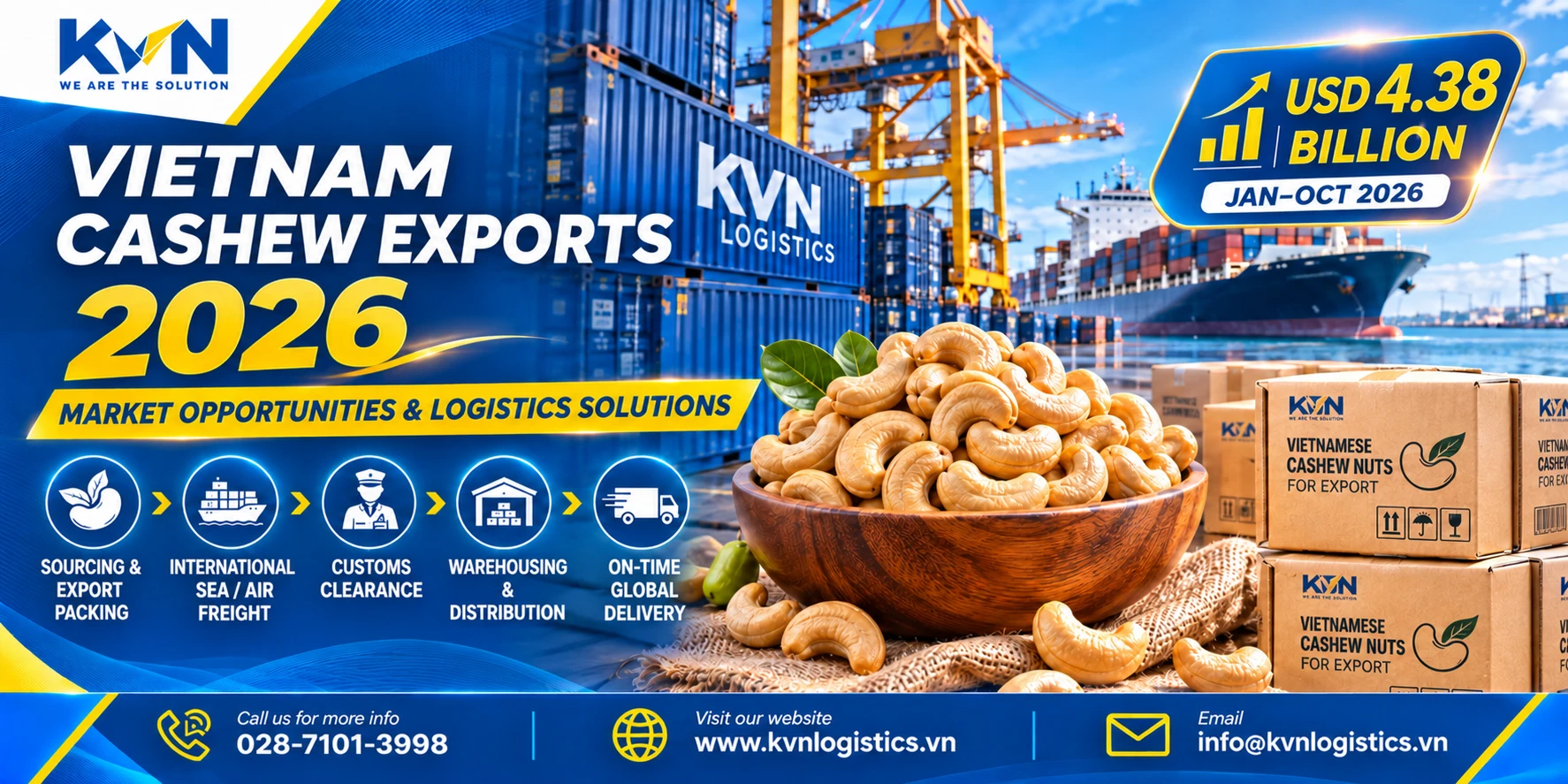
Vietnam’s cashew exports continue to demonstrate resilience in international agricultural trade. During the first ten months of 2026, the country’s cashew export value reached approximately USD 4.38 billion, representing a 2.2% year-on-year increase despite a 2% decline in export volume. This development highlights the growing importance of export value, product quality, and efficient logistics management in maintaining Vietnam’s competitiveness in global cashew markets.
As international buyers place greater emphasis on food safety, supply chain transparency, and delivery reliability, Vietnamese cashew exporters must look beyond production capacity.
Effective international transportation, customs compliance, moisture control, and coordinated supply chain operations are becoming increasingly important to successful cashew exports.
This article examines Vietnam’s cashew export performance in 2026, major international markets, logistics challenges, export procedures, and transportation solutions for businesses operating in the global cashew industry.
1. Vietnam Cashew Export Performance in 2026
Export value increases despite lower shipment volumes
According to information reported by Vietnam’s Ministry of Agriculture and Environment, the country’s cashew exports generated approximately USD 4.38 billion during the first ten months of 2026.
Compared with the same period in 2025:
- Export value increased by approximately 2.2%.
- Export volume declined by approximately 2%.
- Higher average export prices helped support overall export revenue.
These figures suggest that Vietnam’s cashew industry is experiencing an important transition in which commercial value is becoming increasingly significant alongside traditional export volume.
However, stronger export revenue does not automatically translate into higher profitability.
Exporters must also account for raw cashew procurement costs, processing expenses, international freight rates, packaging requirements, financing costs, and compliance expenses.
Key takeaway: Vietnam’s cashew export performance in 2026 demonstrates the importance of combining competitive products with efficient logistics and supply chain management.
The figures are based on the Ministry’s ten-month reporting period and should not be interpreted as full-year 2026 results. vietnamnews.vn
Why logistics matters for Vietnam’s cashew export industry
Cashew nuts are a relatively high-value agricultural commodity traded across international markets.
Unlike many conventional manufactured products, cashew shipments require particular attention to product preservation, food safety, packaging integrity, and transportation conditions.
Successful export operations generally involve:
- Product quality inspection before shipment.
- Moisture control and appropriate packaging.
- Suitable container selection and inspection.
- Export documentation and customs declaration.
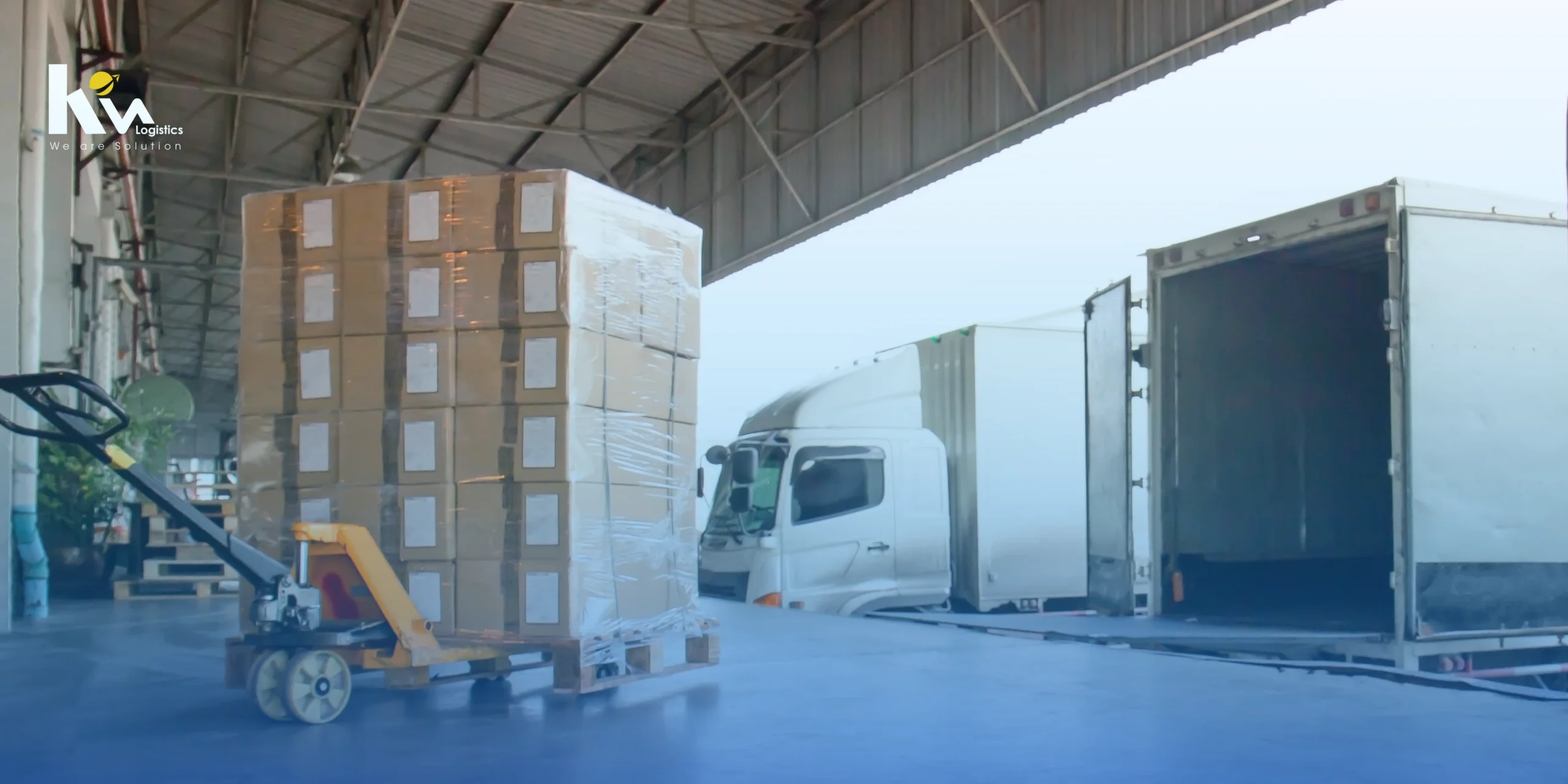
- Inland trucking between factories, warehouses, and ports.
- Ocean freight booking and shipment monitoring.
- Coordination with overseas importers and logistics partners.
Each stage can influence the condition of the goods upon arrival and the exporter’s ability to meet contractual delivery requirements.
For this reason, logistics should be considered an integral part of cashew export planning rather than simply the final transportation stage.
2. Major Export Markets for Vietnamese Cashew Nuts
Vietnamese cashew products are supplied to a wide range of international destinations.
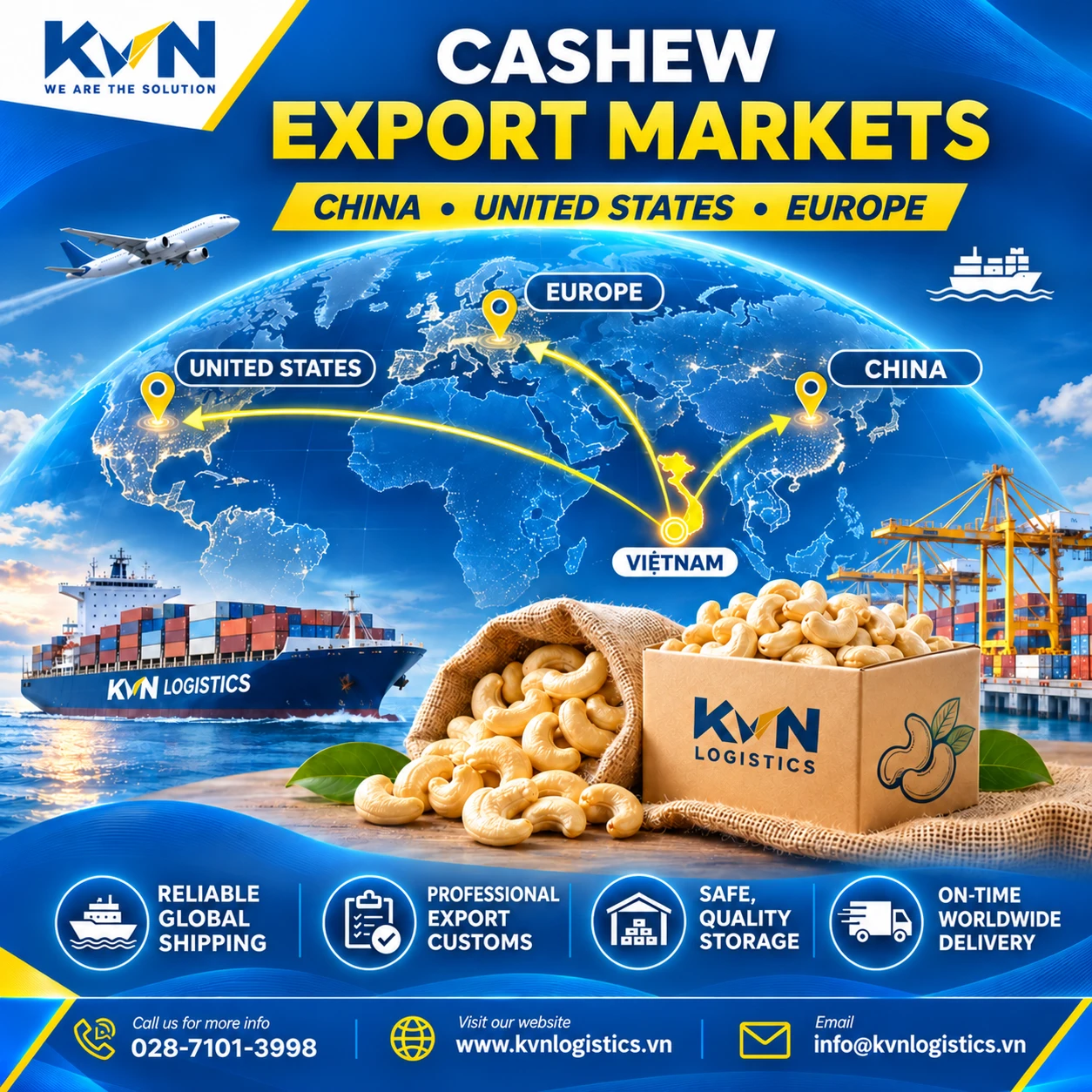
Among these markets, China, the United States, and Europe remain particularly important for exporters seeking to maintain existing commercial relationships and develop new opportunities.
China: A major destination for Vietnamese cashew exports
China remains one of the largest markets for Vietnamese cashew products.
During the first seven months of 2026, Vietnam exported approximately 100,000 tonnes of cashew nuts to China, generating around USD 719 million in export revenue, according to customs-based market reporting.
China’s substantial consumer market, food distribution networks, and demand for processed agricultural products create continued opportunities for Vietnamese exporters.
However, businesses entering the Chinese market must carefully assess applicable import requirements.
Depending on the product and its classification, these may involve:
- Registration of overseas food production facilities.
- Product labeling and packaging requirements.
- Food safety documentation.
- Traceability requirements.
- Customs declarations and import procedures.
Logistics considerations for cashew exports to China
Transportation planning depends on several factors, including the buyer’s location, shipment volume, agreed Incoterms, delivery schedule, and available routes.
Ocean freight can be suitable for commercial container shipments, while alternative transportation arrangements may be considered depending on the destination and operational requirements.
Exporters should assess the complete logistics chain rather than evaluating international freight rates in isolation.
For shipments to Asian markets, businesses can explore KVN Logistics’ Sea Freight from Vietnam to Asia: Routes and Transit Times to better understand routing considerations and transportation planning.
United States: A high-value market with strict food safety requirements
The United States is another major destination for Vietnam’s cashew exports.
During the first seven months of 2026, exports to the US reached approximately 91,000 tonnes, with an estimated value of USD 618 million.
The market offers opportunities for Vietnamese cashew processors and exporters, particularly those capable of maintaining consistent quality and meeting international food safety expectations.
However, exporting food products to the United States requires careful regulatory preparation.
FDA requirements for cashew imports
Depending on the circumstances of the shipment, relevant requirements may include:
1. Food Facility Registration
Facilities that manufacture, process, pack, or hold food for consumption in the United States may be required to register with the US Food and Drug Administration (FDA), subject to applicable exemptions.
2. Prior Notice
FDA generally requires advance notification before food products are imported or offered for import into the United States.
3. Food Safety Compliance
Imported food must comply with applicable US food safety requirements. Importers also have responsibilities under relevant food safety and supplier verification regulations.
4. Product Labeling and Documentation
Packaging, labeling, product descriptions, and supporting documents must comply with applicable regulations and commercial requirements.
Exporters should coordinate with their US importers to identify the precise obligations associated with each shipment.
Transportation challenges on the Vietnam–US route
Ocean freight shipments to the United States may involve extended transit times, transshipment arrangements, and changes in vessel schedules.
For cashew products, these conditions increase the importance of:
- Moisture-resistant packaging.
- Proper container inspection.
- Accurate shipping documentation.
- Appropriate cargo insurance.
- Reliable shipment tracking.
- Proactive communication with overseas buyers.
Businesses seeking additional information can refer to KVN Logistics’ Vietnam to USA Shipping Guide: FCL, LCL & Customs Procedures Explained.
Europe: Opportunities supported by quality and compliance
European markets remain important destinations for Vietnamese cashew exporters.
Countries such as Germany, the Netherlands, and the United Kingdom play significant roles in the European cashew trade.
The European market offers opportunities for suppliers capable of delivering consistent product quality, reliable documentation, and competitive transportation solutions.
However, food safety compliance is a critical consideration.
EU food safety requirements for cashew products
Exporters supplying the European Union should pay particular attention to:
- Applicable maximum levels of contaminants, including aflatoxins.
- Food safety and traceability requirements.
- Product labeling obligations.
- Relevant origin and import documentation.
- Additional certifications requested by individual buyers.
Commission Regulation (EU) 2023/915 establishes maximum levels for certain contaminants in food, including provisions relevant to nuts and nut products.
Businesses should verify the applicable limits and amendments in effect at the time of importation.
In addition to statutory requirements, European importers may request further quality certifications, laboratory testing, or supplier management documentation.
Ocean freight logistics to Europe
For large-volume shipments, ocean freight remains an important transportation option.
However, exporters should evaluate:
- Port of loading and destination port.
- Direct versus transshipment services.
- Expected transit time.
- Container availability.
- Freight rates and surcharges.
- Delivery schedule reliability.
- Cargo storage and handling requirements.
For further guidance, read KVN Logistics’ Sea Freight to Europe: Transit Time, Costs and Risks.
3. Key Logistics Challenges in Cashew Export Transportation
Although Vietnam has established a strong position in the global cashew industry, international transportation still presents several operational challenges.
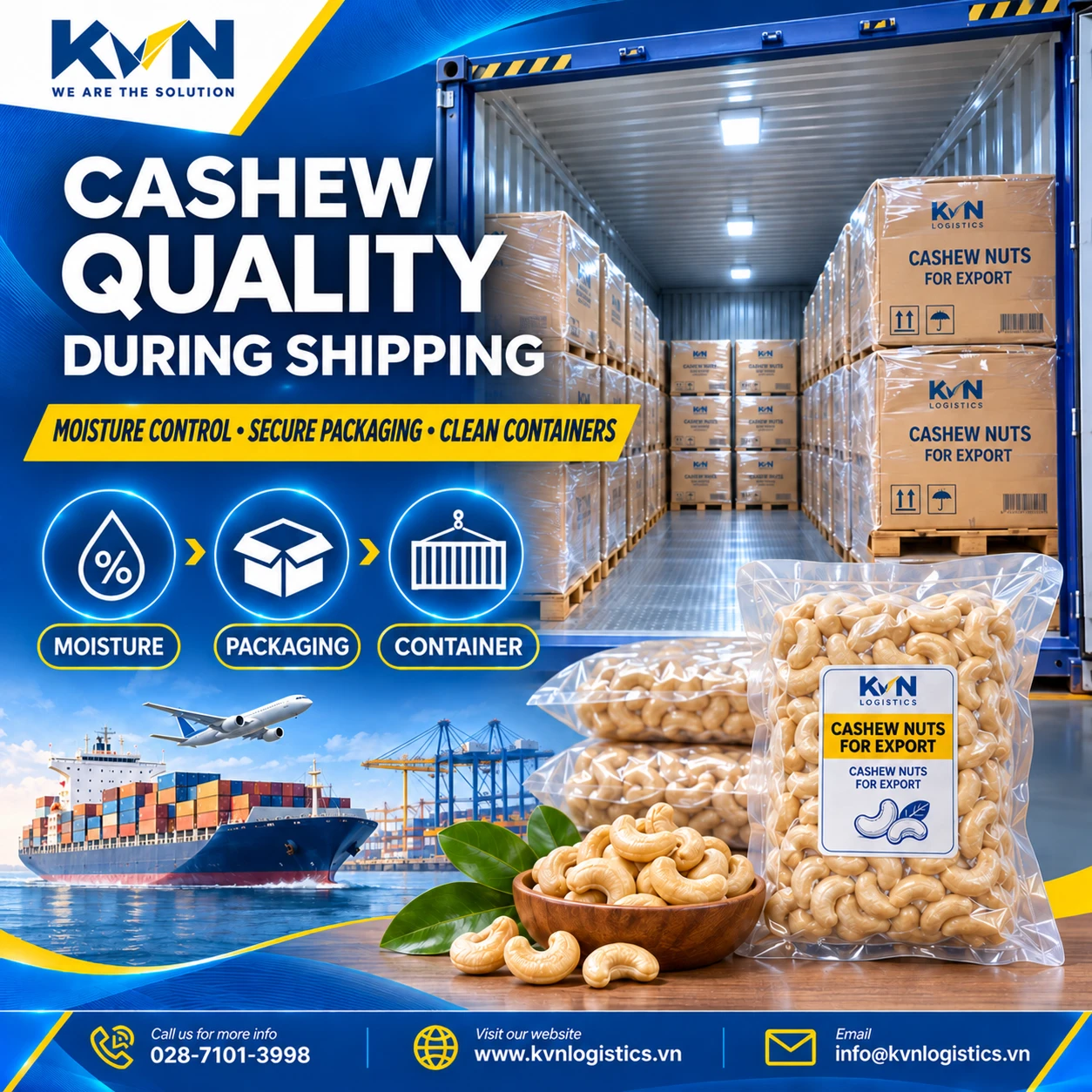
Moisture control and cargo preservation
Cashew kernels are sensitive to moisture and unsuitable storage conditions.
During international shipping, temperature fluctuations can create condensation inside containers.
If moisture is not properly controlled, cashew products may experience:
- Reduced product quality.
- Moisture absorption.
- Packaging deterioration.
- Mold contamination risks.
- Potential commercial disputes.
These risks are particularly relevant to long-distance ocean freight shipments.
How can exporters protect cashew nuts during shipping?
Exporters should consider the following measures:
Check product moisture levels
Products should meet applicable quality specifications before packing and container loading.
Use appropriate packaging
Packaging should provide suitable protection against moisture, contamination, and physical damage.
Depending on the product and buyer requirements, packaging options may include vacuum-sealed materials and other food-grade protective systems.
Inspect containers before loading
Dry containers should be checked for cleanliness, dryness, unusual odors, structural damage, and potential water leakage.
Evaluate container desiccants
Where appropriate, container desiccants may help reduce condensation risks during transportation.
Follow product-specific storage requirements
Storage and shipping conditions should reflect the product’s characteristics, contractual specifications, and applicable food safety standards.
For most commercially packaged cashew shipments, a standard dry container may be suitable when appropriate precautions are implemented.
However, container selection should always be based on actual cargo conditions and shipping requirements.
Vessel schedule disruptions and delivery delays
Cashew export contracts often include specific delivery windows.
International shipping operations, however, may be affected by:
- Port congestion.
- Vessel schedule changes.
- Blank sailings.
- Transshipment delays.
- Container shortages.
- Weather disruptions.
- Changes in maritime trade routes.
These issues can affect delivery commitments and generate unexpected logistics expenses.
Potential costs include:
- Warehouse storage charges.
- Container demurrage.
- Container detention.
- Terminal storage fees.
- Additional trucking expenses.
- Booking amendment charges.
To manage these risks, exporters should coordinate booking arrangements and operational deadlines well before the planned vessel departure.
Important deadlines include:
| Shipping Term | Meaning |
|---|---|
| ETD | Estimated Time of Departure |
| ETA | Estimated Time of Arrival |
| SI Cut-Off | Deadline for submitting Shipping Instructions |
| VGM Cut-Off | Deadline for submitting Verified Gross Mass |
| CY Cut-Off | Deadline for delivering FCL containers to the designated container yard |
| CFS Cut-Off | Deadline for delivering LCL cargo to the designated freight station |
These deadlines vary according to shipping lines, ports, terminals, and individual bookings.
For a detailed operational explanation, see Sea Freight Booking Process: Cut-Off, SI, VGM & CY/CFS.
Rising logistics costs and international competition
Logistics costs can significantly influence the competitiveness of Vietnamese cashew exports.
Businesses should consider the total transportation cost rather than focusing exclusively on the ocean freight rate.
Common logistics expenses include:
- Inland trucking.
- Container handling and stuffing.
- Terminal Handling Charges (THC).
- Ocean freight.
- Documentation fees.
- Customs clearance.
- Specialized inspections, where required.
- Cargo insurance.
- Destination charges, depending on Incoterms.
- Potential storage and delay-related expenses.
FCL vs LCL: Which shipping method is suitable for cashews?
| Criteria | FCL – Full Container Load | LCL – Less than Container Load |
|---|---|---|
| Shipment volume | Suitable for larger shipments | Suitable for smaller shipments |
| Container space | Dedicated container | Shared container |
| Cargo handling | Generally fewer consolidation stages | Additional handling may be involved |
| Cargo separation | Greater control over other cargo exposure | Requires careful assessment of co-loaded cargo |
| Cost considerations | Often economical for larger volumes | Can reduce freight costs for smaller volumes |
| Typical application | Regular bulk commercial orders | Samples and smaller commercial orders |
For food products such as cashew nuts, the choice between FCL and LCL should consider cargo compatibility and preservation requirements.
Additional information about transportation options is available through KVN Logistics’ Sea Freight Services.
4. Cashew Export Logistics Process from Vietnam
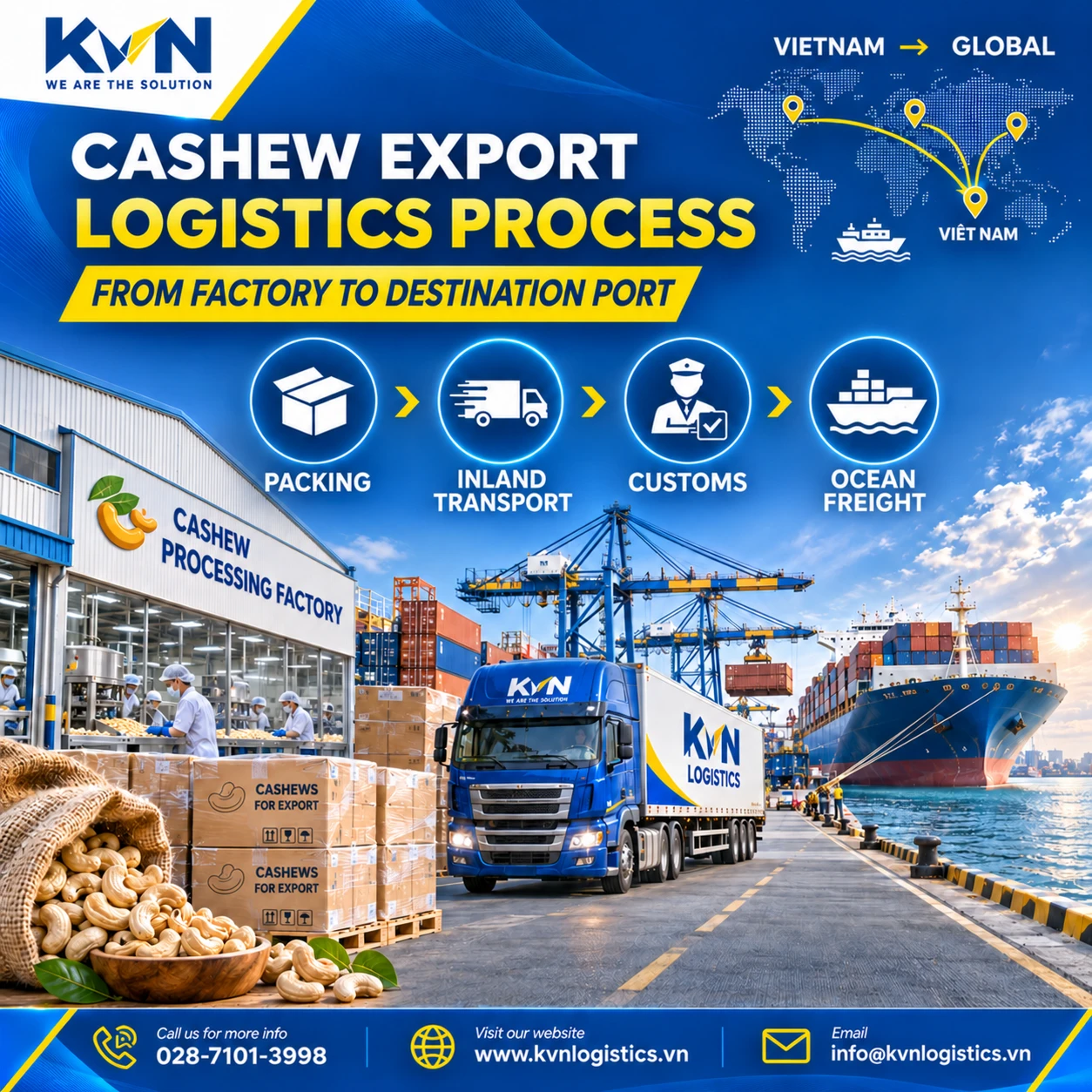
Exporting cashew nuts requires coordination between manufacturers, exporters, customs authorities, shipping lines, and international buyers.
A typical ocean freight export operation can be organized into six stages.
Step 1: Identify export requirements
Before arranging transportation, exporters should confirm:
- Destination country.
- Product classification.
- Applicable HS code.
- Product specifications.
- Shipment volume and weight.
- Packaging requirements.
- Incoterms.
- Delivery deadlines.
- Import requirements at the destination.
The exact HS classification and applicable regulatory requirements depend on the product’s actual characteristics and processing status.
These details provide the foundation for transportation planning and documentation preparation.
Step 2: Prepare export documents
Commercial cashew export shipments commonly require several supporting documents.
Typical documents include:
- Commercial Invoice.
- Packing List.
- Sales Contract or equivalent commercial documentation, where relevant.
- Export customs declaration.
- Bill of Lading or other transport document.
Depending on the product, destination, contractual requirements, and applicable regulations, additional documents may include:
- Phytosanitary Certificate.
- Certificate of Origin (C/O).
- Certificate of Analysis.
- Food safety documentation.
- Quality inspection certificates.
- Other destination-specific certificates.
Important: Not every cashew shipment requires the same specialized documents.
The need for phytosanitary certification, for example, should be assessed according to product type, processing conditions, and the importing country’s requirements.
Exporters should verify these obligations before confirming their shipping arrangements.
Step 3: Select the transportation solution
The next step is to select an appropriate shipping method.
For ocean freight shipments, the main options include:
Full Container Load (FCL)
Suitable for exporters shipping larger quantities that require dedicated container space.
Less than Container Load (LCL)
Potentially suitable for smaller shipments, subject to cargo compatibility, packaging standards, and consolidation arrangements.
Businesses should compare transportation alternatives based on:
- Cargo volume.
- Freight costs.
- Transit time.
- Shipping frequency.
- Container availability.
- Destination requirements.
- Cargo preservation conditions.
KVN Logistics offers international Ocean Freight Solutions covering FCL, LCL, and additional freight forwarding services.
Step 4: Arrange inland trucking and container loading
Once the booking is confirmed, the exporter and logistics provider coordinate domestic transportation.
For FCL exports, this process may include:
- Receiving the booking confirmation.
- Arranging empty container pickup.
- Inspecting the container.
- Transporting the container to the factory or warehouse.
- Completing cargo stuffing and securing.
- Applying the container seal.
- Completing VGM and relevant documentation.
- Delivering the loaded container to the designated terminal.
The transportation schedule should account for factory loading time, road conditions, customs requirements, and terminal cut-off deadlines.
KVN Logistics provides Inland Trucking Services connecting factories, warehouses, industrial zones, depots, and seaports throughout Vietnam.
Exporters can also review the company’s detailed guide: Container Haulage Process: From Empty Pickup to Port Delivery and Return.
Step 5: Complete customs clearance and export procedures
Before shipment, exporters must complete applicable customs and regulatory procedures.
These may involve:
- Verifying HS classification.
- Preparing customs declarations.
- Checking invoice and packing list consistency.
- Reviewing specialized documentation.
- Coordinating cargo inspection, where required.
- Confirming customs clearance status.
- Completing relevant shipping documentation.
Incorrect declarations or incomplete documentation can lead to delays, additional inspections, or unexpected expenses.
For agricultural food products, exporters should pay particular attention to product descriptions, classification, origin documentation, and destination-specific import requirements.
Through KVN CustomsCare – Customs Clearance & Documentation Services, KVN Logistics supports businesses with customs procedures and import-export documentation.
The scope of specialized documentation assistance depends on the shipment’s requirements and agreed service arrangements.
Step 6: Monitor shipment progress and coordinate delivery
After the goods are loaded onto the vessel, exporters should continue monitoring the shipment.
Important activities include:
- Verifying the final Bill of Lading.
- Confirming vessel departure.
- Monitoring estimated arrival.
- Updating overseas buyers.
- Coordinating destination documentation.
- Preparing for cargo release and delivery.
Regular communication helps exporters respond to unexpected changes and maintain visibility over international shipments.
5. KVN Logistics Solutions for Vietnamese Cashew Exporters
As the global cashew market becomes increasingly competitive, exporters need logistics solutions that address transportation, documentation, delivery schedules, and cost efficiency.
KVN Logistics provides integrated freight forwarding and transportation services designed around the operational requirements of international shipments.
With the commitment “We Are The Solution,” KVN Logistics focuses on connecting multiple logistics activities into coordinated transportation plans.
International ocean freight solutions
Through its international freight forwarding network, KVN Logistics provides ocean freight solutions for businesses transporting goods between Vietnam and overseas markets.
Available services include:
- KVN OceanPro – Full Container Load (FCL).
- KVN LCLConnect – Less than Container Load (LCL).
- Master Consolidation services.
- Other specialized ocean freight solutions.
For cashew exporters, transportation arrangements can be evaluated according to cargo volume, shipping route, destination, required delivery date, and preservation considerations.
Businesses can explore the company’s International Sea Freight Services.
Coordinated inland and international transportation
Efficient cashew export operations require reliable coordination between production facilities and seaports.
Through its Inland Trucking Solutions, KVN Logistics supports transportation arrangements connecting:
- Factories.
- Warehouses.
- Container depots.
- Inland container terminals.
- Seaports.
- Industrial zones.
By coordinating inland transportation with ocean freight schedules, exporters can improve shipment planning and reduce the risk of missing operational deadlines.
Customs clearance and documentation support
International cashew shipments require accurate customs and commercial documentation.
KVN Logistics supports businesses through its Customs & Docs service portfolio, including KVN CustomsCare.
Services focus on coordinating customs declarations, reviewing relevant documentation, and supporting shipment procedures within the agreed scope.
For more information, visit KVN Logistics Customs & Documentation Services.
Logistics cost optimization
A cost-effective export strategy should consider the complete logistics journey.
This includes transportation from the factory, port handling, customs procedures, international freight, and relevant destination expenses.
Depending on the shipment, KVN Logistics can help businesses evaluate:
- FCL versus LCL transportation.
- Alternative sailing schedules.
- Port selection.
- Inland trucking arrangements.
- Documentation coordination.
- Shipping cost components.
- Operational risks and potential contingencies.
The objective is to identify transportation arrangements that balance cost, reliability, and cargo requirements.
6. Vietnam Cashew Export Outlook for the Remainder of 2026
Vietnam’s export performance during the first ten months of 2026 indicates that cashew nuts remain an important agricultural export commodity.
However, the industry’s future performance will depend on several interconnected factors.
These include:
- Global demand for cashew products.
- Raw cashew nut procurement costs.
- Processing and production expenses.
- International trade policies.
- Food safety requirements.
- Shipping costs and vessel availability.
- Supply chain efficiency.
For businesses seeking to strengthen their international competitiveness, three strategic priorities deserve particular attention.
Priority 1: Increase product value
Vietnamese cashew exporters can strengthen their market position through:
- Higher-value processed products.
- Consistent product quality.
- Improved packaging.
- Reliable food safety management.
- Greater product traceability.
Value-added products may create opportunities to reach different customer segments and strengthen long-term commercial relationships.
Priority 2: Diversify export markets
Maintaining established export destinations while developing additional markets can help businesses manage commercial concentration risks.
Market diversification requires careful evaluation of:
- Consumer demand.
- Import regulations.
- Product preferences.
- Distribution networks.
- Transportation costs.
- Commercial competition.
A suitable export strategy should balance market opportunities with the operational requirements of each destination.
Priority 3: Strengthen logistics and supply chain efficiency
Reliable logistics performance can support competitiveness by improving delivery planning and reducing avoidable operational costs.
Exporters should prioritize:
- Early shipment planning.
- Suitable packaging and cargo protection.
- Accurate customs documentation.
- Coordinated inland and international transportation.
- Proactive booking management.
- Shipment visibility.
- Contingency planning.
The ability to deliver consistent product quality on schedule will remain important for maintaining long-term relationships with international buyers.
7. Frequently Asked Questions About Vietnam Cashew Exports
How much did Vietnam earn from cashew exports in 2026?
During the first ten months of 2026, Vietnam’s cashew exports generated approximately USD 4.38 billion, representing a 2.2% increase in export value compared with the same period in 2025. This figure refers to January–October, not the full year.
What are the main export markets for Vietnamese cashew nuts?
China and the United States are major destinations for Vietnamese cashew exports. European markets, including Germany, the Netherlands, and the United Kingdom, also play important roles in international cashew trade.
How are cashew nuts exported from Vietnam?
Cashew nuts are commonly transported internationally by ocean freight, particularly for commercial shipments. Depending on cargo volume and shipping requirements, exporters may choose Full Container Load (FCL) or Less than Container Load (LCL) services.
Do cashew exports from Vietnam require phytosanitary certificates?
Phytosanitary certification requirements depend on the product’s characteristics, processing status, and importing country’s regulations. Exporters should verify the applicable requirements before shipment.
How can exporters protect cashew nuts during ocean shipping?
Exporters should control product moisture, use suitable packaging, inspect container conditions, and follow appropriate storage practices. Proper shipment planning and documentation can also reduce transportation risks.
What documents are required for cashew exports from Vietnam?
Common shipping documents include the Commercial Invoice, Packing List, customs declaration, and transport documents. Additional certificates, such as a Certificate of Origin or Phytosanitary Certificate, may be required depending on the destination and shipment characteristics.
Can KVN Logistics support cashew export shipments?
KVN Logistics provides international ocean freight, inland trucking, customs clearance, and shipping documentation services. Businesses can contact KVN Logistics to discuss transportation arrangements based on their cargo specifications, destination, and shipping requirements.
Conclusion: Building a More Competitive Cashew Export Supply Chain
Vietnam’s cashew export performance in 2026 demonstrates the continuing importance of the country’s agricultural processing and international trade capabilities.
With export revenue reaching approximately USD 4.38 billion during the first ten months of the year, the industry continues to create opportunities for manufacturers, exporters, and international buyers.
However, maintaining competitiveness requires more than strong production capacity.
Product quality, regulatory compliance, efficient transportation, and reliable supply chain coordination all contribute to successful international trade.
For Vietnamese cashew exporters, integrating logistics planning into export operations can help improve delivery reliability, manage costs, and maintain product integrity throughout the international transportation process.
KVN Logistics – We Are The Solution
KVN Logistics provides international freight forwarding, inland trucking, and customs documentation solutions tailored to different cargo and business requirements.
Whether your company is preparing an FCL cashew shipment, evaluating ocean freight alternatives, or coordinating export documentation, the KVN Logistics team can help assess suitable transportation arrangements.
Contact KVN Logistics to discuss your cashew export shipping requirements.
🌐 Website: www.kvnlogistics.vn
📧 Email: info@kvnlogistics.vn
📞 Hotline: (+84) 28 7101 3998
KVN Logistics – We Are The Solution.